Strategy
From Support Functions to Strategic Engines: How AI Is Powering Sales, Marketing, CS, Finance & Ops, and HR
18 min read
AI has stopped being a pilot in one curious team and started becoming the layer core functions run on. This breakdown covers all five: what an AI-powered Sales, Marketing, Customer Success, Finance and Operations, and HR function actually looks like, the constraint that limited the traditional model, and the new operating model that replaces it, plus the cross-cutting themes and where to start.
✦Key Takeaways
- The five functions share one trait: high-volume, pattern-based knowledge work. That is the work whose cost collapsed, which is why they are transforming first and together.
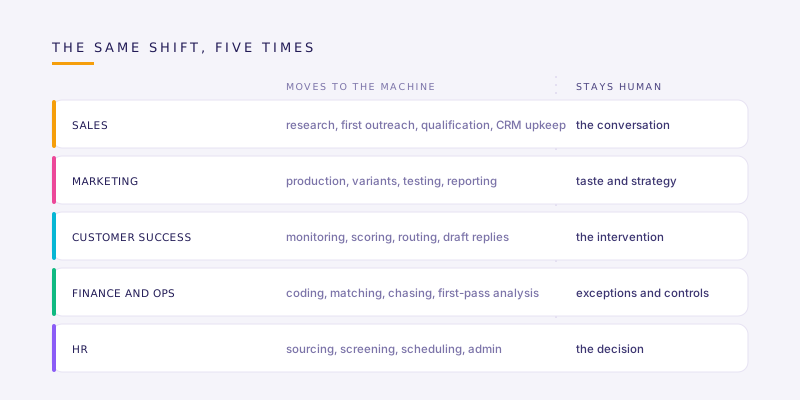
- Every function follows the same structural shift: humans move from executing the work to specifying, reviewing and owning the exceptions.
- Sales stops scaling linearly with headcount, because research, outreach and qualification stop being the constraint on coverage.
- Marketing's bottleneck moves from production to judgement: the scarce resource becomes taste and strategy, not throughput.
- Customer Success flips from reactive firefighting to continuous monitoring, because watching every account is no longer a staffing problem.
- Finance and Operations gains speed and accuracy simultaneously, which the old trade-off never allowed.
- HR reclaims the time lost to screening and scheduling, and finally gets data good enough to make people decisions strategically.
- The hard parts are not the models. They are data quality, governance, new KPIs, and change management.
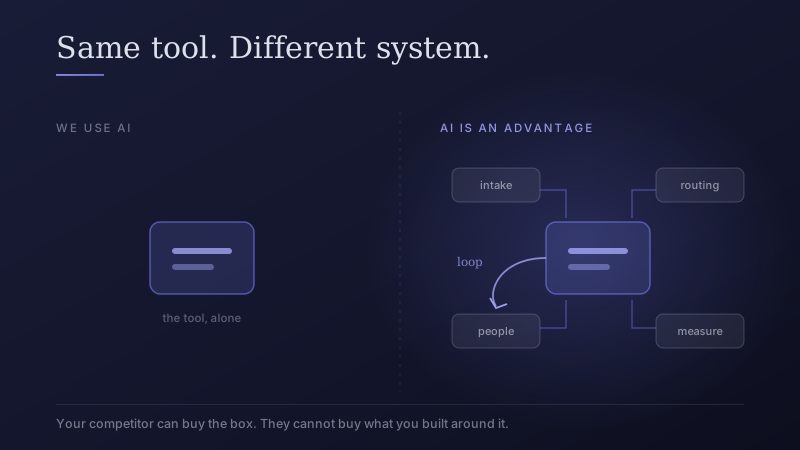
For most of the last decade, AI inside a business meant a pilot. One curious team, one tool, one budget line, one slide deck at the quarterly review. The rest of the company carried on exactly as before. That pattern is ending, and what replaces it is structural: AI is becoming the layer that core business functions run on, not a tool that individual teams occasionally borrow.
The change is easiest to see in five places: Sales, Marketing, Customer Success, Finance and Operations, and HR. These are not a random selection. They are the functions where a specific kind of work dominates the day: high-volume, pattern-based, knowledge-intensive tasks. Researching a prospect. Drafting a variant. Scoring an account. Coding an invoice. Screening a CV. Each requires reading context, applying a rule with some judgement, and producing an output, thousands of times a month. That is precisely the shape of work that stopped being expensive in the last two years.
The consequence is a reclassification. Departments that were run as cost centres, sized by headcount and measured on efficiency, are becoming engines: capacity you provision, tune and scale. The UK data suggests this is well underway rather than speculative, with the Office for National Statistics business insights survey tracking a steady rise in the share of firms using AI technologies, concentrated in exactly these back-office and go-to-market functions.
This article breaks down each of the five: what an AI-powered version of the function actually looks like, the constraint that limited the traditional model, and the new operating model that emerges. Then it covers what all five have in common, and how to sequence the work without breaking things.
Why These Five Functions
The common thread deserves stating plainly, because it explains both the speed of the shift and its limits.
Each of these functions runs on work that is high in volume, repetitive in shape, and dependent on reading unstructured information: emails, documents, transcripts, records, applications. Historically that work could only be done by a person, and the only way to do more of it was to hire another person. Cost scaled linearly with volume. Every one of these departments was therefore sized by a compromise: how much of the work we would like to do, versus how many people we can afford.
That compromise is what AI removes. Not the judgement, not the relationships, not the accountability, but the linear relationship between volume and headcount. When a function can process ten times the volume without ten times the people, its constraint moves somewhere else entirely, usually to the quality of its thinking and the quality of its data. That is what turns a support function into a strategic engine: it stops being limited by how much it can get through, and starts being limited by how well it decides.
Sales: From Headcount Maths to Coverage
What AI-powered sales looks like
The modern sales stack runs continuously rather than in bursts. It researches prospects and enriches records automatically, drafts personalised outreach grounded in what a company actually announced last month, scores leads on fit and intent as signals arrive, books meetings without the four-email dance, transcribes and analyses calls to surface objections and coaching moments, keeps the CRM current without anyone remembering to update it, and produces pipeline forecasts from behaviour rather than optimistic self-reporting.
The traditional constraint
The old model had an unavoidable arithmetic. Coverage required sales development representatives and account executives, and each one carried a large fixed cost: salary, tooling, management. Ramp time meant months before productivity, and turnover in the role is famously high, so a meaningful share of the team was always ramping rather than performing. Message quality varied by individual, so what the market heard depended on who sent the email. Above all, capacity scaled linearly: twice the prospects meant roughly twice the people.
The new operating model
Research, first-touch outreach and initial qualification move to the machine, running against every account in the territory rather than the fraction a human could reach. Humans concentrate where they are irreplaceable: discovery conversations, negotiation, relationships, complex multi-stakeholder deals. Message quality becomes a property of the system rather than the individual, so improvements are made once and apply everywhere, and outcomes feed back into what gets said next. The result is a coverage model, not a headcount model: a smaller team touching a much larger market, with the human hours concentrated in conversations that actually need a person. Our guide to AI lead generation for UK B2B covers the mechanics in more detail.
The failure mode is worth naming: automated outreach at scale, done badly, is just faster spam. The businesses getting value are the ones treating personalisation as a research problem rather than a mail-merge field.
Marketing: From Production Bottleneck to Always-On Testing
What AI-powered marketing looks like
Content produced and optimised at volume across formats and channels. SEO research, briefing and performance tracking as a continuous loop rather than a quarterly project. Ad creative generated in variants, tested against live audiences, with budget shifted toward what works. Email and lifecycle messaging personalised by segment and behaviour rather than by broadcast. Analytics that produce explanations, not just dashboards.
The traditional constraint
Marketing has always been production-bound. Every asset needed a writer, a designer, an approval cycle, so campaign velocity was capped by the slowest step and cost rose with ambition. Quality varied across contributors. Personalisation was theoretical: everyone agreed segments of one were better, and nobody had the hours to build them. Testing was similarly aspirational, because if a variant costs three days to produce, you do not run twelve of them.
The new operating model
Production becomes the cheap part. The team’s centre of gravity moves to strategy, brand voice, offer design and quality control, with AI as the production engine underneath. Iteration becomes the default posture: dozens of variants, tested continuously, retired without ceremony. Personalisation becomes practical at a level of granularity that was previously a slide-deck fantasy, which is the shift we examined in hyper-personalisation at scale. And the discipline that matters most changes shape: when anyone can produce volume, the differentiator is editorial judgement about what deserves to exist, plus measurement rigour of the kind Think with Google has long argued separates spending from investing.
The risk here is the most visible of the five: an infinite supply of adequate content nobody wants to read. Volume without a point of view is a cost, not an asset.
Customer Success: From Firefighting to Early Warning
What AI-powered customer success looks like
Health scores computed continuously from product usage, support history, sentiment and payment behaviour, with churn risk flagged while there is still time to act. Onboarding and adoption journeys that adapt to what each customer has actually done. Tickets routed intelligently, with responses drafted for review and relevant history surfaced automatically. Expansion signals identified from usage patterns rather than guessed at in QBRs. Feedback from every channel analysed continuously so themes surface in days rather than at the annual survey.
The traditional constraint
Customer Success has always been structurally reactive. A CSM managing a portfolio of accounts can genuinely pay attention to a handful at a time, so attention flows to whoever complains loudest and whoever is largest. Risk is spotted late, usually when a renewal conversation goes quiet. Scaling means hiring, and hiring means cost per account rises just as margins are under pressure. Experience quality varies by which CSM you happened to be assigned.
The new operating model
Continuous monitoring replaces sampling. Every account is watched, every day, and humans are pointed at the ones that need them, with context already assembled. That inverts the job: instead of firefighting the loudest problem, the team runs a prioritised list of risks and opportunities. Routine questions resolve without a queue, whether by voice agents or drafted replies, and the human effort concentrates on complex interventions, executive relationships and genuine strategic advice. The economic shift is that portfolio size stops being the binding constraint on quality of attention.
Finance and Operations: From Keying to Judgement
What AI-powered finance and operations looks like
Bookkeeping, expense categorisation and reconciliation running continuously rather than in a month-end crush. Invoices read and coded on arrival, with payables and receivables progressed automatically and chased with context. Cash flow forecast from actual behaviour, including how specific customers actually pay rather than how their terms say they should. Contracts analysed for obligations, renewal dates and unusual clauses. Anomalies flagged as they appear. Reporting available continuously instead of assembled fortnightly.
The traditional constraint
This is the function where the waste was always most visible. Qualified, expensive people spent large portions of their week on data entry, matching, chasing and formatting. Error rates were a function of fatigue. Cycle times were long because everything queued behind a person, and the month-end close became a ritual of late nights. Cost scaled directly with transaction volume, so growth brought proportional back-office expense. And the reporting arrived late enough that decisions were routinely made on a picture of the past.
The new operating model
First-pass processing and pattern matching move to the machine; people move to exceptions, judgement, controls and analysis. Close cycles shorten because the work is spread continuously rather than compressed. Accuracy improves at the same time as speed, breaking a trade-off finance teams have lived with forever. Crucially, this rarely requires replacing your systems: the practical pattern is a thin layer over the ledgers and tools you already run, as we set out in building AI agents on your existing stack.
Two cautions specific to this function. Regulated processes need documented controls, and the profession is explicit that oversight remains a human responsibility; the ICAEW’s guidance on artificial intelligence is a sensible reference point for what supervision has to look like. And an automated system that quietly gets a VAT treatment wrong produces errors at speed. Exception handling is not a nice-to-have here, it is the control environment.
HR: From Admin Load to People Strategy
What AI-powered HR looks like
Sourcing that searches continuously rather than when a vacancy opens. Structured screening and shortlisting against defined criteria, at volumes no panel could read. Interview scheduling that resolves itself. Onboarding workflows that run without chasing. Policy and handbook questions answered instantly from the actual documents. Sentiment analysed across engagement data to surface problems early, and internal mobility suggestions that match existing staff to opportunities before external hiring starts.
The traditional constraint
People teams are famously the most under-resourced function relative to their remit. A single vacancy can attract hundreds of applications, and AI writing tools have made applying nearly free, so volumes have risen sharply. Screening at that volume degrades into skimming, which is inconsistent and vulnerable to bias. Administrative work crowds out strategic work: the same team responsible for culture, capability and retention spends its week on scheduling and paperwork. Response times slip, candidate experience suffers, and scaling people operations traditionally means adding people.
The new operating model
High-volume screening, scheduling and routine administration move to the machine, with humans focused on culture, capability, complex judgement calls and the conversations that shape someone's career. Hiring cycles shorten and candidate experience improves, because responses stop waiting on someone's inbox. And the function finally gets data good enough to be strategic: which channels produce people who stay, where capability gaps are forming, which teams show early signs of disengagement.
This is also the function with the highest duty of care in how AI is applied. Screening decisions affect people’s livelihoods, which is why structured, identity-blind evaluation matters so much; we set out a full technical approach in resume filtering without bias. The CIPD’s work on AI in the workplace is the reference point UK people professionals should be reading, and the rule underneath it is simple: AI ranks and assists, people decide, and every consequential decision has a name attached to it.
What All Five Have in Common
Read the five sections together and the same architecture appears in each.
Execution moves; accountability does not. In every function the pattern is identical: the machine executes, the human specifies and reviews. The work of the team shifts from producing outputs to defining what good looks like, checking the cases that matter, and handling exceptions. That is a genuine change in job content, and it is the part organisations consistently underestimate.
Teams become hybrid. The unit of capacity stops being a person and becomes a person plus the workflows they oversee. Managers find themselves designing work rather than distributing it, and the agentic knowledge work shift means capacity is something you configure as much as something you hire.
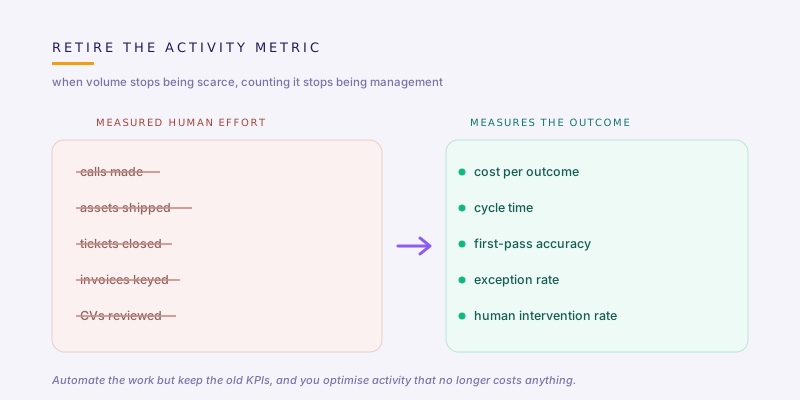
The metrics have to change. Old KPIs measured human effort: calls made, tickets closed, assets shipped, CVs reviewed. Those become nearly meaningless when volume is cheap. The replacements measure outcome and quality: cost per outcome, cycle time, first-pass accuracy, exception rate, and how often a human had to intervene. Teams that automate without changing their metrics end up optimising activity that no longer costs anything.
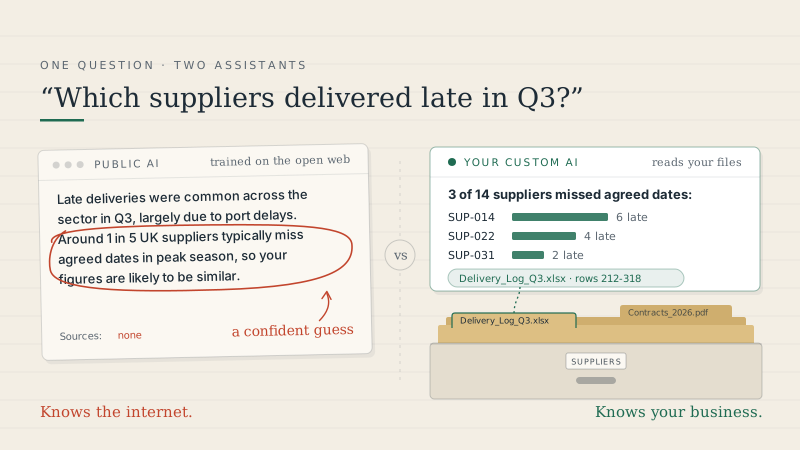
Data quality becomes the ceiling. Every one of these functions runs on the organisation’s own information: CRM records, ledgers, tickets, documents, policies. AI raises the value of good data and the cost of bad data simultaneously, because it acts on both at speed. Most disappointing deployments trace back to this rather than to the model.
Governance is not optional. Systems that act need permissions, logs, review gates and a way to stop them, which is the substance of an agentic governance blueprint. In HR and Finance particularly, this is also a regulatory requirement, not just good practice.
Structure and talent shift. Functions get flatter and smaller in production roles, while new capability appears at the seams: people who can specify workflows, evaluate outputs, and own the relationship between the business process and the system running it.
Implementation: Where to Start and What to Watch
Start where the pain is measurable, not where the technology is interesting. The highest-ROI function differs by business. If growth is the constraint, start in Sales or Marketing. If margin is the constraint, start in Finance and Operations, which usually offers the cleanest before-and-after numbers. If retention is the constraint, start in Customer Success. If you are hiring hard, start in HR. Pick one, prove it, then move.
Build versus buy is now a three-way decision. First, switch on what you already own: your CRM, ledger, helpdesk and marketing platform all ship AI features that are under-used. Second, buy point solutions where a category is mature and your process is not distinctive. Third, build only where the workflow is genuinely yours and the advantage compounds. The expensive mistake is building what you could have configured; the strategic mistake is buying a generic version of the thing that makes you different.
Govern from the first deployment. Least-privilege access to systems, an audit trail of what ran, a named human on consequential decisions, and a tested way to switch it off. Retro-fitting governance after something goes wrong is far more expensive than designing it in.
Treat change management as the main project. The technology rarely fails; adoption does. That means involving the team in design, being honest about how roles change, training the reviewers rather than everyone, and never launching a system whose first effect is more work for the people expected to use it.
Measure per function, in the same shape. Baseline before you build, one primary metric per initiative, cost per outcome tracked against the human baseline, and a scheduled review with the honesty to switch things off. Our framework for measuring AI ROI sets out the discipline.
Conclusion: The Default Operating Layer
The question facing these five functions is no longer whether AI belongs in them. It is how quickly each can be redesigned around it, because the organisations that do will run at a speed, cost and consistency that the traditional model cannot match. That gap will not stay invisible: it shows up in how fast quotes go out, how early churn is caught, how quickly the books close, how good the shortlist is.
None of this makes the people redundant, but it does change what they are for. The functions that came to be seen as overhead, the ones asked to do more with less every year, are becoming where advantage is actually built. Sales that covers a market rather than a list. Marketing that tests rather than guesses. Customer Success that sees problems early. Finance that reports in real time. HR that spends its week on people rather than paperwork.
The practical next step is unglamorous: work out where you actually stand. Assess each function honestly against the operating models described here, find the one where the gap between current and possible is widest, and start there. Our AI maturity scorecard for UK businesses is a reasonable place to begin, and if you would rather do it with help, AI Native Agency runs function-by-function assessments and builds the systems that follow.
Frequently Asked Questions
- Which business function should adopt AI first?
- The one where your binding constraint sits and the numbers are cleanest. Finance and Operations usually offers the most measurable early return because the work is high-volume and error rates are visible. Sales and Marketing offer the fastest revenue impact. Choose one function, prove it with a baseline and a measured result, then expand.
- How is AI changing sales teams?
- Research, first-touch outreach, lead scoring, CRM updates and call analysis increasingly run automatically, so coverage stops being a direct function of headcount. Sales people spend proportionally more time in discovery calls, negotiations and relationships, and the quality of messaging becomes a property of the system rather than of each individual rep.
- Will AI replace marketing teams?
- It replaces a large share of production work, not the function. The scarce resources become strategy, brand voice, offer design and editorial judgement about what deserves to be published. Teams typically get smaller in production roles and stronger in direction, testing and measurement, because volume alone stops being a differentiator when everyone has it.
- What does AI actually do in customer success?
- It monitors every account continuously, scoring health from usage, support history, sentiment and payments, and flags risk or expansion opportunities early. It also drafts responses, routes tickets, and personalises onboarding. Humans then spend their time on the accounts and interventions the system surfaces, rather than on whoever happened to complain.
- Is AI safe to use in finance and accounting?
- Yes, with controls. First-pass processing, coding and reconciliation are well suited to automation, but regulated processes require documented oversight, exception handling and an audit trail, and professional bodies are clear that accountability stays with the humans. Design the control environment before you scale the automation, not afterwards.
- How is AI used in HR and recruitment?
- Common uses are sourcing, structured screening and shortlisting, interview scheduling, onboarding workflows, answering policy questions and analysing employee sentiment. In the UK, screening must be handled carefully to avoid bias and to comply with data protection rules, so the standard pattern is that AI ranks and assists while a named person makes every decision affecting a candidate.
- What KPIs should change when a function adopts AI?
- Retire activity metrics that measure human effort, such as calls made, assets shipped or CVs reviewed, because volume stops being scarce. Replace them with outcome and quality measures: cost per outcome, cycle time, first-pass accuracy, exception rate, and human intervention rate. Otherwise you optimise activity that no longer costs anything.
- Do we need to replace our existing systems to do this?
- Usually not. The common pattern is a thin automation layer connecting the CRM, ledger, helpdesk and document store you already run, plus the AI features already included in those subscriptions. Migrations are the slowest, riskiest path, and the value is in the workflows rather than in a new platform.
- How long does it take to see results in one function?
- A well-scoped first workflow typically shows measurable results within one to three months, provided a baseline was taken before launch. Function-wide redesign takes longer, usually two to four quarters, because the constraint is change management and data quality rather than technology.