Guides
Building AI Agents That Actually Work With Your Existing Stack (Shopify, Xero, Sage, HubSpot, EMIS & More)
10 min read
A practical UK guide to adding AI agents to Shopify, Xero, Sage, HubSpot, and EMIS without rebuilding the systems that already hold your operational context.
✦Key Takeaways
- AI agents can integrate with Shopify, Xero, Sage, HubSpot, and EMIS without replacing your existing systems — using APIs, webhooks, and sidecar patterns.
- The Model Context Protocol (MCP) lets AI agents securely read and write to business tools through a standardised interface, cutting integration time by 60–80%.
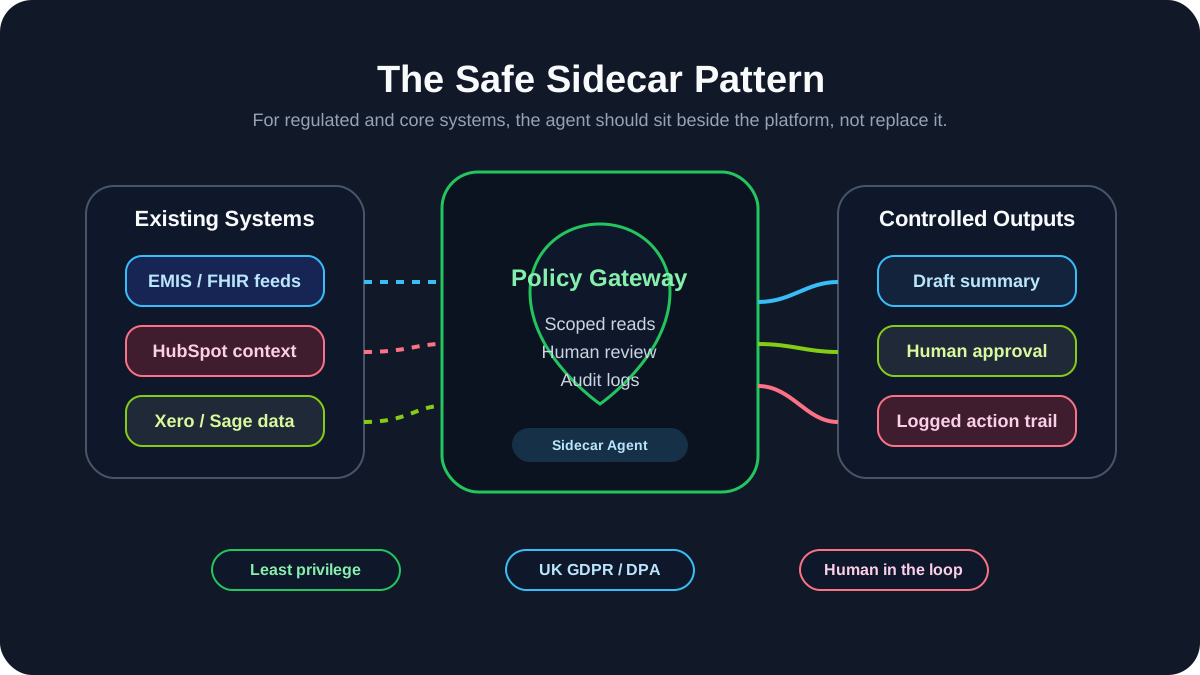
- A 'sidecar' architecture places AI agents alongside legacy systems with guardrails — human approval loops, audit trails, and rollback capability.
- UK healthcare (EMIS) and finance (Xero/Sage) integrations require specific compliance patterns: NHS DTAC, ICO guidance, and MTD-compatible audit logging.
- Start with a single high-volume, low-risk workflow (e.g. order status sync or invoice categorisation) to prove ROI before expanding the agent layer.
In the current AI gold rush, a dangerous myth has taken hold across the UK SME market: that to go AI, you must rip out the systems you already use and start again on some shiny AI-first stack.
For most established businesses, that advice is not just unnecessary. It is a fast route to disruption, duplicated work, and operational paralysis. Your real edge is not the model alone. It is the context already sitting inside Shopify orders, Xero ledgers, Sage records, HubSpot conversations, and EMIS data feeds.
At AI Native Agency, we call this the integrate-don’t-rebuild approach. Instead of replacing the systems your team already trusts, you add an agentic action layer on top of them.
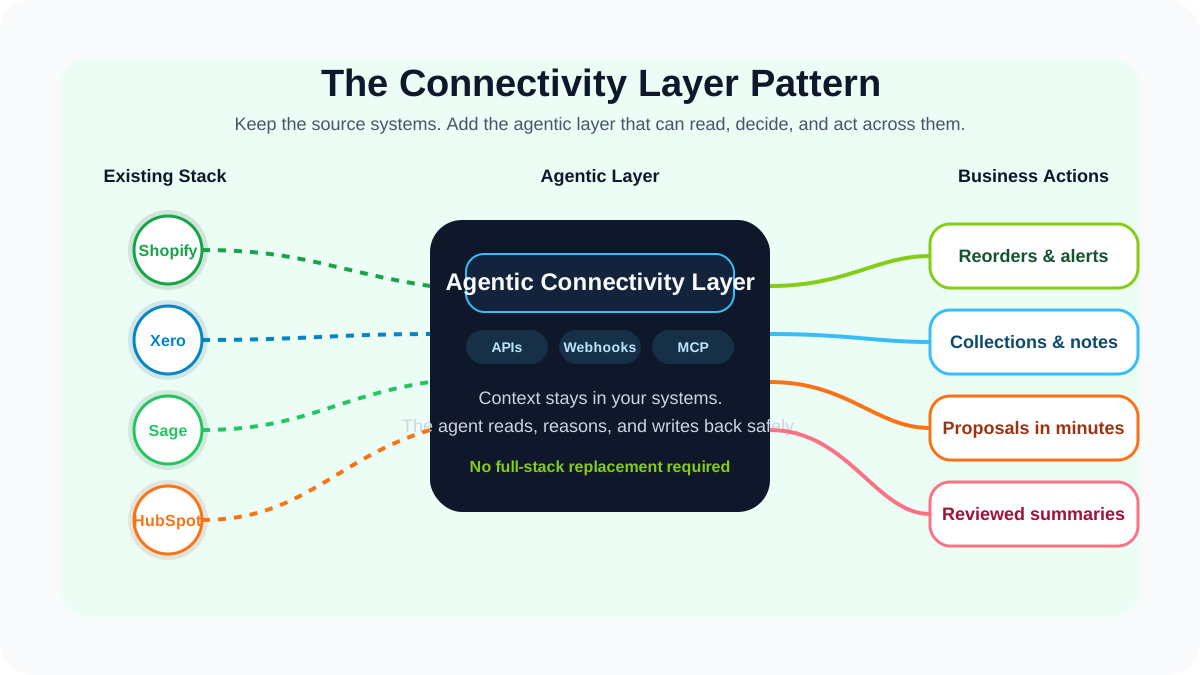
Connect, Don’t Replace
To plug AI into your stack properly, it helps to separate generative AI from AI agents. One can think and write. The other can think, decide, and then use tools to act inside your software.
- Generative AI is a brain without hands. It can write, explain, and summarise, but it cannot update your systems by itself.
- AI agents are the brain plus the hands. They use APIs, webhooks, and integration layers to read data, trigger actions, and keep humans in the loop where needed.
The goal is to build a connectivity layer. Your systems stay as the source of truth, and the agent becomes a high-speed operator working across them. That is how AI becomes useful without forcing a rewrite of your whole business stack.
This is the same maturity principle we outlined in our AI maturity scorecard for UK businesses: once your operational truth is already captured inside tools like Xero and Shopify, you are not starting from zero. You are one good agent layer away from real leverage.
Shopify: Agentic Commerce on Top of Your Store Stack
Most Shopify AI add-ons stop at simple customer-service chat. A stronger integration gives you agents that can reason across stock, demand, lead times, and campaign pressure before a human notices the issue.
Use Case: The Intelligent Inventory Agent
A well-connected Shopify agent does more than read stock levels. It understands the context around those stock levels and turns that context into action.
- Spot a SKU suddenly trending because external demand has spiked.
- Check live inventory through the Shopify Admin API.
- Cross-reference supplier lead times from an operational sheet or database.
- Draft a purchase order or tell marketing to throttle demand before overselling happens.
Implementation Tip
For many founders, the fastest win is not a custom Shopify app at all. It is a workflow that listens for events and routes them into an agent. Shopify Liquid, webhooks, and middleware such as Make.com or Zapier can often get you the first production workflow without a lengthy build cycle.
Xero and Sage: From Bookkeeping to Predictive Operations
Accounting platforms are often where manual drag hides in plain sight. Xero and Sage may have their own assistant features, but the real unlock comes from connecting finance data to customer context, operations, and follow-up actions.
Use Case: The Automated Credit Controller
A finance agent connected to Xero can do more than report who is overdue. It can decide how best to chase, based on what else is happening with that account.
- Scan aged receivables every Monday morning.
- Cross-reference each debtor against recent activity in HubSpot.
- Draft a tone-appropriate follow-up that reflects the current relationship context.
- Log the action back into Xero so the human team can review what happened and what is next.
Research Insight
According to the Mole Valley Chamber’s 2026 UK SME AI Adoption Report, businesses using integrated AI for financial administration save an average of five hours per week. The gain is not in replacing the accountant. It is in removing the copy-paste tax from finance workflows that should already be joined up.
HubSpot: Turn Your CRM into the Agent Memory Layer
HubSpot is one of the most AI-ready tools in the modern SME stack, but founders often stop at the default features. The real opportunity is to use HubSpot as the memory layer for custom agents that need lead history, account context, and follow-up state in one place.
Once an agent can read the entire deal and interaction history before acting, response speed and relevance both improve. That changes how quickly a new enquiry turns into a useful commercial conversation.
Use Case: The 24/7 Sales Engineer
- Ingest form submissions the moment they arrive.
- Search technical documentation in Notion, SharePoint, or your internal knowledge base.
- Draft a tailored proposal or technical summary within minutes.
- Write the interaction back to HubSpot as a task for the sales team to review and close.
This is exactly why our AI Cost-Speed Matrix emphasises wrappers around existing CRM data. You are not paying to swap systems. You are paying to multiply conversion speed with a better action layer.
EMIS and Other Regulated Systems: Use Sidecar Agents, Not Risky Rebuilds
Healthcare and other regulated sectors make the rebuild myth even more dangerous. When the core system is something like EMIS, the right answer is usually not to force the agent inside the legacy platform. It is to build a secure sidecar that interacts with controlled data exports or structured feeds.
That pattern lets you automate interpretation, triage, and drafting work without losing the controls that matter. In regulated settings, the agent should extend the workflow, not bypass it.
Use Case: The Lab Report Interpreter
One of the clearest examples is an agent that takes unstructured pathology text and turns it into a patient-friendly summary for clinician review.
- Extract data through secure, approved pathways.
- Cross-reference clinical ranges and structured context.
- Draft a summary for GP review before anything is sent onward.
In healthcare, human-in-the-loop is not a nice-to-have. It is part of the operating model.
MCP and the Future of Integration
The reason this is getting easier is that the integration layer itself is maturing. MCP, or Model Context Protocol, gives teams a cleaner way to describe how models should talk to tools, which reduces the one-off integration tax that used to make every agent feel bespoke.
That matters because the long-term shift is not from one chatbot to one bigger chatbot. It is from isolated AI features to connected agent ecosystems. If you want the broader strategic picture, our AI maturity roadmap for UK businesses breaks down how that transition unfolds in practice.
Compliance & Security: The UK SME Checklist
Every integration opens a door. The point is not to avoid opening doors. It is to make sure only the right data and actions move through them.
- UK GDPR: Make sure your provider offers the right data processing terms. OpenAI now publishes UK-specific data residency options that can reduce friction for sensitive workflows.
- Shadow AI risk: The bigger danger is often not the custom agent you govern. It is employees pasting sensitive Xero, Sage, or EMIS data into unsanctioned consumer tools.
- Least privilege: Give agents only the scopes they need. Reading invoices, updating CRM notes, or drafting summaries is very different from handing over full admin access.
Your Stack Is the Foundation, Not the Hurdle
The strongest AI transformations rarely start with a dramatic migration. They start with a single high-friction workflow, the right data connections, and an agent designed to remove a concrete bottleneck.
If your team already runs on Shopify, Xero, Sage, HubSpot, or EMIS, you do not need to start over. You need an AI automation and agent layer that can read the context already inside those systems and act safely on top of it.
Ready to plug AI into your business without a rebuild? Contact AI Native Agency today to map the highest-friction workflows in your stack and design the right agentic layer around them.
Frequently Asked Questions
- Can AI agents work with Shopify without replacing it?
- Yes. AI agents connect to Shopify via its Admin API and webhooks, enabling automated inventory management, order routing, customer segmentation, and personalised recommendations — all without changing your existing Shopify setup.
- How do AI agents integrate with Xero or Sage?
- AI agents use Xero's and Sage's REST APIs to automate invoice categorisation, bank reconciliation, expense coding, and VAT calculations. A sidecar pattern adds AI alongside your existing accounting workflow with human-approval gates for sensitive transactions.
- What is the Model Context Protocol (MCP) for AI agents?
- MCP is a standardised protocol that lets AI agents securely connect to business tools (CRMs, ERPs, databases) through a single interface. It reduces custom integration code by 60–80% and provides built-in authentication, rate limiting, and audit logging.
- Can AI agents integrate with NHS systems like EMIS?
- Yes, but with strict compliance requirements. AI agents connect to EMIS via HL7 FHIR APIs within NHS DTAC-compliant infrastructure, using role-based access, full audit trails, and data residency within UK borders.
- How long does it take to add AI agents to existing business software?
- A single-system AI agent integration (e.g. Shopify or Xero) typically takes 3–4 weeks from scoping to production. Multi-system orchestration across 3–5 tools takes 6–8 weeks with an AI-native agency.
Ready to put AI to work for your business?
Let's discuss how we can apply these principles to your specific challenges.
Book Your 15-Minute Strategy Call with our Lead Architect