Strategy
The Difference Between "We Use AI" and "AI Is a Competitive Advantage"
12 min read
These two sentences sound like different points on the same scale. They are claims about different things, and almost every business entitled to the first describes itself with the second. Here is why the model layer cannot be your advantage, what the strongest sceptical case gets right, the four asymmetries that survive commoditisation, and one question that settles which sentence applies to you.
✦Key Takeaways
- The two sentences are not different intensities of the same claim. One describes your tooling, the other describes the gap between you and your competitors.
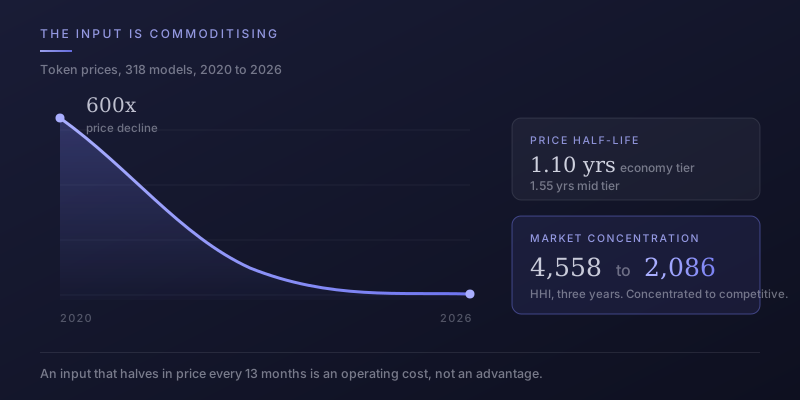
- Token prices fell roughly 600-fold between 2020 and 2026, with an economy-tier price half-life of about 1.10 years. An input that halves in price every 13 months is an operating cost, not a moat.
- Market concentration in LLM inference fell from an HHI of 4,558 to 2,086 in three years, the move from a concentrated market to a competitive one. Your supplier advantage is being competed away.
- Jay Barney, who formalised the resource-based view of the firm, co-authored the argument that AI will never provide sustainable competitive advantage. That argument is correct about the technology and narrower than it appears.
- The advantage was never the electricity; it was the factory reorganisation it made possible. AI is the same. The advantage sits in what you build around the model, not the model.
- BCG puts roughly 10% of AI value in algorithms and 70% in people and process. The 10% is purchasable this afternoon. The 70% takes eighteen months and cannot be bought.
- The substitution test: if your closest competitor bought your entire AI stack tomorrow, what would still be different in ninety days? If the answer is nothing much, you use AI.
- AI advantage is a flow, not a stock. It exists only while your feedback loop runs faster than your competitor's, so underwrite on eighteen to twenty-four months rather than four years.
Two sentences that sound like different points on the same scale.
"We use AI." "AI is a competitive advantage for us."
They are not the same claim with different intensity. They are claims about different things. The first is a statement about your tooling. The second is a statement about the gap between you and your competitors, and almost every business that says the second sentence is actually entitled only to the first.
The distinction matters because the money follows it. A business that believes AI is its advantage will invest to defend something it does not have. A business that understands it merely uses AI will invest in the thing that might actually become an advantage. Those lead to very different budgets.
The Input You Buy Cannot Be the Advantage
Start with the uncomfortable arithmetic, because it settles most of the argument before strategy enters.
A March 2026 study analysing token pricing across 318 models, using OpenRouter and Epoch AI data across 62 milestone observations from 2020 to 2026, documented roughly a 600-fold decline in token prices. It found a price half-life of about 1.10 years for economy-tier models and 1.55 years for mid-tier. It also found that software and architectural innovation, not hardware, drove almost all of the reduction.
The most telling number in that paper is not a price. It is a concentration measure. The Herfindahl-Hirschman Index for the LLM inference market fell from 4,558 to 2,086 over three years. That is the movement from a highly concentrated market to a moderately competitive one, and the paper identifies a structural break in May 2024 where price declines shifted from technology-driven to competition-driven.
Read those together. The core input is getting cheaper by roughly half every twelve to eighteen months, the supplier market is de-concentrating, and open-weight models keep closing the quality gap. Whatever model you are using, your competitor can rent something equivalent, and next year they can rent it for a fraction of what you paid. You can watch this happen in real time on any multi-provider model marketplace.
An input available to everyone at a falling price is not an advantage. It is an operating cost. This is the part most AI strategy decks quietly skip.
The Strongest Version of the Sceptical Case
It is worth steelmanning the position that AI can never be a competitive advantage, because the argument is better than most people expect and it comes from serious people.
In MIT Sloan Management Review, David Wingate, Barclay Burns and Jay Barney argued precisely that. Barney is not a commentator; he is the economist who formalised the resource-based view of the firm, the framework that defines what makes a resource capable of sustaining advantage in the first place.
Their case is simple. Algorithms and training data are being commoditised, hardware competition is fierce, talent is plentiful, and open-source models reliably erode corporate offerings. They point at history: personal computers, the internet, semiconductor fabs, blockchain, genetic sequencing. Each was transformative. None is a competitive advantage for anyone today. Their conclusion is that if everyone has access to the same technology, it may move the market as a whole but will not uniquely advantage anyone.
That argument is correct, and I think most businesses should take it more seriously than they do. But it is correct about a narrower thing than it first appears.
Where That Argument Stops
The claim is that AI will not provide sustainable competitive advantage. It is not the claim that businesses using AI cannot have advantages.
Electricity is the cleanest analogy. Access to electricity stopped being an advantage roughly a century ago. Yet the factories that reorganised around it, moving from a single central steam shaft to distributed motors and therefore to entirely new floor layouts and production flows, took decades to be caught. The advantage was never the electricity. It was the reorganisation the electricity made possible, and reorganisation is slow, specific and hard to copy.
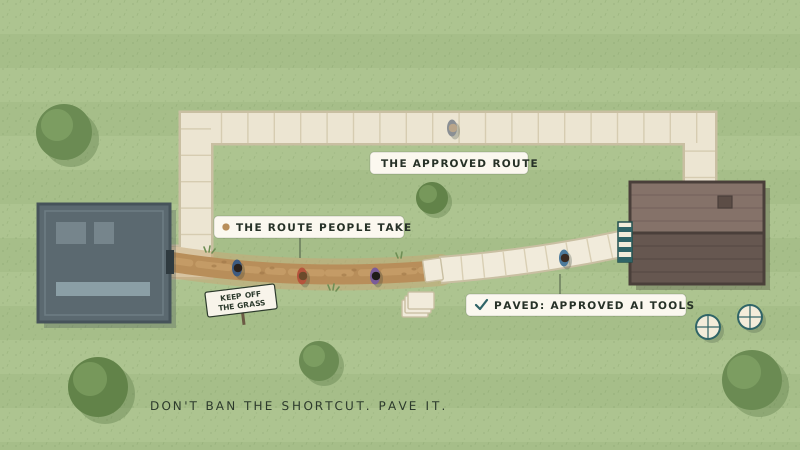
That is the actual distinction between the two sentences. We use AI describes an input. AI is a competitive advantage is only true if AI is attached to something a competitor cannot buy.
BCG's widely cited 10-20-70 principle points at the same thing from the practitioner side: roughly 10% of the value of an AI transformation comes from the algorithms, 20% from technology and data, and 70% from people and process change. The 10% is the part you can purchase this afternoon. The 70% is the part that takes eighteen months and cannot be acquired by procurement.
If the advantage lives in the 70%, then buying more of the 10% will not produce it, which is exactly what the adoption data shows happening across the economy. Stanford's AI Index economy analysis tracks the same divergence between investment and realised business impact.
The Substitution Test
Here is a single question that resolves most of this for a specific business.
If your closest competitor bought your entire AI stack tomorrow, identical vendors, identical models, identical licences, what would still be different in ninety days?
If the honest answer is nothing much, you use AI. That is a fine and defensible position, but you should stop describing it as an advantage and stop funding it as one.
If the honest answer names something specific, that something is your actual advantage, and the AI is amplifying it. Now you know what to protect and where the next pound should go.
Most executives, asked this in a room, take a long time to answer. The delay is the finding.
A Worked Example
Take two mid-sized UK accountancy practices. Both bought the same document-processing AI in early 2025. Both would tell you they use AI.
The first deployed it as an assistant. Staff upload client records when they remember to, the tool extracts and classifies, a human checks the output, and the work continues largely as before. Throughput improved perhaps 15%. Real money, correctly reported as an efficiency gain.
The second treated the tool as the starting point rather than the destination. They rebuilt client onboarding around it: documents arrive through a single structured channel, extraction happens on receipt, exceptions route to a named person by category rather than landing in a shared inbox, and every correction a human makes is captured and fed back as a labelled example. Eighteen months later their extraction accuracy on the specific document types their client base actually sends is materially higher than anything available off the shelf, because it has been trained on twenty months of their own corrections.
Now apply the substitution test. Give practice one's competitor the same software and they match it within a month. Give practice two's competitor the same software and they get the 15%, not the twenty months of corrections, not the routing logic that encodes which exceptions matter, and not the onboarding process rebuilt around it.
Same purchase. Same vendor. One of them bought a tool and the other built a system. Only the second has anything a competitor cannot order.
Four Asymmetries That Survive Commoditisation
If the model is commodity, the advantage has to sit somewhere that does not commoditise. In practice there are four candidates, and they are unevenly available.
Proprietary Data Attached to a Feedback Loop
Proprietary data on its own is weaker than people think. A static archive of historical records is a one-time asset that ages, and Barney's argument dismisses it fairly.
What does not commoditise is a loop: your system produces an output, the real world responds, the response is captured, and the next output is better because of it. Competitors can copy the architecture. They cannot copy the accumulated cycles, because those took calendar time and required your customer volume to generate.
The test is not whether you hold unusual data. It is whether your system is measurably better this quarter than last because of data only you observed.
Workflow Depth
The ONS data on UK businesses shows the average adopter using 1.6 AI technologies, with only around 10% describing their use as extensive. Set against that, a business that has genuinely rebuilt one end-to-end process around AI, with the handoffs, exception handling, permissions and measurement rebuilt too, is doing something structurally different from a business with the same subscriptions.
Depth is hard to copy because it is boring and specific. It encodes decisions about your operation that no vendor sells and no competitor can observe from outside. I covered why breadth without depth produces nothing measurable in the gap between AI hype and results.
Distribution and Customer Access
If you already reach customers your competitor cannot, AI compounds that. If you do not, better AI mostly makes you more efficient at a smaller game.
This is the most under-discussed asymmetry, because it is unglamorous and it predates AI entirely. It is also why incumbents with distribution frequently beat technically superior challengers.
Compounding Organisational Speed
The only asymmetry that generates the others. If your business ships changes weekly and your competitor ships quarterly, you will run four times as many experiments and accumulate four times the learning per year.
This is the mechanism behind our earlier argument that speed is the most durable competitive edge. AI raises the ceiling on speed for everyone, but the organisations that convert it are the ones whose decision rights, deployment processes and risk appetite already allowed fast iteration.
How Long Does an AI Advantage Last?
Shorter than a traditional one, which changes how you should treat it.
Classic operational advantages decayed slowly because copying them required physical investment and years of learning. An advantage built on an AI-enabled process decays faster, because the underlying capability improves for your competitor at the same time it improves for you, and because the tooling that took you a year to assemble may ship as a product feature next quarter.
This has two practical consequences. The first is that AI advantage is a flow, not a stock. It exists only while your loop is running faster than your competitor's. Stop iterating and it dissipates, in a way that a factory or a distribution network does not.
The second is that payback periods should be shorter than the ones you would accept elsewhere. If a project needs four years of exclusivity to justify itself, the exclusivity will probably not be there. Underwrite on eighteen to twenty-four months and treat anything beyond that as upside.
None of which argues against building. It argues against building slowly, and against treating any single deployment as a finished asset.
What the Two Positions Look Like Side by Side
| Dimension | We use AI | AI is a competitive advantage |
|---|---|---|
| What was bought | Licences and seats | Licences plus rebuilt process |
| Where it sits | Alongside existing workflow | Inside the workflow, load-bearing |
| Measurement | Usage and adoption rates | Unit economics, cycle time, margin |
| If competitor buys same stack | They match you in weeks | They still lack the loop and the process |
| Data | Consumed from vendors | Generated and fed back |
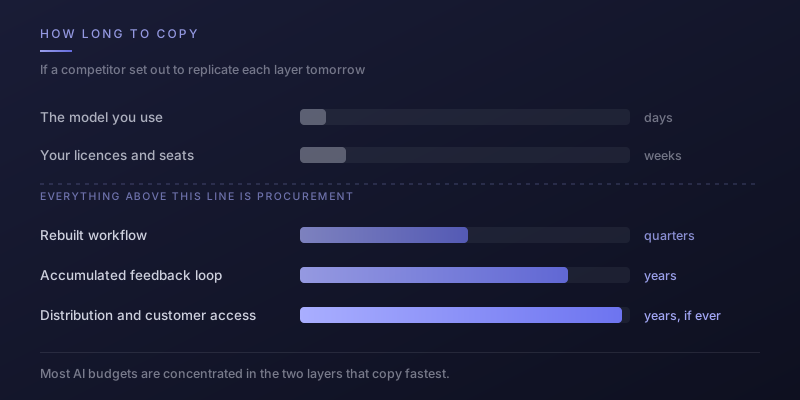
| Timeline to copy | Weeks | Quarters to years |
| Failure mode | Spend without effect | Advantage decays if the loop stops |
The right-hand column is not a bigger version of the left. It is a different investment.
Why Most AI Strategies Are Procurement Plans
Read a typical AI strategy document and count the verbs. Evaluate, select, deploy, roll out, train, license, integrate. Those are procurement verbs. They describe acquiring capability that anyone with the same budget can also acquire.
A strategy that could produce advantage contains different verbs: rebuild, retire, restructure, measure, reorganise. It names a process that will work differently afterwards and a number that will move as a result.
There is a simple diagnostic. If your AI plan would be equally valid pasted into a competitor's board pack, it is not a strategy. It is a shopping list with a timeline attached.
What to Actually Do
Reclassify honestly. Decide which of the two sentences describes you today. Most businesses are at we use AI, which is where the ONS data puts the typical UK adopter. Naming it correctly is not defeatist; it prevents you from defending a position you do not hold.
Pick the asymmetry you already have. You do not get to choose freely. Most businesses have exactly one of the four, usually distribution or a specific data loop. Identify the one you actually possess and put AI behind that, rather than pursuing a generic transformation.
Move budget from the 10% to the 70%. If your AI spend is mostly licences and mostly flat across the organisation, you are funding the commodity layer. Redirect toward rebuilding one process end to end, with measurement attached before you start.
Instrument the loop. An advantage you cannot measure will not survive a budget review. Decide in advance which number should move, over what period, and check it. This is the discipline that separates a compounding system from an expensive habit.
Assume prices keep falling. With economy-tier token prices halving roughly every thirteen months, any advantage resting on privileged access to a model has a short shelf life. Build on the assumption that your competitor gets the same capability next year at a lower price, because they will. We went deeper on how domain-specific systems change that calculation in why specialised AI outperforms generalist tools.
Conclusion
The honest position for most businesses in 2026 is: we use AI, we are getting real efficiency from it, and it is not yet a competitive advantage. That sentence is unglamorous and it is defensible, and stating it plainly puts you ahead of the many organisations that have confused a subscription for a strategy.
The path from the first sentence to the second does not run through more tools. It runs through depth, through a feedback loop that only your operation can generate, and through the slow organisational work that BCG puts at 70% of the value and that most budgets put at almost nothing.
The commoditisation of the model layer is not the bad news it appears to be. It means the expensive part is getting cheaper every year while the valuable part, the reorganisation around it, stays exactly as hard as it always was. That is unusually good news for anyone willing to do work their competitors will not.
Frequently Asked Questions
- Can AI actually be a sustainable competitive advantage?
- The technology itself, no. Researchers including Jay Barney, who originated the resource-based view of competitive advantage, argue that algorithms, data, hardware and talent are all commoditising, and that a technology everyone can access moves the market without uniquely advantaging anyone. What can be sustainable is the system built around the model: a feedback loop, a rebuilt workflow, or distribution that a competitor cannot purchase.
- What is the difference between using AI and having an AI advantage?
- Using AI means you have bought a capability available to anyone with the same budget. Having an AI advantage means the AI is attached to something a competitor cannot buy, so that giving them identical tooling would not close the gap. The first is a procurement outcome, the second is a structural one.
- How do I know whether my business has an AI advantage?
- Apply the substitution test. If your closest competitor acquired your entire AI stack tomorrow, identical vendors, models and licences, what would still be different ninety days later? If you cannot name something specific, you use AI rather than holding an advantage. That is a defensible position, but it should not be funded as though it were a moat.
- Is proprietary data a real competitive moat?
- Only when it is attached to a feedback loop. A static archive of historical records is a one-time asset that ages and can often be approximated from other sources. What resists copying is a running loop where your system produces output, the world responds, the response is captured, and the next output improves. Competitors can copy the architecture but not the accumulated cycles, because those required calendar time and your customer volume.
- Why is the AI model itself not a competitive advantage?
- Because it is a purchased input on a steep deflation curve in a de-concentrating market. Analysis of 318 models found roughly a 600-fold token price decline from 2020 to 2026 and an economy-tier price half-life near 1.10 years, while market concentration measured by HHI fell from 4,558 to 2,086. Whatever you are running, your competitor can rent something equivalent, and cheaper next year.
- How long does an AI-based competitive advantage last?
- Less time than a traditional operational advantage, because the underlying capability improves for your competitor at the same rate it improves for you, and bespoke tooling can arrive as a vendor feature within quarters. Treat it as a flow rather than a stock: it persists only while your iteration outpaces theirs. Underwrite projects on an eighteen to twenty-four month payback and treat anything longer as upside.
- What is BCG's 10-20-70 rule?
- It is the observation that roughly 10% of the value of an AI transformation comes from algorithms, 20% from technology and data, and 70% from people and process change. It matters strategically because the 10% is the part any competitor can buy immediately, while the 70% is slow, specific to your operation and effectively impossible to acquire through procurement.
- How should I change my AI budget based on this?
- Move spend from the commodity layer to the reorganisation layer. If your AI budget is mostly licences spread thinly across the organisation, you are funding the part that copies in weeks. Redirect toward rebuilding one process end to end, with a specific number identified before you start and measured afterwards, and behind whichever asymmetry your business already has.