Technical
Resume Filtering Without Bias: Constructing an Anonymous, Localized Candidate Screening Pipeline
12 min read
Hundreds of applications per role and seven-second CV skims are exactly where hiring bias lives. This technical framework shows small businesses how to build an anonymous, localised screening pipeline: strip personal identifiers with a two-pass scrubber, extract evidence-bound skill trees with a local language model, and rank candidates transparently against internal role profiles.
✦Key Takeaways
- Skimming is where bias lives: identical CVs with different names shift callback rates by around 50 per cent, so strip identity signals before anyone scores an application.
- Anonymisation is a preprocessing step, not a policy memo: a two-pass scrubber (deterministic rules, then named entity recognition) replaces identifiers with typed placeholders before evaluation.
- A localised pipeline keeps candidate data on your own hardware and matches applicants to your internal role profiles, not to a job board's generic ontology.
- Evidence-bound extraction is the reliability trick: every skill the model claims must quote the CV line that proves it, or the skill is dropped.
- Never train the matcher on your past hiring decisions; Amazon's scrapped recruiting engine showed that systems trained on history learn history's preferences.
- Blinding is not proof of fairness: keep a human on every decision and monitor group pass-through rates with the four-fifths rule.
Post one job ad and count what comes back. AI writing tools have made applying nearly free, so a small business hiring for a single role can receive hundreds of polished CVs in a week. At that volume, resume filtering without bias stops being an HR policy question and becomes an engineering problem, and a solvable one.
The default coping strategy is skimming, and skimming is where bias does its work. Eye-tracking research from Ladders puts the average first pass at around seven seconds per CV. Nobody evaluates competence in seven seconds; they react to signals: a name, a university, a postcode, a photo.
This article sets out a framework a small business can actually implement: an anonymous, localised screening pipeline that strips personal identifiers before anything is scored, converts each application into a structured skill tree, and matches those trees against your internal role requirements on hardware you control. No enterprise applicant tracking system required.
Why Manual CV Screening Breaks at Volume
Start with the arithmetic: screening 300 applications at two minutes each is ten working hours no budget pays for. So two minutes becomes seven seconds, attention narrows, and shortcuts take over. The shortcuts are the problem.
The evidence on what they cost is unusually strong. In a landmark field experiment, economists Marianne Bertrand and Sendhil Mullainathan sent nearly 5,000 CVs to real job ads, identical except for the name at the top; CVs carrying white-sounding names received about 50 per cent more callbacks. A British study by Oxford University’s Centre for Social Investigation found the same pattern here: applicants from ethnic minority backgrounds needed roughly 60 per cent more applications to get the same responses. None of this requires a single bigoted decision, only tired people pattern-matching under load.
The popular fixes fail in instructive ways. Keyword filters reject qualified candidates over phrasing (“client services” never matches “customer success”) and are trivially gamed by pasting the job ad into a chatbot. Uploading the pile to a cloud chatbot with “rank these” is worse: the model still sees every identity signal, the ranking is a black box you cannot defend, and a folder of personal data has just left your control.
The cautionary tale for the machine-learning shortcut is Amazon, which scrapped an experimental recruiting engine after finding it penalised CVs containing the word “women’s”, as in “women’s chess club captain”. Trained on ten years of the company’s hiring decisions, it had learned them faithfully. The lesson is precise: do not teach a screening system what your past choices looked like. Teach it what the role requires.
What Resume Filtering Without Bias Actually Requires
Two properties carry the design: anonymous and localised.
Anonymity is the recruitment version of the blind audition. When leading orchestras began auditioning musicians behind a screen, the share of women advancing rose sharply, a result documented by economists Claudia Goldin and Cecilia Rouse. The UK civil service has run name-blind recruitment since 2015 on the same logic: remove identity signals before evaluation, and evaluation has to run on substance.
Localised earns its place twice. First, the pipeline runs on your own hardware, so candidate data, which is personal data under UK GDPR, never leaves your control: no processor agreements, no vendor retention questions. It is the same reasoning behind sovereign AI for UK businesses, and small language models at the edge have made it practical: an open-weight model on a desktop machine now handles extraction that needed a cloud API two years ago. Second, matching is localised to your internal requirements: your role profiles, your definitions, your weightings, not a vendor’s idea of a strong candidate.
One boundary before the architecture: this is a screening pipeline, not a hiring robot. It produces a shortlist with reasons attached; humans make every decision that affects a candidate. That is good practice and the legally safer configuration.
The Pipeline: Four Stages from Inbox to Shortlist
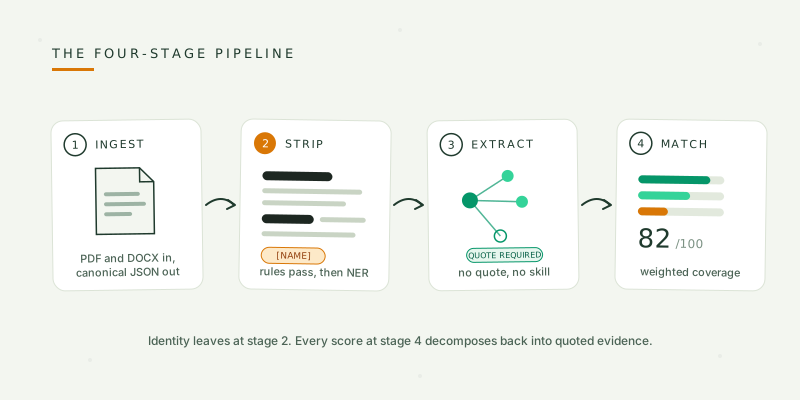
Four stages: ingest and normalise, strip identifiers, extract a skill tree, match against the role profile. Each is simple, writes an auditable record, and can be inspected independently when something looks wrong.
Stage 1: Ingest and Normalise
Applications arrive as PDFs and Word files. Open-source parsers (pdfplumber for PDFs, python-docx for Word) turn each into plain text; the raw files move into a restricted store the pipeline never reads again. Every later stage works on one canonical JSON structure per candidate: work history, education, skills, free text. Photos are dropped at parse time.
Stage 2: Strip Identifiers in Two Passes
The first pass is deterministic: regular expressions catch emails, phone numbers, URLs and postcodes. The second is statistical: named entity recognition, using Microsoft’s open-source Presidio framework built on the spaCy NLP library, catches person names, locations and other identity mentions that rules miss. Every hit becomes a typed placeholder such as [NAME] or [LOCATION], keeping sentences readable for the extraction model downstream.
Some fields need judgement rather than deletion. Graduation years are an age proxy: convert them to experience bands (“qualified more than ten years ago”) instead of deleting the qualification. Hobbies sections proxy class and family status while carrying almost no skill evidence; exclude them from scoring. Right-to-work belongs on the application form as a declared question, verified at offer stage, never inferred from a CV.
In GDPR terms this is pseudonymisation, not anonymisation: identity survives in a separate encrypted mapping from candidate ID to contact details, unmasked only after the shortlist is fixed, so data protection law still applies in full. The goal was never to escape the law; it was to blind the evaluation.
Stage 3: Extract a Structured Skill Tree
Here the framework departs from keyword matching. A skill tree is a small internal taxonomy: competency groups at the top (“data analysis”, “client delivery”), specific skills beneath, and a level scale such as working, practitioner and expert. Do not invent it from scratch; anchor it to an open occupational taxonomy like O*NET or the EU’s ESCO database, then prune hard, down to the 30 to 60 skills your roles actually use.
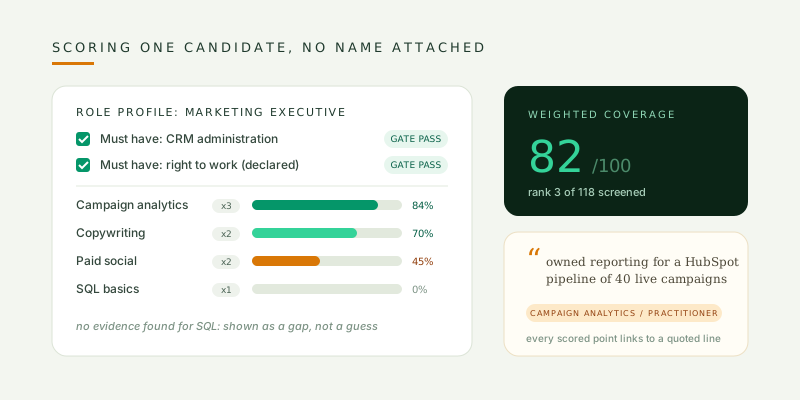
A local language model, served through a runtime such as Ollama, reads each anonymised CV and emits a skill tree as JSON constrained to that taxonomy. One rule transforms reliability: every extracted skill must carry a verbatim quote from the CV as evidence, and a validator confirms the quote appears in the source text. No quote, no skill. That kills hallucinated skills and keeps every claim one click from its source. Levels and recency ride along: practitioner evidence in the current role differs from a skill last used five years ago, and the profile records both.
Stage 4: Match Against the Role Profile
The role profile is written in the same taxonomy, which keeps matching honest. It has three parts: must-have skills acting as hard gates (keep these few and genuinely necessary), weighted desirable skills, and a small capped bonus for relevant extras. A candidate’s score is weighted coverage of that profile. Plain arithmetic, not embedding soup.
Because the score is a sum of visible parts, every ranking decomposes into reasons: a candidate sits third because the profile shows practitioner evidence for four of five weighted skills, quotes attached. A reviewer who disagrees with a weighting can change it and re-rank instantly. What nobody sees, before the shortlist is fixed, is a name.
Guardrails: Keeping the Pipeline Legal and Honest
UK GDPR and the Human in the Loop
UK GDPR Article 22 restricts decisions made solely by automated means that significantly affect people, and rejecting an applicant qualifies. The clean configuration: the pipeline ranks, people decide. Have a human review the shortlist plus a sample of candidates just below the cut, and record those reviews. The ICO’s guidance on AI and data protection sets out the regulator’s expectations, and the regulator is paying attention: its 2024 audit of AI recruitment providers produced nearly 300 recommendations. Before go-live, run a data protection impact assessment and say plainly in your privacy notice that screening is AI-assisted; the government’s Responsible AI in Recruitment guide offers a template for both.
Direction of travel matters too. The EU AI Act places recruitment in its high-risk category, with obligations phasing in through 2027, and New York City already requires annual bias audits for automated hiring tools. Little of this binds a small UK business today; building the audit trail anyway is cheap future-proofing. Our guide to human-in-the-loop AI covers the review patterns.
Measure the Bias You Cannot See
Anonymisation removes signals from the evaluation; it does not prove your outcomes are fair, because proxies survive: career gaps, university names if you keep them, the phrasing itself. So measure: invite applicants to complete a voluntary diversity form, stored separately from scoring data and used only in aggregate to compare pass-through rates between groups. The standard screen is the four-fifths rule: if any group’s pass rate falls below 80 per cent of the highest group’s, stop and investigate.
A local pipeline permits one audit no cloud black box offers: counterfactual testing. Run the same CV through with names and identity signals swapped and confirm the score does not move. Cheap, repeatable, and persuasive evidence that the blinding holds end to end.
A Reference Stack for Resume Filtering Without Bias
Everything below is open source or commodity hardware; the total cost sits well under one month of an enterprise ATS licence.
| Stage | Tooling | Notes |
|---|---|---|
| Ingest | pdfplumber, python-docx | Parse to text; quarantine raw files |
| Anonymise | Presidio with spaCy | Rules pass first, NER second; typed placeholders |
| Extract | 8B-class open-weight model via Ollama | JSON constrained to your taxonomy; temperature 0; quotes validated |
| Match and store | SQLite or Postgres | Versioned role profiles; scores decompose per skill |
| Review | Spreadsheet export or small web app | Unmask only after shortlisting; log every decision |
An 8B-class model on a mini PC clears a few hundred applications overnight. The build practice that pays fastest is shadow mode: run the pipeline alongside your normal process for the next two hires and compare shortlists. Wherever machine and human disagree, one of them is wrong, and finding out which is the best tuning loop you will get.
Conclusion: Structure Is the Fairness Feature
Bias in screening is not primarily a values problem. It is a bandwidth problem: skimming under load runs on shortcuts, and shortcuts run on identity signals. The pipeline above removes those signals mechanically, replaces the skim with evidence-bound structure, and keeps every consequential judgement in human hands with reasons attached. Fair screening stops being an aspiration and becomes a property of the system.
A first version is a focused week of engineering, not a transformation programme. If you would rather have it built than build it, AI Native Agency designs and ships exactly this kind of local, auditable pipeline for UK small businesses.
Frequently Asked Questions
- What is anonymous candidate screening?
- Anonymous screening removes identity signals (names, photos, contact details, addresses, age markers) from applications before anyone evaluates them, so the first judgement rests on skills and experience alone. The UK civil service has used a form of it since 2015.
- Is it legal to use AI to screen CVs in the UK?
- Yes, with conditions. UK GDPR requires transparency in your privacy notice, a data protection impact assessment for profiling at scale, and safeguards around solely automated decisions under Article 22. In practice: the AI ranks, people decide, and human review is recorded at every rejection boundary.
- What should be removed from a CV before screening?
- Name, photo, email, phone, address and postcode, date of birth and nationality, plus indirect age markers such as graduation years, better converted into experience bands. Exclude hobbies sections from scoring too: they proxy class and family status while carrying little skill evidence.
- Does anonymising CVs remove all hiring bias?
- No. It removes identity signals from the first screen, where volume pressure makes bias most likely, but proxies like career gaps and phrasing survive, and interviews reintroduce identity later. Pair it with structured skill scoring and monitor pass-through rates using the four-fifths rule.
- Why run the screening pipeline locally instead of using a cloud AI tool?
- Control and auditability. Applications are personal data; a local pipeline keeps them off third-party infrastructure, simplifies UK GDPR compliance, and lets you run counterfactual bias tests on the exact system you deploy.
- What is a skill tree in recruitment?
- A small structured taxonomy of the competencies a business hires for: groups at the top, specific skills beneath, each with a level such as working, practitioner or expert. Candidates and roles are described in the same tree, so matching becomes transparent coverage arithmetic rather than keyword overlap.
- Can I train the screening system on my past hiring decisions?
- Avoid it. Models trained on historical outcomes learn historical preferences, which is how Amazon's recruiting engine came to penalise the word “women's” before being scrapped. Score candidates against explicit role requirements: the requirements are auditable, and your history is not.
- How many applications does a role need before this is worth building?
- The consistency benefit applies at any volume, but payback is clearest once roles regularly attract 50 or more applications, the point where manual screening degrades into skimming. Once built, the pipeline serves every future role for the cost of a new role profile.