AI Trends
From Process Automation to Agentic Knowledge Work: How AI Is Making Tech the Core of Every Business
12 min read
Process automation executed the steps humans wrote down and left the judgement to people. Agentic AI crosses that line: brief it with an outcome and it plans, uses tools, checks results and escalates. This guide maps the shift from RPA to agentic knowledge work, the commercial evidence it is already here, and the four-rung operating ladder UK businesses can climb.
✦Key Takeaways
- Process automation executes predefined steps on structured data; agentic knowledge work pursues outcomes across messy, unstructured context. They are different technologies with different economics.
- The unit of delegation has changed: you used to buy software to support work, and you now brief software to do work, re-briefing it in plain English instead of re-scripting it.
- The evidence is commercial, not speculative: Klarna's assistant absorbed the workload of roughly 700 support staff in its first month, and controlled studies show developers finishing tasks around 55 per cent faster with an AI pair programmer.
- When execution capacity becomes software, technology stops being a cost centre: each department's throughput becomes something you provision, monitor and govern like infrastructure.
- The durable moat is encoded judgement: procedures, definitions of good and escalation rules written down as context agents can act on. Rivals can rent the same models; they cannot rent your operating knowledge.
- Climb in rungs, not leaps: scripted automation, assisted work, delegated tasks with review, then managed autonomy with budgets, audit trails and kill switches.
In 2011, Marc Andreessen predicted that software would eat the world. For most businesses it only nibbled: a website, a workflow tool, a row of bots renaming invoices. The past two years changed the meal. AI has stopped behaving like a tool that supports your processes and started behaving like a colleague that does your work, and that shift, from process automation to agentic knowledge work, is quietly redrawing what counts as a technology business.
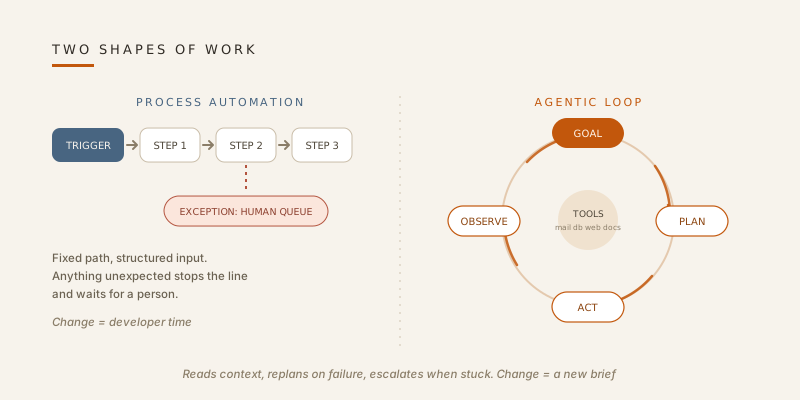
Process automation always had a firm boundary. It executed the steps a human wrote down, on data tidy enough to fit them. Everything ambiguous stayed with people: the judgement, the exceptions, the drafting, the chasing. Agentic AI crosses that boundary. Give it an outcome rather than instructions, and it plans, uses tools, checks its own results and adjusts.
This article maps the shift in four moves: what automation could never reach, what agents actually change, the evidence it is already happening, and a practical ladder for businesses that want technology at the core of operations rather than at the margins.
The Automation Era: Scripts, Bots and the Exception Problem
Robotic process automation, the RPA wave that peaked through the early 2020s, gave businesses software robots that replay what a human recorded: open this screen, copy that field, paste it there, every night at six. Alongside workflow engines and integration platforms, it delivered real value on real work: invoice keying, payroll runs, report refreshes, data ferried between systems that never learned to talk to each other.
Automation of this kind works when three conditions hold. The input is structured, the process is stable, and exceptions are rare. Break any one and the bot breaks with it: a vendor redesigns an interface, a supplier changes an invoice layout, a customer writes something a form never anticipated. Every change lands in a developer's queue, and the fix costs more than the keystrokes it saves. The failure mode is always the same: the bot did exactly what it was told, and exactly the wrong thing.
The deeper limit was never brittleness; it was the ceiling of the write-down-able. Most of a working day is not steps. It is reading an ambiguous email, judging whether a discount request is reasonable, assembling a briefing from six inconsistent sources, deciding which exception matters. Scripted automation, including the processes we catalogued in our guide to workflow automation for UK businesses, removed the typing between judgements. The judgements stayed human. That era optimised the edges of knowledge work without touching its centre.
What Agentic Knowledge Work Actually Changes
An agent is software you give an outcome instead of instructions. It decomposes the goal into steps, calls tools (a mailbox, a browser, a database, a spreadsheet, a code runner), observes what came back, retries or replans when something fails, and escalates when it is genuinely stuck. The language model supplies the part automation never had: the flexible middle that reads unstructured input and maps it to sensible action.
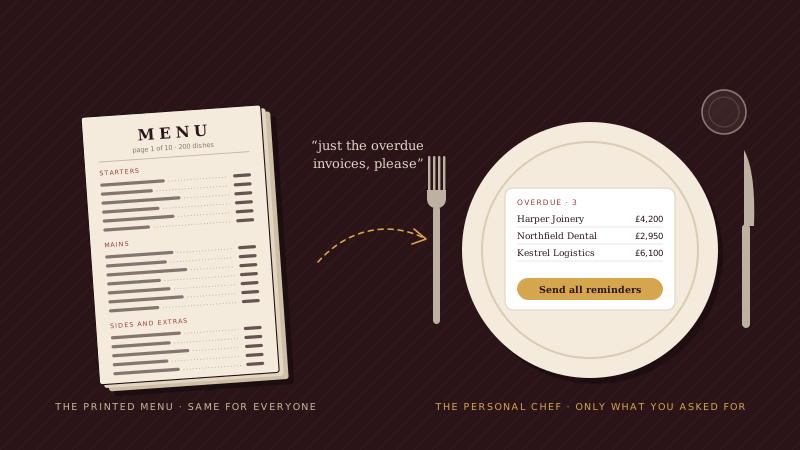
A worked example makes the difference concrete. Take “chase overdue invoices”. The automation version queries the ledger and mail-merges a template at 30, 45 and 60 days. The agentic version reads the ledger and the email thread, notices the customer disputed one line item last Tuesday, holds the chaser that would have inflamed things, drafts a reply resolving the dispute, and flags the account for a credit check before any new order ships. The difference is not a nicer email. The agent consumed context no schema anticipated, and turned it into a decision.
| Dimension | Process automation | Agentic knowledge work |
|---|---|---|
| Unit of work | A step in a script | An outcome with constraints |
| Input | Structured fields | Documents, threads, systems, history |
| Change request | Re-script by a developer | Re-brief in plain English |
| Failure mode | Halts on the unexpected | Can be fluent, confident and wrong |
| Oversight | Exception queue | Review gates, traces, evaluations |
That last row deserves emphasis, because the new failure mode is the honest cost of the upgrade. A script fails loudly; an agent can fail plausibly, producing output that reads well and is wrong. Managing that risk is a discipline of its own, with reasoning traces, versioned prompts and layered controls, which we set out in the agentic governance blueprint. The businesses getting value from agents are not the ones that trust them most; they are the ones that check them best.
The Evidence: Agents Are Already Doing Knowledge Work
Software development went first, because it is the most measurable knowledge work we have. GitHub’s controlled study of its Copilot assistant found developers completing a benchmark task around 55 per cent faster with an AI pair programmer. That was the assisted era. Current coding agents take a ticket, write the change, run the tests and open a pull request for human review. Engineering teams are, in effect, the first departments learning to manage fleets of junior digital colleagues.
Customer operations followed. Klarna’s AI assistant handled 2.3 million conversations in its first month, two-thirds of the company’s service chats, work the firm equated to roughly 700 full-time agents. Whatever view you take of the trade-offs, the underlying fact stands: knowledge work throughput was provisioned like software capacity.
Professional services, the sector most defined by knowledge work, is moving the same way. Legal AI platforms such as Harvey, adopted by major law firms since 2023, draft contract analyses and due diligence summaries that associates review rather than write. Accountancy teams run reconciliation and variance-explanation agents across ledgers that once consumed month-end weekends. In each case the shape repeats: the first draft migrates to software, and the human moves one seat up, from producer to editor.
The platform layer has moved to match. Salesforce ships Agentforce inside the CRM your sales team already uses; Microsoft’s Work Trend Index describes “frontier firms” restructuring around human-agent teams, with more than eight in ten leaders calling this a pivotal year for rethinking how work gets done. And the adoption backdrop makes the direction clear: Stanford’s AI Index reported 78 per cent of organisations using AI in 2024, up from 55 per cent a year earlier. Adoption is no longer the question. Depth of delegation is.
Why Tech Becomes the Core of Every Business
While software was a tool, technology could sit at the side of the business: a support function that bought licences, kept laptops alive and cleared tickets. When software does the work, that framing collapses. Support capacity, research capacity, reporting capacity, even parts of sales capacity become things you provision, monitor and govern, the way you already treat storage and compute. NVIDIA's Jensen Huang put the endpoint memorably: the IT department becomes something like the HR department for AI agents.
What stays scarce when everyone can rent the same models? Your operating knowledge. The procedures, pricing logic, tone of voice, quality bars and escalation rules that live half-written-down across your business are exactly what an agent needs as context to do the work your way. Encoded judgement becomes the moat. A firm whose know-how lives in three people's heads will brief agents badly and get generic output; a firm that writes its judgement down gets a workforce multiplier nobody can copy.
The organisation chart changes with it. Managers spend less time distributing tasks and more time designing work: writing briefs, defining what good looks like, deciding which outputs need a human signature. New roles appear at the seam between business and technology, like the forward deployed engineer who embeds with a team and turns its process into running agents.
For small businesses this is the first platform shift that tilts the field toward them. A twelve-person firm can now run a support triage agent, a research agent and a reporting agent without hiring, and redirect the humans to the judgement calls and the relationships. The binding constraint is no longer budget or headcount. It is clarity about your own processes, which costs thought rather than money, and which no vendor can supply for you.
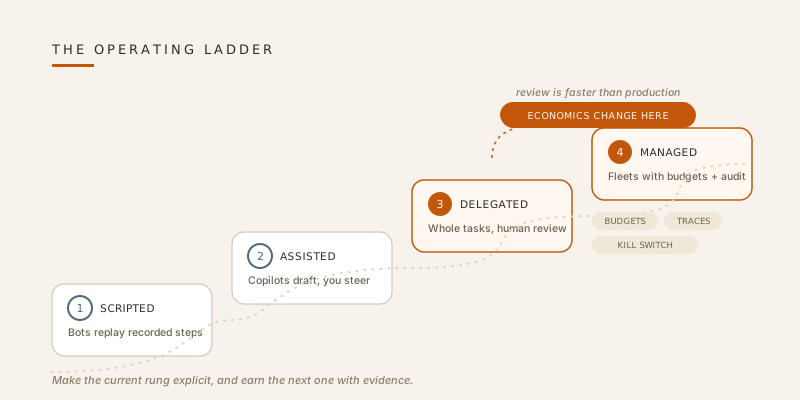
The Operating Ladder into Agentic Knowledge Work
The move is a ladder, not a leap, and each rung has its own economics.
- Rung 1: Scripted automation. Deterministic bots and workflows. Still the right tool for stable, high-volume, structured work. Nothing here needs ripping out.
- Rung 2: Assisted work. Copilots draft and summarise while a human steers every step. Cheap to adopt and low risk, but throughput stays capped at the speed of the person in the loop.
- Rung 3: Delegated tasks. An agent completes whole units of work, a triage, a brief, a reconciliation, and the human reviews the output rather than the keystrokes. This is where the economics change, because reviewing is faster than producing.
- Rung 4: Managed autonomy. Fleets of agents run under explicit budgets, step limits, audit trails and kill switches, with humans sampling output and owning escalations.
Climbing is less about tooling than about management hygiene:
- Pick work with checkable outcomes and survivable failures first; save the irreversible decisions for later rungs.
- Write the brief. Turn your standard operating procedures into context an agent can act on. If you cannot write it down, you cannot delegate it, to a machine or to a new hire.
- Instrument everything from day one: traces of what the agent did, logs of what it cost, a record of what a human changed at review.
- Keep humans on consequential calls, and make the review gate explicit rather than assumed.
- Measure cost per outcome against your human baseline, not against zero. Agents are cheap, not free, and a noisy agent can be expensive.
The common failure pattern is a rung mismatch. A team runs a rung-2 pilot, a copilot and a curious volunteer, then judges it against rung-4 expectations of autonomous, unattended throughput, and concludes agents do not work. Or it leaps to autonomy with no written briefs and no review gates, gets burned by one confident error, and retreats entirely. Both failures are avoidable with the same move: make the current rung explicit, and earn the next one with evidence.
For a typical UK small business, the first delegations that pay are predictable: support triage and drafting, research and tender first drafts, weekly reporting packs, invoice chasing with context, supplier and candidate screening summaries.
Conclusion: Every Business Becomes a Judgement Business
“Technology at the core” does not mean everyone learns to code. It means the defining management skill of the next decade is deciding what to delegate to machines, briefing them precisely, and knowing exactly where human judgement must stay. Process automation made your existing work slightly cheaper. Agentic knowledge work changes what a given headcount can attempt, and it rewards the businesses that understand their own operations well enough to write them down.
The companies that treated software as plumbing will keep buying tools. The companies that treat software as workforce will compound. If you want help finding your first rung, AI Native Agency designs, ships and governs agentic systems for UK businesses, from first pilot to managed fleet.
Frequently Asked Questions
- What is agentic knowledge work?
- It is work that previously required human judgement, such as research, drafting, triage and analysis, performed by AI agents that take an outcome, plan their own steps, use tools and check results, with humans reviewing what matters. It differs from automation, which only replays predefined steps.
- What is the difference between RPA and agentic AI?
- RPA executes a fixed script against structured data and halts at anything unexpected; changing it means developer time. An agent interprets unstructured context, chooses its own actions, retries and escalates, and is redirected by rewriting its brief in plain language rather than its code.
- Will AI agents replace knowledge workers?
- Agents absorb tasks faster than they absorb roles. The pattern in early deployments is redistribution: production shifts to agents, while humans concentrate on review, exceptions, relationships and decisions with consequences. Some roles do shrink, and new ones appear around briefing, reviewing and governing agents.
- What is a digital worker?
- A configured AI agent treated as a unit of capacity: it has a defined scope of work, tools it may use, a budget, an audit trail and a manager. The term signals a management relationship, brief and review, rather than a software relationship of install and configure.
- Where should a small business deploy agents first?
- Start where outcomes are checkable and failures are survivable: support triage, research briefs, reporting packs, invoice chasing and first-draft documents. Avoid irreversible or regulated decisions until you have review gates and an audit trail you trust.
- Do agents need tidy data the way automation did?
- Less. Agents read the unstructured material automation choked on: emails, PDFs, meeting notes. What they need instead is your judgement made explicit: procedures, quality bars and escalation rules written down as context. Clean prose about how you work beats a clean schema.
- How do you keep AI agents safe and compliant?
- Give each agent least-privilege access to tools, hard budgets and step limits, full traces of what it did, and human approval on irreversible actions. If agents touch personal data, UK GDPR applies as usual: minimise what they see and document the processing.
- How is this different from digital transformation?
- Digital transformation digitised records and processes while humans stayed the executors. The agentic shift moves execution itself into software. Transformation stops being a programme with an end date and becomes an operating posture: continuously deciding what to delegate next.