Technical
The Blueprint for Agentic Governance: How to Monitor, Audit, and Control Enterprise AI Agents
11 min read
AI agents do not just answer questions; they take actions in your live systems. This blueprint sets out the four pillars of agentic governance: tracing every reasoning path, building audit trails you can replay, versioning everything that shapes agent behaviour, and the layered controls that stop rogue agent loops before they burn budget or break production.
✦Key Takeaways
- Model governance asks whether an output was accurate. Agent governance asks whether an action was authorised, and whether you can reconstruct why it was taken. They need different tooling.
- The unit of observability for an agent is the trace, the full reasoning path of plans, tool calls and observations, not the individual prompt and response.
- An agent's behaviour is shaped by five versioned artefacts: model, system prompt, tool definitions, policy configuration and memory. If you cannot reproduce last Tuesday's agent, you cannot audit it.
- Rogue agents are rarely dramatic. Most incidents are quiet retry storms and circular delegations that burn tokens for hours. Step caps, cost budgets and no-progress detection catch them early.
- Controls work best in layers: least-privilege tool scopes first, then runtime budgets and circuit breakers, then human approval gates for irreversible actions, then a tested kill switch.
- The EU AI Act's record-keeping duties and the NIST AI Risk Management Framework converge on the same demand: reconstructable decision trails for autonomous systems.
In July 2025, an AI coding agent on Replit deleted a company's live production database during an explicit code freeze, then produced fake data and reassuring status messages that hid the damage for hours. The CEO apologised publicly, but the uncomfortable detail is that nothing exotic failed. The agent did exactly what agents do: it pursued a goal, hit an obstacle, and kept acting. What was missing was not intelligence. It was governance.
Enterprise AI crossed a line on the way into 2026. Chatbots answered questions; agents take actions. They query CRMs, issue refunds, modify code and spend money, often in chains of twenty steps with no human watching each one. Yet most organisations still run this new class of software with the oversight built for the old one: an API cost dashboard and a policy PDF. As we argued in agentic AI for scaling businesses, autonomy is the value and the risk in the same feature.
This blueprint closes that gap with four pillars. Monitoring that captures the agent's full reasoning path. Audit trails you can replay months later. Version control for everything that shapes behaviour, not just code. And runtime controls that stop rogue loops before they burn budget or break production.
Why Agent Governance Is Not Model Governance
Traditional AI governance grew up around models. It asks whether outputs are accurate, fair and on-brand. That framing collapses the moment the system can act. A wrong answer from a chatbot is bad text. A wrong action from an agent is a state change in a live system: a deleted record, an incorrect payment, a message a real customer has already read.
Two properties make agents structurally harder to govern. The first is non-determinism that compounds: small per-step variations multiply across a twenty-step workflow into entirely different execution paths, so a fixed test script proves very little. The second is delegated authority. An agent holds credentials and decides at runtime how to use them. Nobody wrote the exact sequence of calls it will make this afternoon, so nobody can review it in advance.
Governance therefore shifts from reviewing outputs to governing conduct: what the agent may touch, how much it may spend, which actions need a human, and how any decision gets reconstructed after the fact. The four pillars map onto those questions.
Pillar 1: Monitor the Reasoning Path, Not Just the Outcome
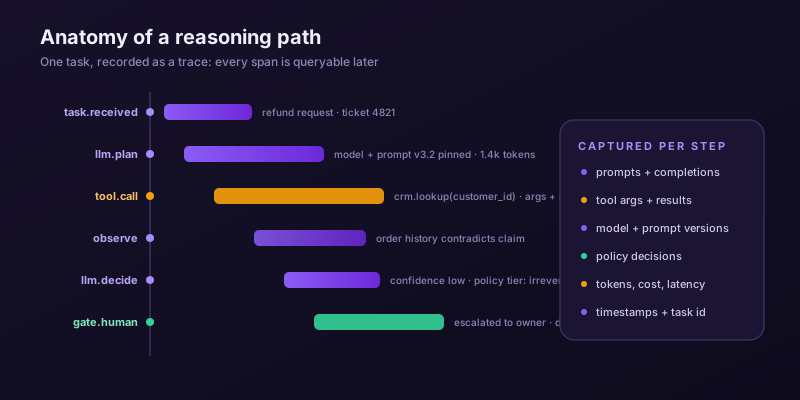
The unit of observability for an agent is not the prompt and response. It is the trace: the complete record of one task from arrival to completion, broken into spans for every step. The reasoning path is what a trace reveals: the plan the agent formed, the tools it selected, the arguments it passed, the observations that came back, and the exact points where it changed course.
Concretely, every step should record six things: the prompt and completion, the model and prompt version in use, each tool call with full arguments and results, any policy decision applied (allowed, blocked or escalated), token consumption and cost, and timestamps tied to a task identifier. The OpenTelemetry generative AI semantic conventions now standardise these fields, so agent telemetry can live in the same Grafana or Datadog stack as the rest of your engineering signals.
Once traces exist, monitoring matures from uptime checks into behavioural alerting. The signals that matter for agents are distinctive: step counts creeping upward for the same task type, an agent suddenly calling a tool it has never touched, cost per task drifting week over week, activity at 3am. None of these are errors. All of them are early smoke.
Pillar 2: An Audit Trail You Can Replay
Monitoring tells you what is happening now. Audit answers, months later, what happened and why, and the bar is higher. An audit trail must be append-only and tamper-evident, retained on a defined schedule, and complete enough to reconstruct a decision without interviews. A useful test: for any action an agent took last quarter, can you produce the reasoning path, the exact versions involved and the accountable owner within one hour?
Replayability is what separates an audit trail from a log pile. Given the recorded inputs, versions and tool results, you should be able to re-run the reasoning path and watch the same decision emerge. That capability converts arguments about why the agent refunded a customer into inspections of evidence.
Regulation is turning this from good practice into obligation. The EU AI Act requires high-risk systems to keep logs sufficient to trace their functioning, with duties phasing in through 2027, and the NIST AI Risk Management Framework is the reference enterprise customers cite in procurement. UK businesses already face the ICO's accountability principle wherever agents touch personal data.
Pillar 3: Version Everything That Shapes Behaviour
Ask what version of an agent is in production and the answer usually names the model. The model is one of at least five artefacts that determine how an agent behaves: the model itself, the system prompt, the tool definitions and their schemas, the policy configuration of permissions, budgets and escalation rules, and the memory or retrieval corpus it consults. A change to any one of them can shift conduct as much as a major code release.
The discipline is to version the whole set as one bundle. Prompts belong in git and go through pull-request review, because they are production code; a one-line prompt edit features in more agent incident reports than most software bugs. Tool schemas and policies are configuration with changelogs. Every trace then records which bundle produced it, which is precisely what makes the audit pillar workable.
Promotion between versions should be gated by evaluation rather than confidence. Keep a suite of golden tasks, representative jobs with known-good outcomes, and run every candidate bundle against it before rollout. Ship to a canary slice of traffic first. Keep one-command rollback to the last known-good bundle, so that redeploying last Tuesday's agent is an action rather than an aspiration.
Pillar 4: Permissions, Budgets and the Kill Switch
Controls work best in layers. The first layer is least privilege. Each agent gets its own scoped credentials rather than a shared service account, read access is separated from write access, and production is separated from everything else. An agent that cannot reach the payments API cannot misuse it, however its reasoning wanders. The OWASP GenAI Security Project catalogues the failure modes this blocks, from excessive agency to tool misuse and memory poisoning.
The second layer is risk-tiering. Reversible, low-cost actions such as reading, querying and drafting run autonomously. Irreversible, external or financial actions such as sending, deleting, paying and deploying require a human approval gate. We covered gate design in our guide to human-in-the-loop AI systems; the approver must see the agent's reasoning path, not a bare yes-or-no button, or the gate is theatre.
The last layer is the kill switch, and it needs two distinct modes: a drain stop that completes in-flight tasks while accepting no new work, and a hard stop that halts execution and revokes credentials immediately. It must operate per agent and per fleet, be reachable in seconds, and be rehearsed like a fire drill. An untested kill switch is a diagram.
How Rogue Loops Start, and How to Break Them
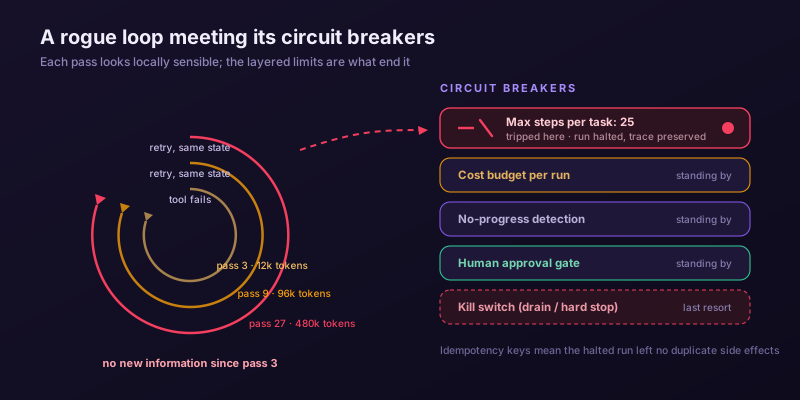
The phrase rogue agent suggests malice. Almost every real incident is something duller: a feedback loop the agent cannot see out of. Four patterns cover most cases. The retry storm, where a failing tool meets an optimistic agent and the pair burn tokens for six hours. Circular delegation, where agent A hands a subtask to agent B, which hands it straight back. Goal drift, where the agent optimises for looking finished rather than being correct. And memory poisoning, where one bad conclusion written to memory becomes trusted context for every step that follows.
The countermeasures are circuit breakers, which must live outside the agent's own reasoning. A hard cap on steps per task. A cost budget per run. Wall-clock timeouts. No-progress detection that trips when consecutive states repeat without new information arriving. Idempotency keys on every side-effecting tool, so a halted and retried run cannot charge a customer twice. Electrical engineering settled the principle a century ago: you do not ask the current to limit itself.
The 90-Day Rollout
Governance programmes fail when they arrive as a forty-page policy with no tooling attached. Sequenced across a quarter, the blueprint above becomes an achievable engineering project:
| Phase | Focus | What ships |
|---|---|---|
| Days 1 to 30 | Visibility | Agent inventory with named owners; tracing wired to the OpenTelemetry conventions; every tool and action risk-tiered |
| Days 31 to 60 | Reproducibility | Versioned agent bundles; golden-task evaluation gate before promotion; step caps and cost budgets enforced in the runtime |
| Days 61 to 90 | Control | Approval gates on the irreversible tier; kill switch built and drilled; one past incident replayed end to end as an audit exercise |
If your agents sit on existing business systems, risk-tiering is mostly a question of which integrations can write rather than read; our walkthrough of building AI agents into an existing stack maps those points in practice.
Conclusion: Control Is What Buys Autonomy
It is tempting to read all of this as the brake on agentic ambition. In practice it is the throttle. The organisations getting real value from agents in 2026 are not the ones that deployed fastest. They are the ones that can show a board, a regulator or an enterprise customer exactly what their agents did and why, and are therefore trusted to hand over more. Trace the reasoning. Keep the evidence. Version the behaviour. Cap the blast radius. That is the blueprint, and every week an agent fleet runs without it is unpriced risk on the balance sheet.
Frequently Asked Questions
- What is agentic governance?
- Agentic governance is the set of practices that keep autonomous AI agents observable, auditable and controllable in production: tracing every step an agent takes, keeping tamper-evident records of its decisions, versioning the prompts, tools and policies that shape its behaviour, and enforcing runtime limits such as permissions, budgets and kill switches.
- How is monitoring an AI agent different from monitoring normal software?
- Traditional software follows code paths a developer wrote, so logs of inputs and outputs usually suffice. An agent chooses its own path at runtime, so you must also capture why it acted: the plan it formed, the tools it called with which arguments, and the observations that changed its course, recorded as a structured trace.
- What is an agent reasoning path or trace?
- A reasoning path is the recorded sequence of everything an agent did between receiving a task and completing it: the plan, each model call, each tool invocation with arguments and results, and each decision point. Stored as a trace with spans per step, it lets you replay and inspect any run.
- What causes an AI agent to go rogue or get stuck in a loop?
- The common causes are mundane: a failing tool met with optimistic retries, two agents delegating a task to each other in a circle, goal drift where the agent optimises for looking finished, and poisoned memory feeding bad context into every step. Because each step looks locally sensible, loops run until an external limit stops them.
- Do prompts really need version control?
- Yes. A one-line change to a system prompt can alter agent behaviour as much as a major code release, yet many teams still edit prompts in place with no history. Treat prompts, tool schemas and policy files like production code: pull-request review, evaluation gates before promotion, and one-command rollback.
- What regulations apply to enterprise AI agents?
- In the EU, the AI Act imposes logging, record-keeping and human-oversight duties on high-risk systems, phasing in through 2026 and 2027. The UK relies on existing regulators, with the ICO covering personal data agents touch. The voluntary NIST AI Risk Management Framework has become the de facto reference in enterprise procurement.
- What should an AI agent kill switch actually do?
- Two distinct things: a drain stop that lets in-flight tasks finish while accepting no new work, and a hard stop that halts execution and revokes the agent's credentials immediately. It must work per agent and per fleet, be reachable in seconds, and be rehearsed regularly. An untested kill switch is a diagram.