Half your staff already use ChatGPT, yet it cannot answer a single question about your own policies, suppliers or sales. This guide explains how custom AI for business connects securely to your data, cites its sources, respects existing permissions and stays UK GDPR compliant.
✦Key Takeaways
- Public AI tools learn from the open internet, so they excel at generic writing and fail at anything that depends on your pricing, policies, contracts or history.
- Custom AI uses the same class of foundation model as ChatGPT. The difference is a secure knowledge layer that retrieves your own documents and instructs the model to answer only from them.
- Saying "I don't know" is the most valuable behaviour a business AI can have. Logged unanswered questions become a precise map of the gaps in your documentation.
- Source citations change the trust model: staff verify an answer in seconds instead of trusting it blindly, the discipline the High Court demanded after fictitious AI citations reached English courts.
- Business and API access to the major models is not used for training by default, and custom systems can be hosted on UK or EU infrastructure to support UK GDPR compliance.
- Because a custom AI honours existing permissions exactly, it also exposes permission mistakes. Audit folders shared with "Everyone" before launch, not after.
- For numerical questions, figures must come from your system of record, never the model's memory. The model explains; your ERP and CRM supply the arithmetic.
- First deployments no longer need machine learning scientists. They need well-built integrations, which puts focused projects in the tens of thousands of pounds rather than millions.
Walk into almost any UK office this year and you will see the same browser tab open on half the desks. Someone is drafting a delicate email in ChatGPT. Someone else is summarising meeting notes or asking for ten ideas for the next newsletter. It feels like a productivity revolution, and in a narrow sense it is. Microsoft and LinkedIn's Work Trend Index found that 75% of knowledge workers were already using generative AI at work, and 78% of those users were bringing their own tools rather than waiting for IT to supply them.
Now ask that same assistant a real business question. "What is our return policy for wholesale clients?" "Which suppliers delivered late in Q3?" "How much compassionate leave does someone on a fixed-term contract get?" You will receive a fluent, confident, well-structured answer, and it will be invented. The model has read an enormous slice of the public internet, but it has never seen your trade terms, your delivery log or your staff handbook. It knows the internet. It knows nothing about your business.
That gap is where the real advantage now sits, and it is why custom AI for business has moved from IT experiment to board agenda. In 2026, simply using AI is table stakes, because your competitors' staff have the same browser tab open. The advantage belongs to organisations that securely connect AI to their own data: the handbooks, contracts, spreadsheets and operational systems that actually run the company.
The simplest way to picture the difference is this. ChatGPT is a brilliant graduate who has read every book in the library but has not attended your induction or opened a single one of your files. Custom AI is that same graduate, securely handed the keys to your filing cabinet. The rest of this article explains how that works, what it means for data security, and what it looks like for HR, operations and the boardroom.
Why Generic AI Falls Short for Real Business Processes
The general knowledge trap
Public models learn from vast quantities of text drawn from the open web, books and other sources. That makes them excellent at any task where the right answer is the same for everyone: a polite rejection email, a first draft of a job advert, a plain-English explanation of a lease clause. Ask for something where the right answer depends on your context, and they have nothing to stand on.
Compare two requests. "Write a polite email declining a discount request" is a writing task, and a public model will do it well. "Reply to our largest wholesale customer declining a further 12% discount, referencing their tier on our pricing matrix and the concession we agreed in March" is an operational task. It depends on three facts the model cannot see: the pricing matrix, the customer's tier and the history of the account. Most of the valuable work in a business looks like the second request, not the first.
The copy-paste bottleneck
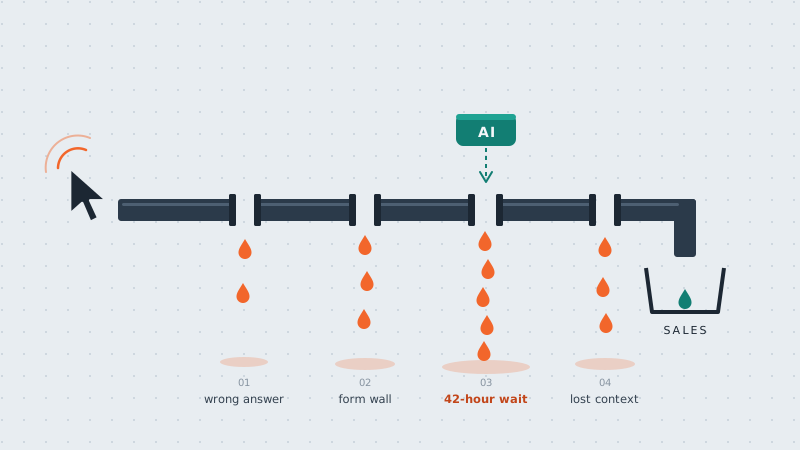
So staff improvise. The typical workflow looks like this: download a 50-page supplier agreement from SharePoint, open it, copy the text, paste it into a chat window, discover it is too long or the formatting has collapsed, split it into chunks, paste again, and finally ask the question. Tomorrow, repeat with a different document. Next week, a colleague repeats the whole exercise to get the same answer.
It is slow, it does not scale, and it creates a second problem: every paste moves a copy of company data into a tool the business does not control, often on a personal account. Atlassian's State of Teams 2025 research, covering 12,000 knowledge workers, found that teams lose around 25% of their time simply searching for answers. Copy-and-paste AI does not solve that problem. It adds a step to it.
Confident guesses are a corporate liability
The most serious limitation is how a public model behaves when it does not know something. It rarely says so. It produces the most statistically plausible answer, which for a policy question usually means an industry-typical answer delivered with complete certainty.
For an HR Director checking whether a policy matches a specific contract clause, or an Operations Manager confirming stock before committing to a delivery date, a plausible guess is worse than no answer at all. English courts have already seen where this leads. In June 2025 the High Court dealt with two cases in which fictitious authorities had been put before judges, including an £89.4 million claim in which 18 of 45 citations did not exist. The judgment was blunt: freely available tools such as ChatGPT "are not capable of conducting reliable legal research" and "may make confident assertions that are simply untrue". Swap case law for contract terms, safety procedures or pay scales, and the same risk lands on your business.
Teaching AI to Read Your Filing Cabinet
Custom AI is not a secret, different kind of model. In most business deployments it uses the same class of foundation model you already know from ChatGPT, Claude or Gemini. What changes is everything around the model: what it is allowed to read, what it is told to do with that material, and what it must do when the material runs out.
How a secure knowledge layer works
Picture a librarian standing between your staff and the model. When an employee asks a question, the librarian acts first:
- Checks who is asking. The system identifies the employee and what they are permitted to see.
- Searches your own sources. SharePoint, Google Drive, the HR platform, the ERP, the CRM: whichever systems have been connected.
- Pulls the exact passages that matter. Not whole documents, but the relevant clauses, rows or pages.
- Hands them to the model with strict instructions. In effect: "Answer the user's question using only the facts in these extracts, and say where each fact came from."
We call this a secure knowledge layer: a form of contextual memory for your organisation. The model supplies the language, reasoning and fluency. Your documents supply the facts. Nobody copies or pastes anything; they simply ask.
The closed loop: why "I don't know" is a feature
The most important instruction is the one that covers failure. A well-built custom AI is restricted to your version of the truth. If the librarian cannot find the answer in the connected sources, the system is designed to say so, for example "I can't find that in current policy; the HR team can help", rather than filling the gap with an industry average that sounds right.
No system is flawless, and sensible builds still include testing and human review checkpoints for high-stakes answers. But the failure mode changes character, from invisible invention to visible silence. There is a useful side effect, too. Every unanswered question is logged, and within weeks that log becomes a precise map of the gaps in your documentation. If forty people ask about the hybrid working policy and there isn't one, you have found a policy gap, not an AI problem.

The Three Pillars of a Custom Business AI
1. Direct data connection. It reads your PDFs, spreadsheets and databases directly through secure integrations with the systems you already use, and it keeps pace as those documents change. When the handbook is updated on Monday, Tuesday's answers reflect it. No downloading, no pasting, no character limits. Our guide to building AI on top of your existing software stack covers the integration side in more depth.
2. Source citation. A custom AI shows its working. Every answer carries a reference an employee can check in seconds: "According to Supplier_Contracts_2026.pdf, page 12, payment terms for Tier 2 suppliers are net 45." That one design choice changes the trust model. Staff do not have to take the AI's word for anything; they can verify it, which is exactly the discipline the High Court said should apply to any AI-generated claim.
3. Format understanding. It understands the architecture of your business: that a client invoice, an employee performance review and a marketing brief are different kinds of document, with different owners, different sensitivity and different rules about who may see them. It knows that the 2026 handbook supersedes the 2023 draft still sitting in someone's shared folder, and it treats a figure in your finance system as more authoritative than the same figure quoted in an old email.
That last point exposes an uncomfortable truth: a custom AI is only as good as your filing cabinet. If three versions of the expenses policy are live on the intranet, the first project task is deciding which one is true. Most businesses find that clean-up valuable in its own right.
Are We Giving OpenAI Our Company Secrets?
This is usually the first question a Managing Director asks, and it is the right one. The nightmare is familiar: sensitive financial data, client lists or HR records pasted into a public chat box, stored on someone else's servers and absorbed into the next generation of a public model. It is not hypothetical. In 2023 Samsung restricted staff use of generative AI tools after engineers pasted confidential source code into ChatGPT.
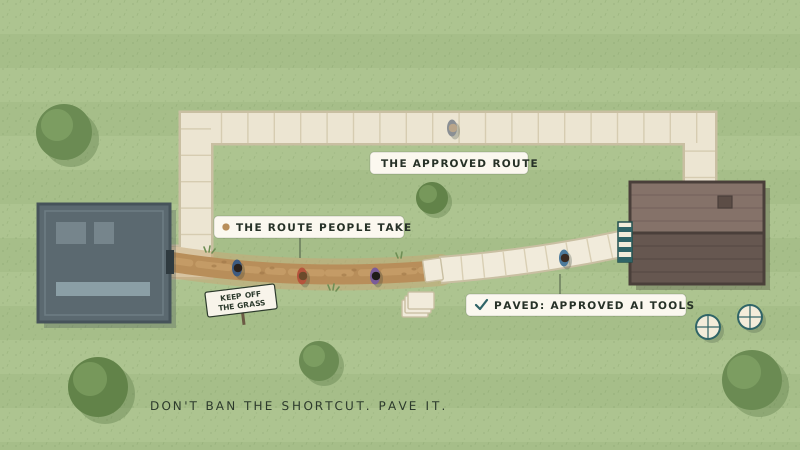
The concern is valid for consumer tools. On free and personal tiers, conversations can be used to improve models unless the user switches that setting off, and few employees ever do. With nearly four in five AI users bringing their own tools to work, many businesses already carry this exposure without realising it. A policy that bans public AI rarely ends the behaviour; it usually just moves it onto personal phones.
Custom AI built properly works on different terms. It runs inside a walled garden, governed by enterprise contracts rather than consumer terms of service, with three protections that matter most.
Zero data retention and no training. Business access to foundation models runs through enterprise agreements and APIs, not consumer apps. OpenAI states that it does not train its models on data from its API or business plans by default, and the other major providers make equivalent commitments for their commercial services. For sensitive workloads, zero data retention arrangements go further, so prompts and responses are processed but not stored. Your data informs the answer, and then it is gone.
Role-based access control (RBAC). The AI respects the permissions you already have. If a junior employee asks the internal assistant for the Managing Director's salary, the system cannot retrieve the payroll file, just as that employee could not open it on the company server. Microsoft documents the same principle for its own workplace assistant, which only surfaces organisational data that an individual already has at least view permission to access.
There is a practical catch worth knowing before you start. Because the AI honours existing permissions exactly, it also exposes permission mistakes. A board pack saved three years ago to a folder shared with "Everyone" was technically accessible but practically invisible. An AI assistant makes it findable in seconds. A permissions audit belongs in the first week of any serious deployment, not after launch.
GDPR and sovereign hosting. Bespoke systems can be hosted on UK or EU infrastructure, and the major model providers now offer regional data residency options. Add a data protection impact assessment, which the ICO's guidance on AI and data protection indicates is likely to be required wherever AI processes personal data, and HR and legal teams have a defensible compliance position rather than a hopeful one. Our guide to sovereign AI and GDPR for UK businesses covers the UK specifics.

What Custom AI Looks Like in Practice
The real shift is from chat to operations: from a tool people visit to a capability built into the way work already flows. Here is what that looks like from three seats at the leadership table.
For the HR Director
Before: the HR team answers the same thirty emails every week. How much maternity pay will I get? Can I carry over unused holiday? Is Easter Monday on top of my annual leave allowance? Each reply means finding the right clause in the right version of the handbook, then writing a careful answer.
After: an internal assistant sits inside Slack or Microsoft Teams, where staff already work. An employee asks in plain English at nine o'clock on a Sunday evening and receives the exact clause from the current handbook, with a link to the source. Anything sensitive or ambiguous, such as a grievance, a health disclosure or a question the documents cannot answer, is routed to a named person. HR stops being a helpdesk and gets its time back for strategic work: workforce planning, retention and culture.
For the Operations Manager
Before: three hours spent comparing twenty supplier quotes, each in a different PDF layout, to find the best margin. One supplier prices per metre and another per 25-metre coil; one buries its payment terms on page four.
After: the manager asks, "Compare these 20 quotes in a table and highlight which supplier offers the best net-30 terms for copper piping." The system extracts unit prices, normalises the units, pulls out payment terms and lead times, and returns a comparison table in minutes, with every figure linked back to the page it came from. The afternoon of drudgery becomes a short review. The judgement stays human; the retyping does not.
For the Managing Director
Before: waiting three days for a department head to turn last quarter's regional sales reports into a summary, by which time the question has moved on.
After: the MD asks a secure dashboard, "Summarise the Q3 revenue drop in the North West region and cross-reference it with our marketing spend." The system queries the sales and finance systems directly, pulls the regional figures alongside campaign spend, and returns a short narrative with the underlying numbers attached.
One design point matters here. For numerical questions, a well-built system reads figures from your system of record, whether that is the ERP, the CRM or the finance platform, and calculates from them. It never asks a language model to remember or estimate a number. The model writes the explanation; your systems supply the arithmetic. That separation is what makes the answer fit to take into a board meeting.
It Doesn't Cost Millions Anymore
A few years ago, "AI that knows our business" was assumed to mean building or retraining a model of your own, with a team of machine learning scientists and a budget to match. That is no longer how it is done. The foundation model is rented by the token from providers such as OpenAI, Anthropic and Google. What an agency builds is the connective tissue: the integrations, permission layer, search, citations and guardrails that link those models safely to your data.
That puts a first deployment within reach of the mid-market. Our UK guide to AI development costs places focused internal tools in the £15,000 to £40,000 range, with multi-system builds connected to live business data typically between £40,000 and £120,000.
Now set that against the cost of standing still. Take a 60-person business. If staff spend half the time Atlassian's research suggests searching for information, roughly an eighth of the working week, and a custom assistant recovers just a fifth of that, the business gets back the equivalent of 1.5 full-time roles every year. Add the internal support tickets that no longer need a human and the documents that no longer need processing by hand, and the case rarely depends on heroic assumptions. Our framework for measuring AI ROI shows how to test it against your own numbers.
The Next Step for Your Business
The divide in business is no longer between companies that use AI and companies that don't. Almost everyone uses it now. The divide is between those using AI as a public calculator, useful but generic and disconnected from how the business runs, and those who have integrated it as the central nervous system of their private operations: connected to their data, respectful of their permissions and accountable for every answer it gives.
If you want to see what that looks like with real documents rather than a slide deck, book a discovery call with AI Native Agency. We will show you a live demonstration of a secure custom AI querying private business data, citing its sources and declining what it should not answer, and help you identify the first use case worth building.
Frequently Asked Questions
- What is the difference between ChatGPT and custom AI?
- ChatGPT answers from general knowledge learned during training, plus whatever you paste into the conversation. Custom AI connects the same kind of model to your internal systems, retrieves the relevant documents for each question, respects user permissions and cites its sources. The first is a general-purpose assistant; the second is an operational tool that knows your business.
- Can ChatGPT be trained on my company's data?
- You can upload files to ChatGPT, and its business plans offer connectors to common workplace tools, which suits individuals and small teams with simple needs. For company-wide use, most businesses do not retrain a model at all. They connect a model to their data at the moment each question is asked, which keeps answers current as documents change, respects access permissions and avoids baking sensitive information into a model.
- Is it safe to put company data into ChatGPT?
- Not on a personal account. Consumer versions can use conversations to improve models unless the user turns that setting off, so sensitive data should never be pasted into free or personal tiers. Business plans and API access carry contractual commitments not to train on your data by default, and a custom build adds permission controls, audit logs and UK or EU hosting on top.
- Is custom AI GDPR compliant?
- It can be, but compliance comes from the design rather than the label. The essentials are UK or EU hosting where required, a lawful basis for processing, data processing agreements with every provider, permission-aware retrieval, and a data protection impact assessment where personal data is involved, which ICO guidance indicates is likely for AI systems that process it.
- Does custom AI stop hallucinations completely?
- No system eliminates errors entirely. Grounding every answer in retrieved documents, requiring citations and instructing the model to decline when sources are missing substantially reduces fabricated answers, and makes the remaining errors visible and checkable. For high-stakes decisions such as pay, disciplinary matters or contractual commitments, keep a human review step.
- What is the technical term for AI that answers from company documents?
- Engineers usually call it retrieval-augmented generation, or RAG: the system retrieves relevant material from your sources and passes it to the model, which generates an answer from it. The term is useful when comparing suppliers, but the questions that matter more are about permissions, citations, hosting and what the system does when it cannot find an answer.
- How long does it take to build a custom AI assistant?
- A focused first deployment, such as an HR policy assistant in Microsoft Teams connected to a single knowledge base, can typically be delivered in weeks rather than months. Timelines grow with the number of systems connected, the state of your documents and permissions, and the depth of security review your organisation requires.
- Do we need to clean up our data before building a custom AI?
- Usually a little, and it is worth doing. Outdated duplicates, conflicting policy versions and over-shared folders all reduce answer quality or create exposure. Most projects begin with an audit of the chosen sources and their permissions, and many businesses find that exercise valuable in its own right.
- Will custom AI replace HR or operations staff?
- In most deployments it removes repetitive retrieval work rather than roles. HR teams stop answering the same policy questions every week, and operations managers stop retyping figures from supplier PDFs. The time recovered typically moves to work that needs human judgement, such as employee relations, supplier negotiation and planning.