Guides
The 2026 AI Maturity Scorecard: In 10 Minutes Find Out Exactly Where Your UK Business Stands
10 min read
Take a 10-minute AI maturity assessment for UK businesses and score your data, operations, culture, and governance to see whether you are lagging, emerging, or already agentic.
✦Key Takeaways
- Score your UK business across four pillars — data readiness, workflow automation, talent & culture, and governance — to identify your AI maturity tier.
- Three maturity tiers: Legacy (score 0–8), Emerging (9–16), and Agentic (17–24) — each with a specific action plan to advance.
- Most UK businesses in 2026 score in the Emerging tier: they have AI pilots running but lack the governance and data infrastructure to scale.
- The governance pillar is the most commonly failed — UK businesses often adopt AI tools before establishing compliance, oversight, and audit frameworks.
- A 10-minute self-assessment replaces expensive consulting engagements for the initial diagnostic — saving £5K–£15K in discovery fees.
March 2026 has made the split impossible to ignore. Some UK businesses have integrated AI into core operations and decision-making. Others are still running scattered pilots, isolated chat tools, and one-off experiments that never touch the P&L.
For mid-market manufacturers, law firms, consultancies, and service businesses, the real question is no longer whether anyone in the building uses AI. It is whether your organisation is mature enough to turn AI into margin, speed, resilience, and better client delivery.
According to the UK Government’s latest AI Adoption Report, the productivity gap between AI-native firms and traditional firms has widened over the past year. This scorecard gives you a fast, unvarnished way to see where your business actually stands.
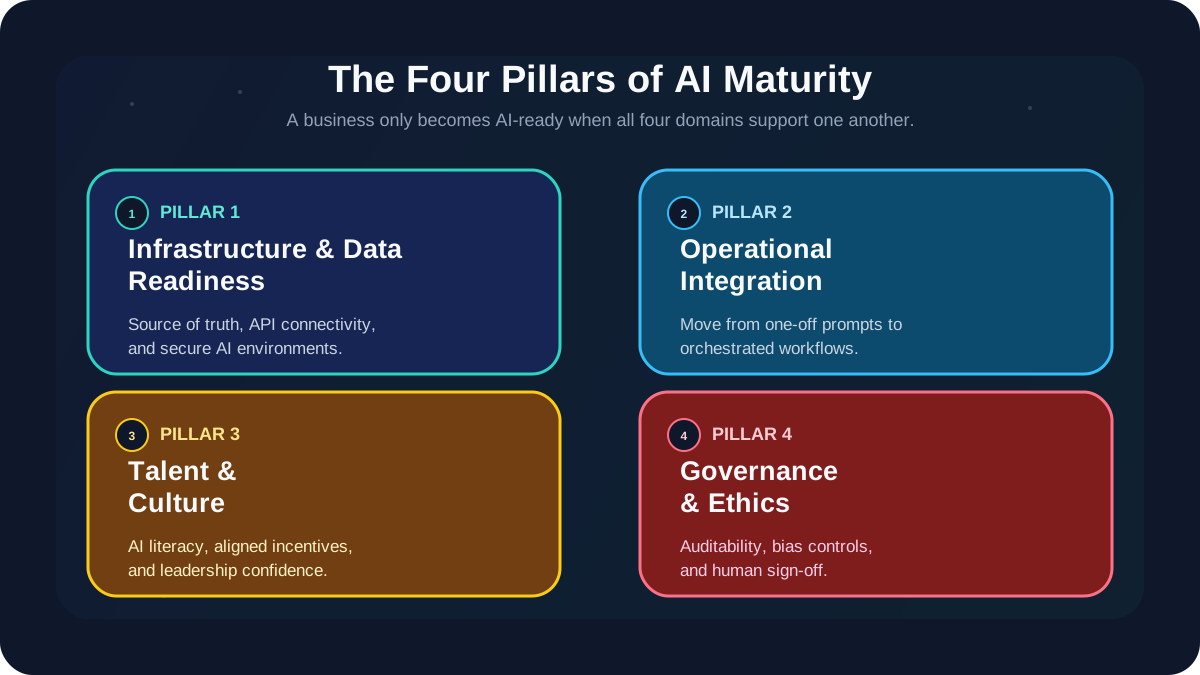
The Four Pillars of AI Maturity
To move beyond random acts of AI, a business needs strength in four separate domains. Score each pillar from 1 to 5 as you read. A low score in one area will drag the rest of the system down.
Pillar 1: Infrastructure & Data Readiness
Without a clean data spine, your AI is just a hallucination machine.
- Data centralisation: Is your ERP, CRM, project, and finance data available through a reliable source of truth, or buried across spreadsheets and PDFs?
- API connectivity: Can your core systems exchange information automatically, or are staff still acting as the middleware?
- Security protocols: Do you have a private environment for sensitive AI workflows, or are employees putting proprietary client material into public tools?
Score this pillar: 1 for fragmented and risky, 5 for unified and secure.
Pillar 2: Operational Integration
Moving from chatting with AI to running workflows through it.
In 2026, the real benchmark is agentic workflow orchestration. Mature businesses are no longer asking AI to draft one email or summarise one document. They are using it to monitor, interpret, escalate, and coordinate across whole sequences of work.
- Automation depth: Are you only using AI for isolated tasks, or for end-to-end workflow execution?
- Tooling: Are you relying on generic wrappers, or have you built retrieval and reasoning layers tuned to your own industry language and operating constraints?
- Decision support: Does AI produce real-time recommendations for operations and leadership, or is it still trapped inside one department?
Score this pillar: 1 for manual and siloed, 5 for agentic and measurable.
Pillar 3: Talent & Culture
AI maturity is a management challenge before it is a technical one.
The biggest blocker in legacy businesses is often the frozen middle: managers who understand enough to feel threatened, but not enough to redesign work. If your team hides AI usage or treats it like a side project, maturity stalls fast.
- AI literacy: Are staff trained in prompting, review, and agent orchestration, or self-teaching in a vacuum?
- Incentives: Are people rewarded for automating low-value work, or quietly punished because it reduces visible effort?
- Leadership buy-in: Does the board treat AI as a revenue and productivity lever, or as a vague IT expense?
Score this pillar: 1 for resistant, 5 for empowered.
Pillar 4: Governance & Ethics
Compliance becomes a competitive advantage once AI touches real operations.
With the UK’s AI Regulation Bill shaping the operating environment, businesses that cannot explain how their systems reach decisions expose themselves to legal, commercial, and reputational risk.
- Auditability: Can you trace an AI output back to the source systems and prompts that informed it?
- Bias monitoring: Do you actively test for hallucinations, drift, and biased outputs in regulated or high-trust workflows?
- Human-in-the-loop: Is there a crisp rule for which decisions stay autonomous and which require sign-off?
Score this pillar: 1 for wild west, 5 for governance-first.
The 10-Minute Assessment
Now score your organisation from 1 for strongly disagree to 5 for strongly agree against the ten statements below.
- We have a clear, documented AI roadmap for the next 12 months.
- Our data is cleaned, structured, and ready for agentic AI to process.
- We have identified at least three high-ROI workflows that are actively being automated.
- Employees feel more excited about AI making work easier than fearful of replacement.
- We do not use public AI tools for sensitive business operations.
- Leadership meets regularly to review AI integration and impact.
- We have moved beyond simple chatbots and are testing autonomous agents.
- We can measure time saved, cost removed, or revenue generated by current AI systems.
- Our industry-specific know-how is being captured into a digital brain or knowledge layer.
- We are ahead of our closest UK competitors in AI adoption.
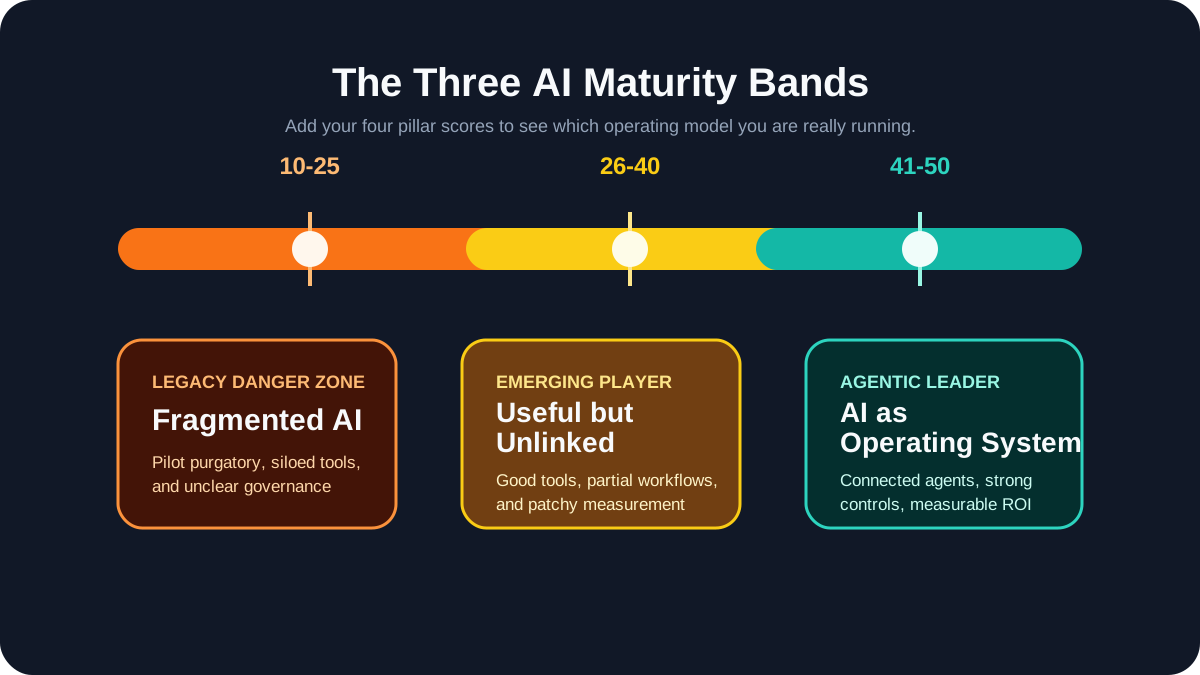
The Results: Where Do You Stand?
10–25: The Legacy Danger Zone
If you land here, your business is still vulnerable to disruption. AI is probably being used in a fragmented, shadow-IT way, while competitors are learning how to connect models, data, and workflows into operating leverage.
Your priority is not another experiment. It is a foundation rebuild. Start with a structured roadmap such as The AI Maturity Roadmap for Legacy UK Businesses.
26–40: The Emerging Player
You have cleared the first hurdle. Leadership is paying attention, some data is usable, and there are signs of traction. The risk is that AI still behaves like a collection of tools rather than an operating model. Your next step is orchestration: linking systems and workflows so AI produces measurable commercial outcomes instead of isolated efficiency wins.
41–50: The Agentic Leader
You are ahead of most of the market. Your challenge is no longer adoption but scale, governance, and competitive defence. At this stage, you should be strengthening your digital brain, expanding cross-functional agents, and learning from patterns in agentic AI operating models.
Why Mid-Market UK Firms Are Still Struggling
Research from Gartner reinforces the same pattern we see in practice: AI projects do not usually fail because models are weak. They fail because scope drifts, ownership is unclear, and the solution never becomes specific enough to the operating reality of the business.
A factory in Leeds does not need a generic chatbot. It needs an agent that understands maintenance logs, production tolerances, supply chain constraints, and the cost of downtime. A financial or legal team in Bristol does not need novelty. It needs systems that respect FCA obligations, document trails, and sign-off logic.
That is why the scorecard matters. It reveals where maturity breaks down. But closing the gap still requires moving from experimentation to engineering.
From Score to Strategy
Legacy businesses still hold one major advantage: history. You already have the operational data, client context, and domain expertise that newer entrants would struggle to replicate. When that human knowledge is captured into structured data flows, governed prompts, retrieval systems, and specialised agents, it becomes a moat.
Use this scorecard as a working session with leadership. Be honest about your weakest pillar, identify the next three workflows worth automating, and decide what governance must exist before you scale further. That is how you stop treating AI like a side experiment and start treating it like an operating capability.
If your score came in lower than expected, that is not a reason to wait. It is the reason to act while the gap is still bridgeable.
Frequently Asked Questions
- What is an AI maturity scorecard?
- An AI maturity scorecard is a structured assessment that benchmarks your business across key dimensions — data readiness, workflow automation, talent & culture, and governance — producing a score that maps to a maturity tier (Legacy, Emerging, or Agentic) with specific next steps.
- How do I assess my company's AI readiness?
- Score yourself 0–6 on four pillars: data infrastructure (quality, accessibility, pipelines), workflow automation (manual vs automated processes), talent & culture (AI literacy, experimentation), and governance (compliance, oversight, audit trails). Total your score to identify your tier.
- What are the stages of AI maturity for businesses?
- Three stages: Legacy (0–8 points) — ad-hoc AI usage with no strategy; Emerging (9–16) — active pilots with partial automation but governance gaps; Agentic (17–24) — AI-first operations with autonomous workflows, strong data pipelines, and enterprise governance.
- Why do most UK businesses fail at AI adoption?
- Most UK businesses stall in 'pilot purgatory' because they adopt AI tools before building the foundational data infrastructure and governance frameworks needed to scale. The governance pillar is the most commonly failed dimension in 2026 assessments.
- How long does an AI maturity assessment take?
- This self-service scorecard takes approximately 10 minutes to complete and provides an immediate maturity tier classification with actionable recommendations — replacing the need for an initial £5K–£15K consulting discovery engagement.
Ready to put AI to work for your business?
Let's discuss how we can apply these principles to your specific challenges.
Book Your 15-Minute Strategy Call with our Lead ArchitectRelated Articles
Guides
Building AI Agents That Actually Work With Your Existing Stack (Shopify, Xero, Sage, HubSpot, EMIS & More)
ReadGuides
AI-Native Agency vs Freelance AI Engineer vs Big Consultancy: The 2026 UK Cost & Speed Matrix
ReadGuides