AI Trends
What Are AI Native Voice Agents? And How They Differ from Traditional Voice AI
10 min read
AI native voice agents replace the brittle transcribe, classify, respond pipeline of traditional voice AI with a single model that hears, reasons, and acts in one pass. This guide explains what AI native voice agents are, how they work, and the concrete ways they differ from legacy IVR and chained voice bots.
✦Key Takeaways
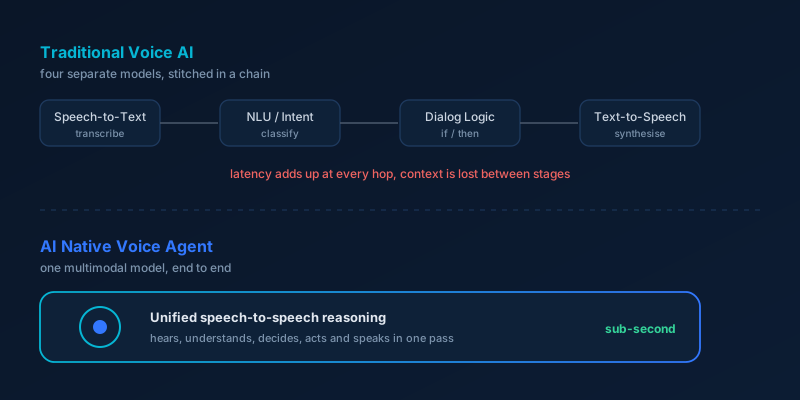
- Traditional voice AI is a chain of four separate systems: speech-to-text, natural language understanding, scripted dialog logic, and text-to-speech. Each hop adds latency and discards context.
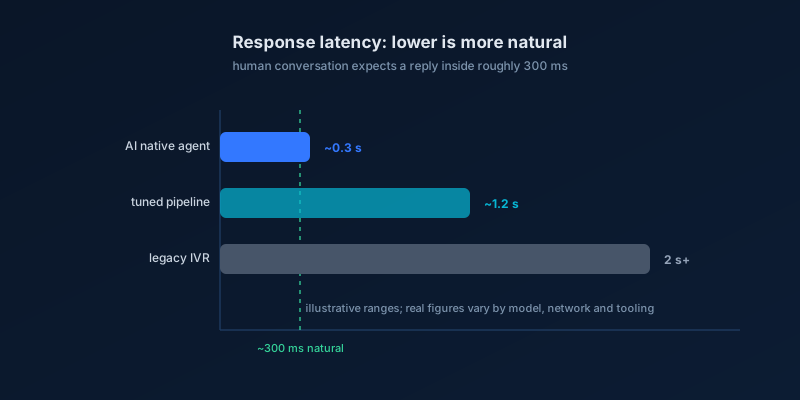
- AI native voice agents collapse that chain into a single multimodal model that listens, reasons, and responds in one pass, often replying in roughly the 300 milliseconds humans expect.
- The defining difference is not better speech recognition; it is that the agent understands intent, holds context across the whole conversation, and can take actions rather than reciting scripted branches.
- Speech-to-speech models preserve tone, interruptions, and emotional nuance that are flattened the moment legacy systems convert audio to plain text.
- AI native agents handle the unscripted middle of a conversation: clarifying questions, topic changes, and messy real-world phrasing that break decision-tree IVR.
- The real deployment work is integration and guardrails: connecting the agent to your CRM, booking systems, and knowledge base, with a human-in-the-loop path for high-stakes calls.
- Voice is becoming an action layer, not just an answer layer; the agent that books the appointment beats the one that only reads out opening hours.
You already know what traditional voice AI feels like. You call a company, a synthetic voice asks you to press 1 for sales or say your account number, you say it, and you hear: sorry, I did not catch that. You repeat yourself slower, then louder, then you mash the zero key hoping a human will rescue you. That stilted, brittle experience defined automated phone systems for twenty years.
Something genuinely different is now answering those calls. AI native voice agents can hold a flowing conversation, understand a caller who changes their mind halfway through a sentence, and actually complete a task such as rebooking an appointment before the call ends. They do not feel like a smarter menu. They feel like talking to a capable person who happens to be software.
The gap between the two is not a matter of degree. It is a different architecture built on a different assumption about how machines should handle speech. This guide explains what AI native voice agents actually are, how they work under the hood, and the concrete ways they differ from the traditional voice AI and legacy IVR systems most businesses still run.
How Traditional Voice AI Actually Works
Traditional voice AI is not one system. It is a relay race between four separate systems, each handing off to the next. Understanding that chain is the key to understanding why the old experience feels the way it does.
The pipeline runs in four stages: speech-to-text transcribes the caller's audio into written words; natural language understanding (NLU) tries to match that text to one of a fixed set of predefined intents, such as "check balance" or "book appointment"; a dialog manager follows a scripted decision tree to decide what to say next; and finally text-to-speech converts the chosen script back into spoken audio. Four models, four handoffs, one conversation.
Legacy interactive voice response, the press-1-for-sales menu, is the most rigid version of this. Even the more modern voice bots that let you speak naturally still sit on the same skeleton: transcribe, classify into a known bucket, play a pre-written response. The intelligence is mostly a flowchart that someone drew in advance.
Why the Pipeline Breaks Down
Three weaknesses are baked into that chain. First, latency accumulates at every handoff. Each stage has to finish before the next can start, so the caller waits through the sum of four processing delays, which is what creates those unnatural pauses before the system replies.
Second, context is thrown away at the very first step. The moment audio becomes plain text, everything else in the speech is gone: the hesitation, the rising panic, the sarcasm, the half-finished correction. The downstream stages reason about a flattened transcript, not a human being talking.
Third, the system is brittle to anything it was not scripted for. If the caller phrases a request in a way the intent classifier has not seen, or asks two things in one breath, or interrupts, the flowchart has no branch for it. That is the precise moment the old voice bot says sorry, I did not catch that, and the caller starts hunting for a human.
What AI Native Actually Means for Voice
An AI native voice agent is built the opposite way. Instead of stitching four narrow components together, it is built around a single large multimodal model that handles the whole conversation. The model takes in spoken audio, works out what the caller wants, decides what to do, and produces a spoken reply, all within one system that was designed for this from the start rather than retrofitted from a text chatbot.
The word native matters here. An AI enhanced voice product bolts a language model onto the old pipeline, often just swapping the scripted dialog manager for a smarter one while keeping the separate transcription and speech stages. An AI native voice agent treats the model as the core of the system, with everything else, including connections to your business tools, arranged around it. That architectural choice is what unlocks every difference that follows.
Speech-to-Speech, Not Speech-to-Text-to-Speech
The clearest example is the rise of speech-to-speech models. Rather than forcing audio through a text bottleneck and back, these models process spoken input and generate spoken output much closer to the raw audio. OpenAI's Realtime API and similar real-time systems are designed exactly for this low-latency, audio-in audio-out pattern.
Why does that matter? Because human conversation runs on tight timing. A widely cited cross-language study published in PNAS found that the gap between conversational turns averages around 200 to 300 milliseconds across cultures. Beat that window and the exchange feels natural; miss it by a second and the caller senses they are talking to a machine. Collapsing the pipeline into one model is how AI native agents get close to that human rhythm.
Five Ways AI Native Voice Agents Differ from Traditional Voice AI
The architecture is abstract; the differences callers and businesses feel are concrete. Here is the split across the five dimensions that matter most.
| Dimension | Traditional Voice AI | AI Native Voice Agent |
|---|---|---|
| Latency | Often over a second; audible pauses | Roughly 300 to 800 ms; near-human |
| Comprehension | Matches to fixed intents | Understands free-form language |
| Memory | Per-turn; forgets earlier context | Holds context across the whole call |
| Capability | Reads scripted answers | Takes actions via tools and APIs |
| Nuance | Tone lost at transcription | Preserves tone and interruptions |
1. Latency and Natural Turn-Taking
Because there is no four-stage relay, the agent can begin formulating a response while the caller is still finishing their sentence, and it can be interrupted mid-reply without falling over. The result is overlap, back-channelling, and quick clarifications, the texture of a real conversation rather than a walkie-talkie exchange of fixed turns.
2. Understanding Versus Matching
Traditional NLU asks a narrow question: which of my known intents is this closest to? An AI native agent asks a broader one: what is this person actually trying to achieve? It can handle a caller who says I think I booked the wrong day, it might be the Tuesday, actually no, the one after the bank holiday, without needing that exact phrasing to exist in a training set of intents.
3. Memory and Context Across the Call
Scripted systems treat each turn in isolation, which is why they ask you for your account number three times. An AI native agent carries the full conversation in its working context, so a detail mentioned in the first ten seconds still informs its answer two minutes later. It can also draw on prior interactions and account data when connected to your systems.
4. Action, Not Just Answers
This is the difference that produces business value. A traditional voice bot reads out your opening hours. An AI native agent connected to your booking system, CRM, and knowledge base can check live availability, move the appointment, send the confirmation, and log the change, all inside the call. Voice stops being an answer layer and becomes an action layer.
5. Tone and Emotional Nuance
Because speech-to-speech models work close to the audio, they can pick up that a caller sounds frustrated or confused and adjust, slowing down, softening, or escalating to a human. They can also produce speech with appropriate emphasis and warmth rather than the flat cadence of a synthesised script. The nuance that traditional systems delete at the transcription step survives.
Where AI Native Voice Agents Earn Their Keep
The strongest use cases share a shape: a high volume of natural conversations that need to end in a concrete action. Inbound customer service is the obvious one, where an agent can resolve routine queries end to end instead of collecting details and handing off. We cover this in depth in our guide to AI voice agents for UK customer service.
Appointment booking and rescheduling is a natural fit for clinics, salons, and trades, where the agent owns the diary and the call ends with a real change. Lead qualification lets sales teams answer every inbound call instantly, ask the right questions, and route hot leads to humans. After-hours coverage means the line is never dead, which matters most for businesses whose customers call outside nine to five.
A useful way to think about the boundary: a voice agent is to an old phone menu what an AI agent is to a basic chatbot. If that distinction is fuzzy, our explainer on chatbots versus AI agents for UK businesses draws the same line in the text channel.
What It Actually Takes to Deploy One
The model is the easy part. The work that determines whether an AI native voice agent succeeds is everything around it. Integration comes first: the agent is only as capable as the systems it can reach, so connecting it to your CRM, booking platform, payment tools, and knowledge base is what turns a good conversationalist into a useful colleague.
Guardrails come next. A model that can take actions can take wrong ones, so high-stakes calls need confidence thresholds, scoped permissions, and a clean escalation path to a person. This is the human-in-the-loop discipline that separates a production deployment from a demo: the agent removes the queue, not the people who handle the hard cases.
Finally, voice agents need ongoing evaluation. You cannot ship one and walk away. Real calls surface accents, edge cases, and phrasings nobody scripted, so the loop of reviewing transcripts, measuring resolution rates, and refining prompts and tools is what compounds quality over the first few months of live traffic.
The Bottom Line
Traditional voice AI was a flowchart that could talk. It transcribed your words, matched them to a script, and read an answer back, dropping context and racking up latency at every handoff. AI native voice agents replace that relay with a single model that hears, reasons, and acts in one continuous pass, close to the rhythm and nuance of human conversation, and able to finish the job rather than just describe it.
For most customer-facing phone work, that is not an incremental upgrade; it is the difference between deflecting callers and actually serving them. If your business still runs on a menu that frustrates the people you most want to keep, an AI native voice agent is the upgrade worth scoping next. Our team designs and deploys these systems for UK businesses, integrated with the tools you already run.
Frequently Asked Questions
- What is an AI native voice agent?
- An AI native voice agent is a voice system built around a single large multimodal model that processes spoken audio directly, reasons about what the caller wants, and responds in natural speech, often calling business tools to complete tasks along the way. Unlike traditional voice AI, it is not assembled from separate transcription, intent-matching, and text-to-speech components, so it keeps context and tone across the entire conversation.
- How is an AI native voice agent different from a traditional IVR or voice bot?
- A traditional IVR or voice bot follows a scripted decision tree: it transcribes speech, matches it to a predefined intent, then plays a pre-written response. An AI native voice agent understands free-form language, handles interruptions and topic changes, remembers earlier parts of the call, and can take real actions such as booking an appointment or updating a record. The legacy system recites branches; the AI native agent holds a conversation.
- What is a speech-to-speech model?
- A speech-to-speech model is an AI model that takes spoken audio as input and produces spoken audio as output without forcing everything through an intermediate text bottleneck. Because it works closer to the raw audio, it can react faster and preserve signals such as tone, emphasis, and pauses that are lost when speech is flattened into plain text and back again.
- Are AI native voice agents better than traditional voice AI?
- For open-ended, customer-facing conversations they are usually far better because they handle unscripted language, lower latency, and real actions. For extremely narrow, high-volume, strictly regulated flows where every word must be fixed, a deterministic traditional system can still be appropriate. The right answer depends on how much conversational flexibility and integration the use case needs.
- What latency do AI native voice agents achieve?
- The best real-time AI native voice agents respond in roughly 300 to 800 milliseconds, close to the natural human turn-taking gap of about 300 milliseconds. Traditional pipelines that chain separate speech-to-text, logic, and text-to-speech stages typically land north of a second, which is what creates the awkward, robotic pauses callers associate with older voice bots.
- Where do AI native voice agents deliver the most value for businesses?
- The strongest use cases are inbound customer service, appointment booking and rescheduling, lead qualification, and after-hours coverage, anywhere a high volume of natural conversations needs to end in a concrete action. The value comes from resolving the call end to end rather than collecting information and handing off to a human or a form.
- Do AI native voice agents replace human agents?
- In most deployments they augment rather than replace people. They resolve routine, repetitive calls end to end and free human agents for complex, sensitive, or high-value conversations, with a human-in-the-loop escalation path for anything outside the agent's confidence or authority. The goal is to remove the queue, not the people.