Most AI products fail because someone bolted a chat box onto existing software and called it a copilot. These ten are different: each one breaks completely without the model, attacks work businesses already pay people to do badly, and is buildable by a small team. Includes the removal test for spotting a real product, and a five-question scorecard for choosing which to build.
✦Key Takeaways
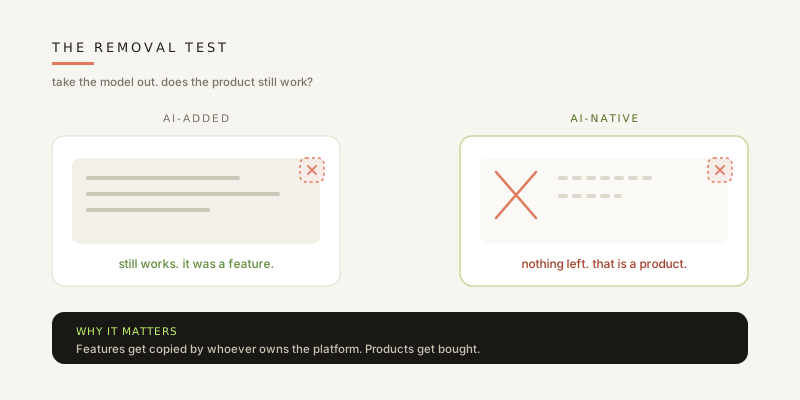
- An AI-native product breaks completely without the model. If removing the AI leaves a working product, you built a feature, not a product.
- The best opportunities sit where messy, unstructured input meets an expensive human bottleneck: documents, calls, applications, tenders.
- Vertical beats horizontal. A generic summariser competes with everything; a subcontractor invoice engine for construction competes with nothing.
- The moat is rarely the model, which everyone rents. It is your workflow, your evaluation set, your integrations and your accumulated domain judgement.
- Prefer problems with checkable outputs and survivable failures, so trust builds quickly rather than collapsing on one bad answer.
- Price on the outcome the buyer already pays humans for, not on tokens or seats.
Most AI product ideas fail the same test. Someone bolts a chat box onto an existing tool, calls it a copilot, and discovers six months later that customers used it twice. The problem is not the model. It is that the product was designed as a feature added to software rather than as software that could not have existed two years ago.
An AI-native product is different in kind. Remove the model and the product stops working entirely, because the model is doing something no amount of conventional code could do: reading messy documents, understanding intent, deciding what to do next. That distinction is the difference between a nice-to-have and a line item nobody cancels.
The ten ideas below are chosen on three criteria: the underlying work is expensive and repetitive today, the output is checkable so errors surface fast, and there is a defensible position for whoever builds it well. Each is buildable by a small team, and each has a real buyer with a budget.
What Makes a Product AI-Native
Three properties separate an AI-native product from AI-flavoured software.
The model does the core job. Not summarising a screen, but performing the task the customer is paying for: reading the claim, drafting the bid, scoring the account. If your AI is a convenience layer, the first competitor to build it as the core loop will beat you.
The interface fits the work. The best AI products rarely look like a chat window. They look like a completed draft in a folder, an updated record, a flagged exception in a queue. Chat is a fallback interface, not a default.
It improves with use. Every correction becomes an example, every exception a rule. That compounding is what turns a product into a position rather than a demo.
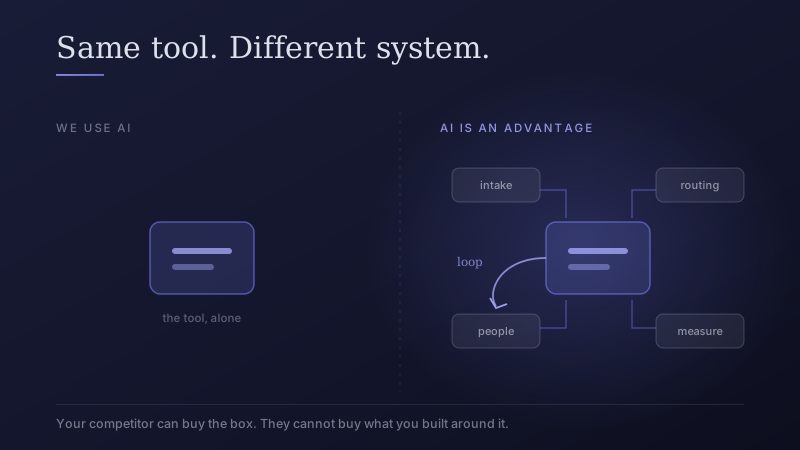
Two things you do not need: your own model, or a rebuilt system of record. The overwhelming majority of viable products are a thin, well-designed layer over existing tools, using frontier models via API and toolkits like the Vercel AI SDK. Which is exactly why speed matters more than scale here, a point we made in building an AI-native SaaS in six weeks.
1. The Vertical Document Intake Engine
Every industry has a document tax. Construction has subcontractor invoices and delivery notes. Insurance has claim packs. Logistics has proof of delivery. Clinics have referral letters. The documents arrive as PDFs, phone photographs and scans, and somebody keys them into a system by hand.
The product reads them on arrival, extracts the fields that matter, validates against existing records, files the original and flags anything uncertain to a human queue. Not a general OCR tool: one industry, one document set, deeply understood.
Who buys it: operations managers drowning in admin at firms with 20 to 500 staff. Why now: modern models read bad photographs of creased paper, which OCR never managed. The moat: the exception rules and edge cases you accumulate in one vertical, which a generalist tool cannot match.
2. Ask Your Own Company
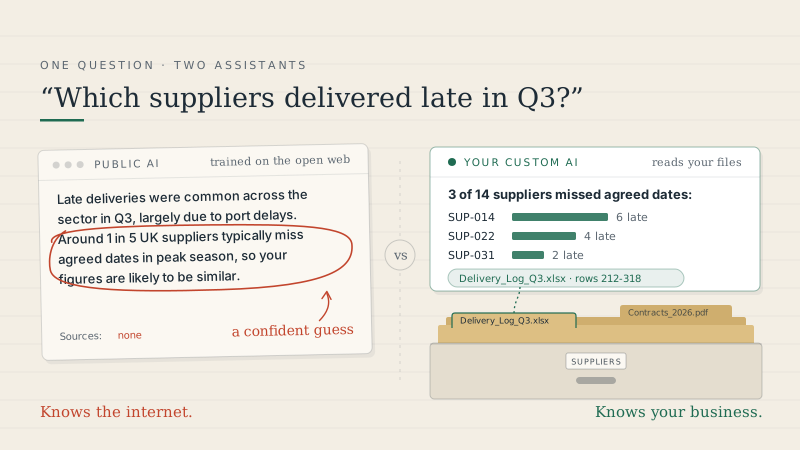
Every business over about thirty people has lost track of what it knows. The answer to a customer's question sits in a two-year-old ticket, a contract clause, a Slack thread, and a wiki page nobody has opened since the author left.
The product indexes those sources and answers questions with citations, so staff stop interrupting colleagues and stop guessing. The interface belongs where people already work, not in a separate destination.
Who buys it: operations and support leads at 50 to 500 person firms. Why now: retrieval quality crossed the usefulness threshold, and the retrieval architecture choices now genuinely matter, which we covered in advanced RAG versus long context windows. The moat: permissions done properly, plus the feedback loop of which answers were actually right.
3. The Bid and Tender First-Draft Engine
UK professional services, construction and facilities firms spend enormous unbilled effort on tenders. A bid team reads a 60-page ITT, finds the questions, hunts for what they wrote last time, and reassembles it under deadline.
The product ingests the tender, extracts every question and requirement, drafts each answer from the firm's library of past winning submissions and case studies, and flags the gaps a human must fill. Win rates barely move; the cost of bidding halves.
Who buys it: bid managers and directors at firms where tendering is a permanent cost of doing business. Why now: long-context models can hold a full tender and a response library at once. The moat: the client’s own winning-answer corpus, which improves with every submission.
4. The Continuous Compliance Monitor
Regulated firms discover compliance gaps during audits, which is the most expensive possible moment. The obligations live in regulations and standards; the evidence lives in policies, procedures and records that drift apart over time.
The product maps obligations to the documents that satisfy them, watches for changes on both sides, and produces a live gap list with the evidence attached. Think UK GDPR, ISO 27001, FCA rules, CQC standards.
Who buys it: compliance and quality managers, plus any firm whose contracts require certification. Why now: models can read a regulation and a policy and reason about whether one satisfies the other. The moat: the mapping itself, plus audit trails regulators accept, which needs the discipline set out in our agentic governance blueprint.
5. The Inbound Voice Agent for Appointment Businesses
Dentists, garages, salons, veterinary practices, letting agents and trades all lose money the same way: the phone rings while everyone is busy, and the caller books with someone else.
The product answers every call, understands the request, checks live availability, books or reschedules, takes a deposit if needed, and escalates anything unusual to a human with a summary. It has to hold a natural conversation and write to the real diary, which is what separates it from the phone trees everyone hates.
Who buys it: owner-operators of appointment-driven businesses. Why now: latency and voice quality crossed the point where callers stop noticing, as we explored in AI-native voice agents. The moat: deep integration with the specific booking systems each trade actually uses.
6. Quote From a Photograph
In trades and light manufacturing, quoting is the bottleneck on growth. Someone visits a site, takes photographs, measures, then spends an evening producing an estimate. Jobs are lost to whoever quotes first.
The product takes photographs plus a short description, identifies the work, applies the firm's own rate card and material costs, and produces a priced, branded quote for review in minutes. It should be wrong sometimes and obviously so, with the human confirming before anything reaches a customer.
Who buys it: roofing, landscaping, electrical, fit-out and similar firms. Why now: vision models can identify materials and conditions from ordinary phone photographs. The moat: each firm’s pricing logic, which is genuinely proprietary and improves as quotes are corrected.
7. The Account Early-Warning System
Subscription businesses lose customers who were visibly drifting for months. The signals exist across product usage, support tickets, invoice behaviour and the tone of email threads, but nobody reads all four for every account.
The product watches all of it continuously, scores risk and opportunity, and hands the account manager a prioritised list with the evidence and a suggested action. The value is not the score. It is that a portfolio of 400 accounts finally gets the attention that only 20 used to receive.
Who buys it: heads of customer success at SaaS and subscription firms. Why now: models can read qualitative signals like sentiment in a thread, which no dashboard ever captured. The moat: the outcome data linking early signals to what actually happened.
8. The Natural Language Layer Over Legacy Systems
Many UK businesses run on systems that work perfectly and report terribly: an ageing ERP, a practice management system, a bespoke database built in 2009. Getting a straightforward answer requires a specialist and a queue.
The product sits on top, translates questions into the queries those systems understand, and returns answers with the figures traceable to source. It changes nothing underneath, which is precisely why it can be sold to a risk-averse buyer.
Who buys it: operations and finance directors held hostage by a system nobody wants to replace. Why now: models generate reliable structured queries when constrained to a known schema. The moat: the schema knowledge and query patterns per system, and the trust that comes from never writing to the database.
9. The Contract Obligation Tracker
Businesses sign contracts and then forget what they promised. Notice periods lapse, service credits go unclaimed, auto-renewals trigger, obligations sit unmet until a dispute makes them expensive.
The product reads every contract, extracts obligations, dates and liabilities into a live register, and alerts the responsible owner before deadlines rather than after. For most buyers the first run pays for the product, because it surfaces at least one renewal or entitlement nobody was tracking.
Who buys it: finance directors, procurement leads and operations managers. Why now: extraction accuracy on long legal documents is now good enough to be trusted with review. The moat: the obligation taxonomy and the integrations that turn an alert into an action.
10. The Personalised Lifecycle Engine for Ecommerce
Most independent retailers send the same email to everyone. True personalisation was always possible in theory and impossible in practice, because nobody had time to write a thousand variants.
The product generates and sends genuinely individual messages and on-site content based on each customer's behaviour, purchase history and stage, and tests continuously without a human writing every version. It works because both production and decision-making are cheap now, not just one of them.
Who buys it: ecommerce and direct-to-consumer brands past the point where manual segmentation collapses. Why now: generation and decisioning together, which we unpacked in hyper-personalisation at scale. The moat: the performance data feeding back into what gets generated next.
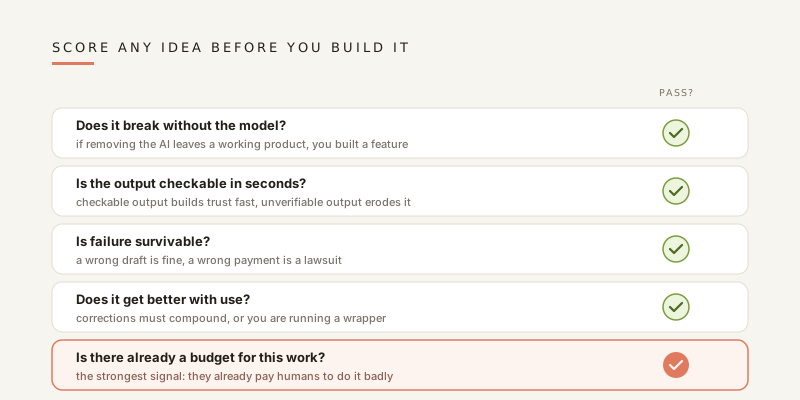
How to Choose One
Ten ideas are useless without a way to pick. Score any candidate against five questions, and be honest about the answers.
Does it break without the model? If removing the AI leaves a working product, you have a feature. Features get copied by whoever owns the platform.
Is the output checkable? Prefer problems where a human can tell in seconds whether the answer is right. Checkable output builds trust fast; unverifiable output erodes it.
Is failure survivable? Early products should not sit on irreversible actions. A wrong draft is fine. A wrong payment is a lawsuit.
Does it get better with use? If corrections do not improve the product, you are running a wrapper with no compounding advantage. Domain specificity is what compounds, which is the argument in domain-specific AI as a moat.
Is there an existing budget? The strongest signal is that the buyer already pays humans to do this work badly. You are replacing a cost line, not creating one. That also tells you how to price: on the outcome, with usage-based mechanics of the kind Stripe’s billing tooling now makes straightforward, rather than per seat.
For inspiration on where these gaps cluster, Y Combinator’s Requests for Startups is a useful pulse check on which categories investors expect to grow. But the better source is your own operational irritation: the process that everyone in your industry hates and nobody has fixed. Enrichment products, for instance, become viable in the UK largely because open sources like the Companies House API exist to build on.
Conclusion: Boring Problems, Excellent Products
The pattern across all ten is unglamorous. None of them is a new social network or a frontier model. Every one attacks work that already happens, that people already dislike, and that already has money attached to it.
That is the opportunity in an AI-native market. The technology is available to everybody, so the advantage goes to whoever picks the right problem, understands it more deeply than a generalist can, and ships something people use on a Tuesday morning without thinking about the AI at all.
If one of these maps onto a problem you already recognise in your own business or market, AI Native Agency takes ideas like these from concept to working product for UK businesses, usually in weeks rather than quarters.
Frequently Asked Questions
- What is an AI-native product?
- A product where the AI model performs the core job rather than assisting around the edges. Remove the model and the product stops working entirely. AI-added software, by contrast, keeps functioning without its AI features, which is why those features are easy for competitors and platforms to replicate.
- What is the best AI product idea for a small business to build?
- Whichever one attacks a process your industry already pays people to do badly, with output a human can check quickly. Vertical document intake and bid drafting are common starting points because the manual cost is visible, the buyer already has a budget, and errors surface immediately rather than silently.
- Do I need to train my own AI model?
- Almost never. Most viable products use frontier models through an API and compete on workflow, integrations, domain knowledge and evaluation quality. Training your own model is expensive, slow to maintain, and rarely the reason a customer chooses you over an alternative.
- What makes an AI product defensible if anyone can use the same models?
- Everything that is not the model: your proprietary or customer-specific data, the workflow you have refined, the integrations you have built, the evaluation set that tells you when quality drops, and the domain judgement encoded in your rules and exceptions. Those compound with use; the model does not.
- How do you price an AI-native product?
- Price against the cost of the work being replaced, not against your token spend. Outcome or usage-based pricing usually beats per-seat pricing, because value scales with volume processed rather than with the number of people logged in. Always model your inference cost per outcome before setting a price.
- How long does it take to build an AI-native product?
- A usable first version of most ideas here is weeks, not quarters, because the hard parts are integration and evaluation rather than model development. Production hardening, permissions and governance take longer, and should start before the first real customer rather than after.
- Should the product have a chat interface?
- Usually not as the primary interface. Chat requires the user to know what to ask, which caps adoption. Deliver finished outputs into the tools people already use: a draft in the inbox, a record updated, an exception in a queue. Keep chat as a secondary way in for open-ended questions.