Hyper-Personalization at Scale: How AI Is Making 1:1 Marketing Actually Possible
9 min read
The promise of 1:1 marketing has existed for decades. AI has finally made it structurally achievable. This guide explains the three technical layers behind hyper-personalization at scale, the UK GDPR architecture that enables it, and the practical steps UK businesses can take in the next 90 days.
✦Key Takeaways
Hyper-personalization uses real-time behavioural signals and AI to treat each customer as a unique segment, not just a demographic bucket.
McKinsey research shows companies that personalise at scale generate 40% more revenue than competitors who do not.
The technical barrier to 1:1 marketing has collapsed: embedding models, real-time ML pipelines, and LLM-powered content generation are now accessible to any engineering team.
Effective hyper-personalization requires three layers: a unified data foundation, a predictive decision engine, and a dynamic content generation system.
Privacy-first personalization using zero-party and first-party data outperforms third-party cookie-based approaches on conversion metrics.
UK businesses must implement personalization architectures that separate model training from identifiable PII to remain compliant with UK GDPR.
The biggest failure mode is the creepy threshold: overreaching on intimacy destroys trust faster than impersonal messaging ever would.
The promise of 1:1 marketing has existed for decades. In 1993, Don Peppers and Martha Rogers wrote The One to One Future, arguing that businesses would eventually treat every customer as an individual market of one. For most of that time, it remained theoretical. Personalising at any real scale meant armies of analysts, months of campaign cycles, and results that were already outdated by the time they launched.
AI has changed the equation. Not incrementally, but structurally.
In 2026, hyper-personalization at scale is no longer a marketing aspiration. It is a measurable competitive advantage being deployed by companies from early-stage SaaS firms to FTSE 250 retailers. This article explains how it works, what it actually requires, and how to build it without the complexity that has historically made it inaccessible.
Why Traditional Personalization Failed at Scale
The standard personalization most businesses deployed through the 2010s and early 2020s was segmentation dressed up as individualism. You were sorted into one of eight audience buckets based on demographics and purchase history, then served a template with your first name in the subject line.
This approach had a ceiling. Segment size creates averaging effects: a campaign optimised for high-value urban female 25 to 34 was still targeting a group of tens of thousands, not an individual. The content was generic for the segment, not specific to the person.
The second problem was lag. Traditional CRM-driven campaigns operated on weekly or monthly data cycles. A customer who abandoned a checkout at 11pm on Tuesday might receive a retargeting email on Thursday, by which time the purchase intent had dissolved or the competitor had already converted them.
The third problem was volume. Writing genuinely individual content for millions of customers required human copywriters. The math simply did not work. AI breaks all three constraints simultaneously.
The Three Technical Layers of Real Hyper-Personalization
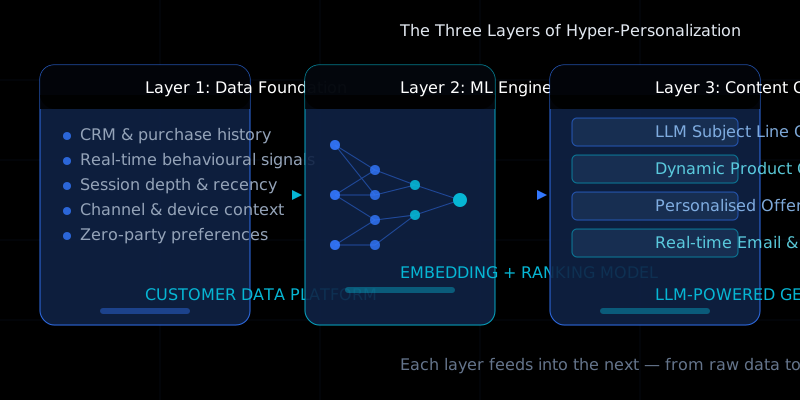
Building a hyper-personalization system that functions at scale requires three distinct technical layers working together.
Layer 1: The Unified Data Foundation
AI personalization is only as good as the data it operates on. Most businesses sit on fragmented data: CRM data in Salesforce, behavioural data in Google Analytics, transactional data in their e-commerce platform, support history in Zendesk. These silos produce contradictory, low-resolution signals.
The foundation of effective hyper-personalization is a Customer Data Platform (CDP) or equivalent data unification layer that creates a single, continuously updated customer profile. Tools like Segment, Rudderstack, and Amplitude connect these sources in real time, creating what practitioners call a golden record: one canonical view of each customer that updates as they behave.
This profile must include not just historical data but behavioural signals: pages visited in the last session, content consumed, search queries, time spent on specific product categories, and the recency and frequency of interactions. These signals carry far more predictive value than static demographics.
Layer 2: The Predictive Decision Engine
The second layer decides, in real time, what to show each individual customer. This is where machine learning operates. Modern recommendation systems use embedding models to represent customers and products in the same vector space. A customer's historical interactions are encoded as a vector. Products, content pieces, and offers are also encoded. The engine then calculates which content items are most similar to the customer's current intent state and ranks them accordingly.
What makes this different from earlier recommendation engines is the real-time nature. Companies like Netflix and Spotify have demonstrated architectures capable of re-ranking content for each individual within milliseconds of a new interaction. The same infrastructure is now available to any team through platforms like Amazon Personalize, Google Recommendations AI, and open-source libraries like LightFM and Surprise.
The decision engine also incorporates contextual signals: device type, time of day, session depth, and referring channel. A user arriving from an organic search query has different intent from one who clicked a paid ad for a specific product. The engine weights these signals and adjusts its recommendations accordingly.
The three layers work in sequence: clean unified data powers accurate predictions, which power individually relevant content
Layer 3: Dynamic Content Generation
The third layer converts the decision engine's output into actual content. This is where large language models have been the enabling breakthrough.
Previously, delivering individually relevant messaging required humans to write many variations of each piece of content, then use rules to match the right variation to the right segment. LLMs dissolve this bottleneck entirely. A system can now take the product recommendation from the decision engine plus a small set of context parameters and generate a unique subject line, body copy, or product description on the fly. Each customer effectively receives content that was written specifically for them, in language calibrated to their communication style and purchase context.
Tools like Persado have demonstrated this in enterprise email marketing, reporting 41% improvements in conversion rate over manually written campaigns. The same principle applies to on-site product descriptions, push notifications, in-app messages, and chatbot interactions.
What Hyper-Personalization Looks Like in Practice
A UK fashion retailer using this architecture might present the same homepage to three customers very differently. Customer A, who has viewed formal workwear three times in the last two weeks, sees a hero image featuring tailored suits and office attire, with copy referencing the September office return. Customer B, whose browsing history clusters around weekend casual and outdoor wear, sees lifestyle imagery and copy reflecting that preference. Customer C, a new visitor with no history, sees the brand's highest-conversion editorial content and a progressively disclosed preference quiz.
All three experiences are generated in real time from the same underlying product catalogue and content library. No human wrote three versions of the homepage. The system inferred intent and generated the experience.
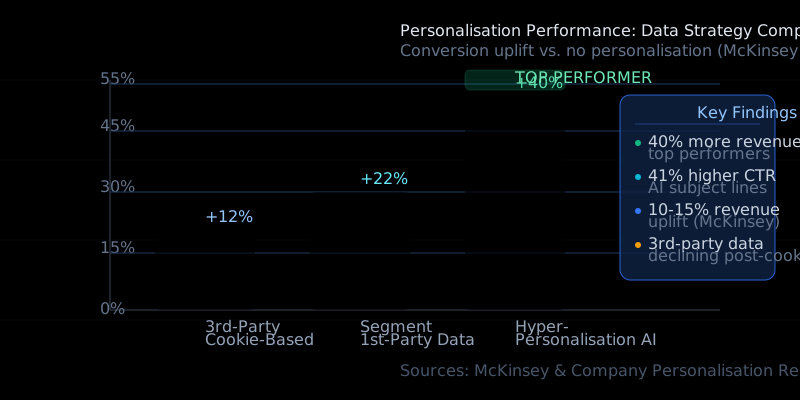
This is not science fiction. Retailers including ASOS, Next, and John Lewis have deployed variations of this architecture. The performance data is consistent: McKinsey's personalisation research found that companies getting personalization right generate 40% more revenue than the average, with leaders seeing 10 to 15 percentage point revenue uplifts from personalisation programmes.
Privacy-First Personalization: The UK GDPR Constraint and Opportunity
UK businesses operating under UK GDPR face real constraints on how personalization data is collected, stored, and used. Behavioural profiling at the level required for hyper-personalization sits within legitimate interests territory under Article 6, but requires a demonstrable balancing test showing the individual's interests do not override the business interest.
The practical response is a privacy-first architecture that relies on zero-party data (data the customer explicitly shares, such as preference quiz answers or stated interests) and first-party data (behaviour on owned channels) rather than third-party data from ad networks. This is not just a compliance response: it is also a performance one.
First-party data is more accurate, more recent, and more relevant than inferred third-party profiles. Customers who explicitly share their preferences produce higher-quality personalization signals than customers who have been probabilistically profiled across thousands of third-party data points. The death of the third-party cookie, far from harming personalization programmes, has redirected investment toward data infrastructure that actually works better.
The critical architectural decision under UK GDPR is separating model training from inference in ways that prevent re-identification. Train embedding models on anonymised interaction data; serve inferences using tokenised identifiers. This approach satisfies the data minimisation principle under Article 5(c) while preserving the signal quality needed for accurate recommendations.
If you are building AI workflows that touch customer data, our guide to sovereign AI and UK GDPR compliance covers the infrastructure decisions in more detail.
Privacy-first first-party data strategies outperform third-party approaches on conversion, while AI hyper-personalization leads by a significant margin
The Creepy Threshold: Where Personalization Destroys Trust
The biggest risk in hyper-personalization is not technical. It is psychological. There is a well-documented creepy threshold at which personalization stops feeling helpful and starts feeling intrusive.
Referencing something a customer said in a support chat in a subsequent marketing email. Displaying a product the customer viewed on a colleague's laptop in their own retargeting feed. Using location data to infer life events and referencing them in copy. Each of these crosses the line from convenient to unsettling, and the trust damage is severe and difficult to recover from.
The practical rule: personalise based on what customers have done in the context they expect you to know about. A customer who browsed trainers on your website expects to see trainers featured in a follow-up email. A customer who mentioned a pregnancy in a support conversation does not expect their next promotional email to be baby-product themed.
The best performing hyper-personalization programmes apply explicit content policies on which data signals can be used in which communication contexts. Not every signal that could improve relevance should be used. The long-term relationship value of perceived trustworthiness consistently outweighs the short-term conversion uplift from hyper-targeted messaging.
Practical Takeaways for UK Marketing Teams
Getting started with hyper-personalization does not require a two-year infrastructure programme. Most UK businesses can move meaningfully in 90 days.
Start with email: Implement a basic real-time product recommendation engine using your existing product catalogue and CDP data. Replace static ‘you might also like’ blocks with dynamically ranked recommendations. Measure lift against your current baseline.
Layer in dynamic subject lines: Once the data foundation and measurement infrastructure are in place, add LLM-generated subject lines at send time. Test this against your existing subject line performance. Results are typically quick to validate.
Invest in data quality first: A well-structured CDP with 12 months of clean behavioural data is worth more than a state-of-the-art ML model trained on fragmented, duplicated, inconsistent records.
Establish a content policy: Document which data signals are permitted in which communication contexts before deployment. This protects trust and simplifies compliance review under UK GDPR.
The businesses that are winning in 2026 are not the ones with the most sophisticated AI: they are the ones that started the data infrastructure work earliest. A clean, unified customer data foundation creates compounding returns that widening marketing budgets cannot replace.
Conclusion
The 1:1 marketing future that Peppers and Rogers predicted in 1993 has arrived. The combination of unified customer data platforms, real-time ML recommendation engines, and LLM-powered content generation has removed every technical constraint that previously made it impossible at scale.
For UK businesses, the path forward requires investment in three things: clean first-party data infrastructure, a predictive decision layer, and a content generation system that can operate in real time. The privacy constraints of UK GDPR, properly implemented, are an architectural forcing function toward approaches that outperform the third-party alternatives they replace.
The competitive window is still open. Most businesses are still sending the same email to the same eight audience segments they defined three years ago. The ones who build the infrastructure now will find themselves with a compounding advantage that becomes increasingly difficult for competitors to close.
Frequently Asked Questions
What is hyper-personalization in marketing?
Hyper-personalization goes beyond demographic segmentation to deliver individually relevant content, offers, and experiences based on each customer's real-time behaviour, preferences, and context. It uses AI and machine learning to update individual profiles continuously and generate content specific to each person, rather than fitting them into a predefined segment.
How is hyper-personalization different from regular personalization?
Traditional personalization groups customers into segments and serves segment-level messaging with individual tokens such as a first name. Hyper-personalization treats each customer as a unique segment of one, using real-time signals to make individual decisions about what content, product, offer, or message is most relevant at that specific moment.
What technology is needed for hyper-personalization at scale?
Three layers are required: a unified Customer Data Platform that creates a single real-time customer profile, a recommendation or predictive engine that uses ML to rank content for each individual, and a content generation system often powered by LLMs that produces dynamically relevant messaging. Cloud platforms like AWS, Google Cloud, and Azure each offer managed services covering all three layers.
Is hyper-personalization compliant with UK GDPR?
Yes, if implemented correctly. Behavioural personalisation can fall under legitimate interests under Article 6(1)(f), subject to a balancing test. The safest architecture relies on zero-party and first-party data with clear consent, separates model training from inference using anonymised data, and gives customers meaningful control over their personalisation preferences.
What is the ROI of hyper-personalization?
McKinsey research consistently shows that companies excelling at personalization generate 10 to 15 percentage point revenue uplifts from those activities versus the average, with top performers showing 40% more revenue. Email personalization using AI-generated subject lines typically shows 15 to 41% conversion improvements in controlled tests.
What is the creepy threshold in personalization?
The creepy threshold is the point at which personalisation stops feeling helpful and starts feeling invasive. It is typically crossed when brands reference data signals that customers did not knowingly share in that context, or when the specificity of targeting reveals more is known about the customer than they expected. Crossing this threshold destroys trust rapidly and is difficult to recover from.
How long does it take to implement hyper-personalization?
A meaningful first implementation focused on email recommendation personalisation can be completed in 60 to 90 days for a team with existing CDP infrastructure. Full hyper-personalisation across all channels typically requires 6 to 12 months of phased implementation depending on data quality and engineering resource.
Can small businesses use hyper-personalization?
Yes. Tools like Klaviyo, Braze, and Iterable provide managed personalization infrastructure accessible to businesses without dedicated ML teams. Shopify merchants can implement AI-powered product recommendations through native tools or plugins. The key investment for small businesses is data quality: a clean, unified customer record produces better results than any algorithm trained on messy data.