Strategy
How Much Should You Budget for AI in 2027? A Practical Guide for SMEs
15 min read
Most 2027 budgets will hold either nothing or a round number for AI. This practical guide breaks AI spending into five cost layers, gives UK benchmark ranges by business size and walks through a line-by-line budget for a 40-person firm.
✦Key Takeaways
- An AI budget is five cost layers, not one line: seats, usage, build, run and people. Each behaves differently when you scale up, overrun or cancel.
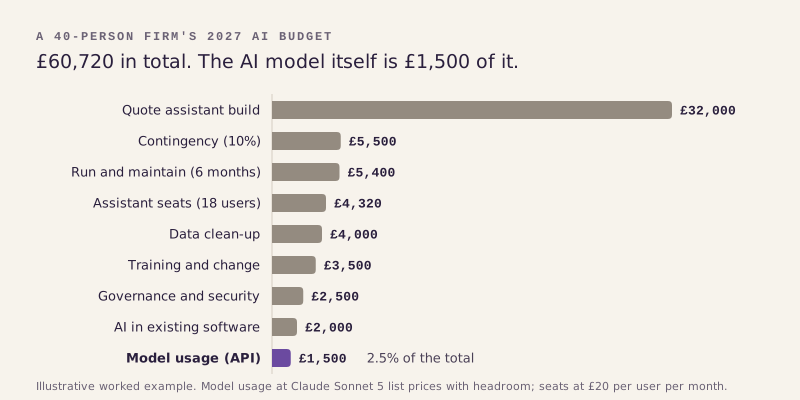
- The AI model is usually the smallest line. In our worked 40-person example, API usage is under 3% of a £60,720 budget, while the build and data clean-up take nearly 60%.
- Unit prices are falling fast, with GPT-3.5-level inference more than 280 times cheaper in under two years, but agents do far more work per task. Budget for usage growth, not usage price.
- As a planning benchmark, a UK business with 10 to 49 staff needs roughly £5,000 to £15,000 to explore AI in 2027, or £30,000 to £75,000 in a year it builds a custom workflow.
- Buy assistant seats for demonstrated users, not for headcount. Only 15% of UK businesses with ten or more staff report that more than half their employees use AI in daily work.
- Over two years, running and improving a custom AI system costs about as much again as building it, so every build approval is also a run-cost approval.
- Some 2027 AI spending will arrive as price rises in software you already use, from Google Workspace to Microsoft 365. Check renewal dates before you set the number.
- Release money through stage gates tied to measured results. A pilot that misses its target should cost you the pilot, not the year's budget.
It is budget season. Across the UK, owner-managers and finance directors are opening next year's spreadsheet, and somewhere between software and training a newer line is waiting for a number: AI. In most SMEs that cell will end up holding either a zero or a suspiciously round figure, often £10,000, chosen because it sounds serious enough to count and small enough to survive the board meeting. Neither is a plan. Setting an AI budget for SMEs in 2027 takes different maths, because AI spending does not behave like any other line on the sheet.
The pressure to get it right is rising. The Office for National Statistics reports that the share of UK businesses with ten or more employees using AI has risen from around 12% in late 2023 to around 35% in June 2026. Yet only 10% of those adopters say they use AI extensively. Most firms have bought a few licences and run a few experiments; far fewer have moved AI into the workflows that make money. 2027 is when that gap gets decided, and the budget is where it gets decided first.
This guide is written for owners, managing directors and finance leads at UK businesses with fewer than 250 staff. It breaks AI spending into five cost layers, gives benchmark ranges by business size, walks through a line-by-line budget for a 40-person firm, and flags the hidden costs that turn sensible plans into overspends. Every figure is either sourced or clearly labelled as an estimate, so you can swap in your own numbers.
Why Your 2027 AI Budget Needs Different Maths
Most software is budgeted in one of two ways: a subscription per user, or a one-off project. AI is now both at once, plus a third behaviour that many finance teams have never had to plan for: metered consumption that rises and falls with how much work the AI actually does. Three shifts make 2027 different from the experimental budgets of the past two years.
The price per unit keeps falling
The raw cost of AI capability has collapsed. Stanford's 2025 AI Index found that the inference cost of a system performing at the level of GPT-3.5 dropped more than 280-fold between November 2022 and October 2024. Current list prices reflect the trend: Anthropic's published pricing for its mid-tier Claude Sonnet 5 model is $2 per million input tokens and $10 per million output tokens, where a token is roughly three-quarters of a word. For many everyday business tasks, the model itself now costs pennies per job.
The work per task keeps growing
Falling unit prices do not mean falling bills, because the way businesses use AI is changing. A 2024 chatbot answered one question with one model call. A 2026 agent, meaning software that plans and carries out a multi-step task such as reading an enquiry, checking stock, drafting a quote and updating the CRM, may make dozens of calls and read thousands of words of context for a single job. Cheaper tokens invite more ambitious uses, and more ambitious uses consume more tokens. Budget for usage growth, not for usage price.
AI is arriving inside software you already pay for
The third shift is quieter. Vendors are folding AI into existing products and repricing them. When Google built Gemini into its Workspace business plans in January 2025, Business Standard went from $12 to $14 per user per month. Microsoft updated list prices for its Microsoft 365 suites from 1 July 2026, pointing to new AI, security and management capabilities. Salesforce now meters its Agentforce agents at $0.10 per action. Some of your 2027 AI spending will therefore arrive as price rises and usage charges in tools filed under a different heading, so find them before your renewal dates do.
The Five Layers of an AI Budget for SMEs
The most useful thing you can do before choosing a number is to stop treating AI as a single line. An AI budget for SMEs has five layers, and each behaves differently when you scale up, overrun or cancel.
1. Seats: AI assistants for your people
These are per-user subscriptions to general assistants such as Microsoft 365 Copilot, ChatGPT Business, Claude Team or Gemini in Google Workspace. Standard business seats from the major vendors are listed at roughly $20 to $30 per user per month; Microsoft launched Copilot Business for smaller organisations at $21 per user per month, on top of the Microsoft 365 plan it requires. Premium seats with higher usage limits cost several times more.
Seats scale with headcount and are easy to cancel, which makes them the lowest-risk layer. They are also the most wasteful when bought for everyone by default. The ONS found that only 15% of businesses with ten or more employees report that more than half of their staff use AI in their daily work. Buy seats for demonstrated users, measure usage for a quarter, then expand.
2. Usage: metered AI consumption
This layer covers pay-as-you-go model APIs, AI features billed by credit or action, and automation platforms with AI steps. It scales with activity rather than headcount, and it is the only layer that can surprise you in the middle of a month. The raw numbers are usually modest. A customer service assistant handling 2,000 conversations a month, each sending around 30,000 tokens of instructions, retrieved documents and history and getting 2,400 back, would cost about $168 a month at Sonnet 5 list prices. The danger lies in the multipliers: longer conversations, more agent steps and more users, which is exactly how cheap prototypes become expensive production systems.
3. Build: making AI fit your business
Build is the one-off investment that connects AI to your data and processes: integrations with your CRM, ERP or document stores, retrieval over your own content, permission controls, testing and a usable interface. Our UK guide to AI development costs places focused internal tools at £15,000 to £40,000 and multi-system builds at £40,000 to £120,000. Configured no-code automations can come in well below that. This is the layer where most of the value sits, and most of the risk.
4. Run: keeping it working
Anything you build needs hosting, monitoring, security updates, evaluation (regular testing that answers stay accurate as your data and the underlying models change) and a support arrangement. Models are retired on published schedules, so plan for at least one upgrade cycle a year. Our rule of thumb is that over two years, running and improving a custom AI system costs about as much again as building it. A quote that covers only the build is half a quote.
5. People: skills, change and governance
The final layer covers training, time for internal champions, an AI usage policy, data protection impact assessments where personal data is involved, and security review. It is the layer most often left at zero, and ONS data shows the cost of that: only 11% of UK businesses with ten or more employees say more than half their workforce has received AI-related training. Free courses help. The government's AI Skills Hub offers foundations training to every UK adult, which lets you spend paid training time on your own workflows instead.
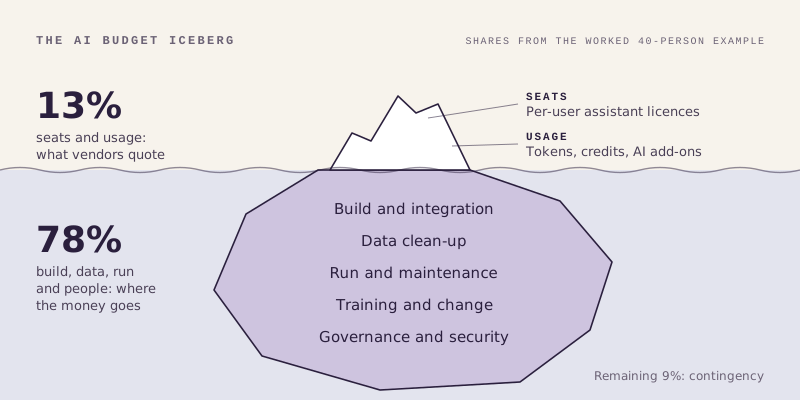
Laying the layers side by side reveals the pattern that catches most budgets out. Seats and usage are the costs vendors quote you, so they are the ones people see. Build, run and people are where the money goes in any year you move beyond experimenting.
How Much Should an SME Budget for AI in 2027?
There is no official benchmark for SME AI spending, and percentage-of-revenue rules mislead: a 30-person recruitment firm and a 30-person manufacturer can have very different turnover and very similar AI needs. The ranges below are our planning estimates, built from current published list prices and typical UK project costs. Use them to sense-check a figure, not to replace the bottom-up exercise later in this guide.
Each size band has two budgets. An explore budget covers assistant seats for the people who will use them, training and light automation. An embed budget adds at least one custom workflow built into your systems. Decide which of the two you are setting before you pick a number.
| Business size | Explore budget (per year) | Embed budget (per year) | What an embed year typically buys |
|---|---|---|---|
| Micro (1 to 9 staff) | £1,000 to £4,000 | £6,000 to £20,000 | Seats for the whole team and one configured automation, such as enquiry triage or invoice capture |
| Small (10 to 49 staff) | £5,000 to £15,000 | £30,000 to £75,000 | Seats for power users, one focused custom workflow and its first months of running costs |
| Medium (50 to 249 staff) | £15,000 to £50,000 | £80,000 to £250,000 | Seats by team, two or three custom workflows, a governance framework and a full run budget |
Two patterns stand out. The jump from explore to embed is steep at every size, because a custom build is a step change rather than a gradual increase; that is why the stage gates described below matter. And per head, the figures converge: in an embed year, most small and medium firms land between roughly £700 and £2,500 per employee. Micro businesses can run higher, because a build does not get cheaper just because the team is smaller.
What moves you up or down the range
Four factors push a budget towards the top of its band:
- Data in poor shape. Scattered spreadsheets, duplicate records and documents without owners all have to be fixed before AI can use them.
- Regulated or sensitive data. Health, financial or children's data brings impact assessments, hosting requirements and audit trails.
- Customer-facing AI. Anything a customer sees needs more testing, guardrails and monitoring than an internal tool.
- Legacy systems. Every integration that has to work around software without a modern API adds time and cost.
Pulling the other way: modern cloud software with good integrations, such as Microsoft 365, Xero or HubSpot; one clear, high-volume process to start with; and a team already using AI informally, which shortens the training curve.
A Worked Example: One 40-Person Firm's 2027 AI Budget
Ranges are easier to judge with a real shape behind them. Take an illustrative 40-person engineering components distributor in the Midlands. Its estimators spend much of the week turning emailed requests for quotation, often with drawings and part lists attached, into priced quotes using a price book and the ERP. For 2027 the firm wants to give 18 people an AI assistant and build one custom workflow: a quote assistant that reads each request, matches parts, pulls prices and stock from the ERP and drafts a quote for an estimator to check and send.
| Line item | Layer | 2027 cost | Assumption |
|---|---|---|---|
| Assistant seats | Seats | £4,320 | 18 users at £20 a month for 12 months |
| AI in existing software | Usage | £2,000 | Price rises and AI add-ons in the CRM and helpdesk |
| Quote assistant build | Build | £32,000 | Focused custom workflow, built January to June |
| Data clean-up | Build | £4,000 | Price book and part codes; contractor plus internal time |
| Run and maintain | Run | £5,400 | July to December at £900 a month |
| Model usage (API) | Usage | £1,500 | About 400 quotes a month, roughly $70 a month at list prices, plus generous headroom |
| Training and change | People | £3,500 | Workshops for power users; free foundations course for everyone |
| Governance and security | People | £2,500 | AI usage policy, data protection impact assessment, security review |
| Contingency | All | £5,500 | Roughly 10% of the lines above |
| Total | £60,720 | About £1,500 per employee |
Three things stand out. The AI model itself, the thing most people picture when they hear the words AI budget, accounts for under 3% of the total. The build and data clean-up together account for nearly 60%. And the run line covers only six months, because the assistant goes live in July.
The 2028 line you are approving today
That last point shapes next year's conversation. In 2028 the build line disappears, but the run line doubles to a full year, usage grows as estimators trust the tool with more work, and a second workflow will probably be on the table. A realistic 2028 figure for this firm is around £25,000 before any new build. Approve the 2027 budget knowing that a recurring cost comes with it.
Does it pay back?
The build only makes sense if the workflow is worth automating. If the quote assistant saves 20 minutes on each of 400 quotes a month, that is roughly 1,600 estimator hours a year, or about £56,000 of capacity at a loaded cost of £35 an hour, before counting faster turnaround and won work. Test your own case with our framework for measuring AI ROI, and be wary of any business case that only works with heroic assumptions.
Want the same line-by-line view for your own business? Talk to our team about costing your first workflow before you commit to a number.
The Hidden Costs That Break AI Budgets
Most AI overspends are not caused by the AI. They come from six predictable places, and each can be budgeted for in advance.
- Shadow AI you already pay for. The ONS found that 55% of employees report using AI for work or education, against 35% of businesses reporting AI use. Much of that gap is staff on personal tools, often paid for on personal cards or expensed as one-off subscriptions. Audit expenses and card statements before you budget: consolidating onto business plans can fund part of the seat line and close a data protection gap at the same time, as we explain in our comparison of custom AI and ChatGPT.
- Data that is not ready. Duplicate product records, conflicting policy versions and spreadsheets only one person understands. In our experience, preparing and permissioning data is one of the largest tasks in any first project; skipping it simply moves the cost into poor answers later.
- Usage that compounds. Long conversations resend their history on every turn, and agents make many calls per task. Set monthly spending caps and alerts with every provider from day one.
- Currency swings. Model providers and many AI tools bill in US dollars. A 10% move in sterling changes those lines by roughly the same amount, so budget dollar-priced items at a cautious exchange rate.
- Model and vendor churn. The model you build on will be replaced within a year or two, and plans and prices change several times a year. Budget for testing and upgrades, and avoid designs that lock you into a single model.
- Your best people's time. Every AI project needs a process owner who knows how the work really gets done. Their hours are a real cost, and projects stall without them.
Where the Money Can Come From
An AI budget does not have to be entirely new money. Check four sources before asking for a fresh allocation.
- Consolidation. Overlapping subscriptions, shadow AI tools and point products whose features now sit inside platforms you already pay for.
- Redeployed spend. Outsourced admin, temporary cover for seasonal peaks and external fees for tasks an automated workflow can absorb. Treat this as a gradual shift over the year, not an instant saving.
- Tax relief, carefully. HMRC's guidance on R&D relief requires a project to seek an advance in science or technology by resolving scientific or technological uncertainty. Genuinely novel technical work may qualify; routine integration of off-the-shelf AI usually will not. Ask your accountant before you count on it.
- Free training. Use the AI Skills Hub for foundations so paid training can focus on the workflows that matter to you.
How to Build Your 2027 AI Budget in Six Steps
With the layers, ranges and pitfalls in mind, here is the process we recommend. It takes a few weeks rather than a few months, and it produces a figure you can defend line by line.
- Audit what you already spend. Pull twelve months of card statements, expense claims and software invoices, and tag anything AI-related, including AI add-ons and price rises in existing tools.
- Choose two or three workflows, not a technology. Pick high-volume, rules-heavy processes with a clear owner and a measurable outcome: quoting, invoice processing, customer enquiries or management reporting.
- Cost each workflow across all five layers. Seats, usage, build, run and people, with at least two years of run costs included.
- Add buffers where the uncertainty is. Put caps on usage, budget dollar-priced lines cautiously and hold 10% to 15% contingency.
- Release money through stage gates. Fund discovery, then a pilot, then rollout, releasing each tranche only when the previous stage hits a measured target such as time saved per task or accuracy on a test set. Suppliers who offer outcome-based pricing make this easier to enforce.
- Review every quarter. Compare seat utilisation, usage and outcomes against plan, then reallocate unused licences and stop pilots that are not earning their keep.
The stage gate is the step most SMEs skip and the one that protects them most. A pilot that misses its target costs you the pilot, not the whole budget, and a pilot that hits its target makes the rollout decision easy.
Set the Number Last
The businesses that get the most from AI in 2027 will not necessarily be the ones that spend the most. They will be the ones that know what each pound is for: seats for people who use them, a build for a workflow worth automating, a run budget that keeps it working and time for their people to learn. The unit price of AI will keep falling. Your AI budget probably will not, because you will keep finding work worth giving it. Handled well, that is a good sign rather than a warning.
If you are setting your 2027 numbers now, book a discovery call with AI Native Agency. We will help you choose the first workflow worth funding, cost it across all five layers and set the stage gates that protect your budget.
Frequently Asked Questions
- How much does AI cost for a small business in the UK?
- For a business with 10 to 49 staff, a realistic 2027 AI budget runs from about £5,000 a year for assistant seats, training and light automation to £30,000 to £75,000 in a year you build a custom workflow into your systems. Micro businesses can start for a few hundred pounds a month. The biggest cost driver is not the AI model but whether you connect AI to your own data and processes.
- What percentage of revenue should an SME spend on AI?
- There is no reliable percentage-of-revenue benchmark for SMEs, and turnover is a poor guide because firms with similar headcounts can have very different revenue and similar AI needs. Budget per workflow instead: cost the specific processes you want to improve, then sense-check the total against per-employee ranges. In a year that includes a custom build, many small and medium firms land between roughly £700 and £2,500 per employee.
- Is Microsoft 365 Copilot worth it for a small business?
- It can be for staff who spend most of the day in Outlook, Word, Excel and Teams, because Copilot works across the emails and documents they already have. Microsoft launched Copilot Business for smaller organisations at $21 per user per month on top of a qualifying Microsoft 365 plan. Start with a pilot group of heavy users, measure time saved over six to eight weeks and expand only where usage holds up.
- What are the ongoing costs of AI after implementation?
- Expect hosting, monitoring, security updates, model upgrades, accuracy testing, metered usage and a support arrangement, plus any seat subscriptions. As a rule of thumb, running and improving a custom AI system costs about as much again as building it over two years. Ask every supplier for a 24-month cost, not just a build price.
- Should we build custom AI or buy off-the-shelf AI tools?
- Buy for general tasks such as drafting, summarising and meeting notes, where off-the-shelf assistants already do well. Build when a high-volume process depends on your own data and systems, such as quoting, claims or order processing, because generic tools cannot see that data. Most SMEs end up with both: seats for the people who benefit and one or two custom workflows where the return is clearest.
- How do we stop AI costs spiralling?
- Set hard monthly spending caps and alerts with every model provider, route simple tasks to cheaper models and keep the context sent with each request no longer than it needs to be. Review seat usage every quarter and remove licences nobody uses. Above all, release project money in stages tied to measured results rather than in one upfront commitment.
- Are there grants or tax reliefs for AI projects in the UK?
- R&D tax relief can apply where a project seeks an advance in science or technology by resolving genuine technical uncertainty, but routine integration of existing AI tools usually does not qualify. Grant competitions open and close regularly through bodies such as Innovate UK, so check what is live when you plan. Free AI foundations training is available to every UK adult through the government's AI Skills Hub.
- When should we set our AI budget for 2027?
- Alongside your normal budget cycle, so AI is weighed against other investments rather than bolted on later as an exception. If your financial year starts in April, use the autumn to run a short discovery exercise so the number rests on costed workflows. If it starts in January, a two-week audit of current spend and one priority workflow is enough to replace a round-number guess.