AI Trends
From Generalists to Specialists: Why Domain-Specific AI is the Ultimate Competitive Moat
10 min read
Discover why UK SMEs are moving beyond generalist AI tools — and how fine-tuning domain-specific models on proprietary data can cut inference costs by 90% while delivering higher precision than trillion-parameter models.
✦Key Takeaways
- Generalist LLMs like GPT-4 are the Swiss Army Knife of AI — impressive but expensive and imprecise for specialist tasks.
- A 7B-parameter model fine-tuned on your proprietary data outperforms trillion-parameter generalists in your domain at 1/10th the inference cost.
- Your proprietary data is the moat — competitors can buy the same base model but cannot replicate your domain-specific training set.
- BrightFlow Solar's specialist model achieved 98.5% accuracy (up from 80%) and cut review time from 45 minutes to 30 seconds.
- UK SMEs should start with a focused proof-of-concept: one workflow, one dataset, one fine-tuned model — then compound the advantage.
The AI gold rush of the last two years has been defined by "The Generalists." We have all marvelled at ChatGPT's ability to write a sonnet about sourdough bread and then immediately pivot to debugging Python code. For many UK SME founders, these "God-in-a-box" models were the first taste of what AI could genuinely do — and the excitement was real.
But as the novelty wears off, a frustrating reality is setting in: a generalist AI knows everything about nothing.
While a massive, trillion-parameter model can give you a "pretty good" marketing plan or a "decent" summary of a meeting, "decent" doesn't win in a competitive market. In the high-stakes world of UK business — where regulatory compliance, specific industry jargon, and razor-thin margins matter — the generalist always falls short at the final hurdle.
The future belongs to the Specialists. To build a true competitive moat, your UK SME doesn't need a bigger AI; it needs a smarter one. It needs a model that knows your industry, your data, and your customers inside out.
The Swiss Army Knife vs. The Scalpel
Imagine you are a surgeon about to perform a delicate operation. Someone offers you a tool. It's a high-end Swiss Army Knife. It has thirty different blades, a screwdriver, a pair of tweezers, and even a tiny saw. It is a marvel of engineering.
Then, someone else hands you a surgical scalpel. It does one thing: it cuts with molecular precision.
Which one do you take into the theatre?
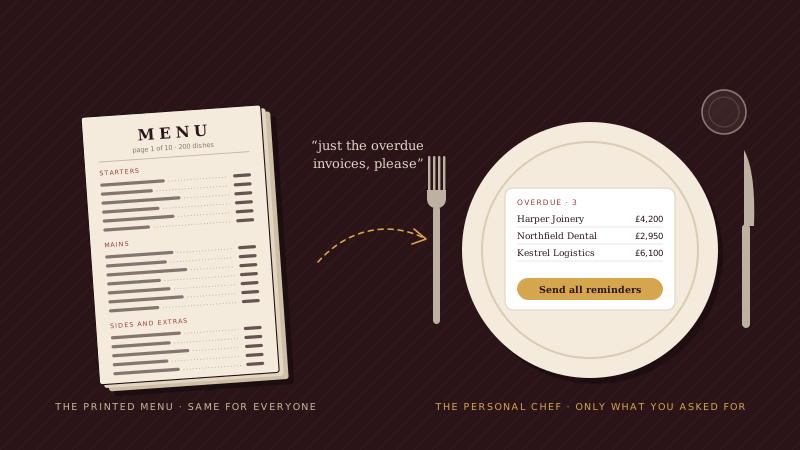
Generalist models like GPT-4 or Gemini Ultra are the Swiss Army Knives of the digital age. They are incredibly impressive, but they are "heavy." They require massive amounts of computing power (inference cost), they are prone to "hallucinating" when they don't know an answer, and they carry around trillions of parameters dedicated to tasks your business will never need.
If you are a finance director at a UK firm, you don't need a trillion-parameter model to categorise 50,000 invoices. You need a 7-billion-parameter model that has seen 100,000 invoices and understands the difference between a VAT-exempt supply and a zero-rated one.
The specialist model is the scalpel. It is smaller, faster, cheaper, and infinitely more precise.
The Economics of the Specialist: 10x Performance at 1/10th the Cost
For the average UK SME, the “AI-first” transition often stalls at the billing stage. Using the most powerful generalist models via API can become prohibitively expensive as you scale.
This is where the logic of Domain-Specific AI becomes undeniable. By taking a smaller, open-source “base” model (like Llama 3 or Mistral) and fine-tuning it on your specific industry data, you create a specialist.
1. The Cost Advantage
A generalist model is like renting a massive mansion just to sleep in one bedroom. You are paying for all that extra space you aren't using. When you use a 7B or 8B parameter model fine-tuned for a specific task, the "inference cost" (the cost of the AI thinking) can be as low as 1/10th of the cost of running a frontier generalist model on the same task.
2. The Performance Peak
In a study of medical AI performance, models fine-tuned specifically on proprietary healthcare data consistently outperformed generalist models that were 50 times their size. Why? Because the specialist isn't "guessing" based on a general understanding of language; it has mastered the specific vocabulary, the edge cases, and the regulatory constraints of a single domain.
The same applies to the UK legal sector. A model trained on the intricacies of the UK Companies Act and English Case Law will identify risks in a contract far more reliably than a model trained on the entirety of the internet (which is dominated by US legal concepts).

Case Study: The "Solar-Save" Success Story
Let's look at a fictional but highly realistic example of a UK-based SME we'll call BrightFlow Solar, a mid-sized installer of commercial solar arrays in the Midlands.
The Problem: BrightFlow's engineers spent 15 hours a week manually reviewing structural surveys and electrical grid constraints to see if a warehouse roof could handle a specific solar load. They tried using a generalist AI to summarise the reports, but it kept missing "DNO" (Distribution Network Operator) constraints — a critical UK-specific regulatory concept.
The Specialist Solution: BrightFlow worked with an AI-native agency to build a domain-specific "Grid-Spec" model. They took a small, efficient open-source model and fine-tuned it on 5,000 of their past successful and failed applications, including specific UK electrical regulatory documents.
The Result:
- Accuracy: Rose from 80% to 98.5%.
- Speed: Review time dropped from 45 minutes per report to 30 seconds.
- Cost: Because they hosted the small model on their own private cloud, their monthly API costs dropped by 85% compared to their “generalist” experiments.
BrightFlow now has a competitive moat. A competitor can buy a subscription to ChatGPT, but they cannot buy a model that understands the specific electrical constraints of the West Midlands power grid like BrightFlow's Specialist AI does.
Why Data is the New "Moat" (And How to Build Yours)
In the traditional business world, a "moat" was a brand name, a patent, or a physical location. In the AI era, your moat is your proprietary data.
Everyone has access to the same generalist AI tools. If you use the same AI as your competitor to write your emails and code, you have no advantage. You are both running at the same speed.
However, if you have ten years of customer service logs, 50,000 industry-specific technical drawings, or a unique database of UK property transactions, you have the "fuel" for a specialist AI that no one else can replicate.
How to start building your moat tomorrow:
- Identify the “Repeatable High-Value Task”: Don’t try to automate “Marketing.” Instead, automate “Categorising inbound leads based on our specific UK buyer personas.”
- Audit Your “Dark Data”: Look for the PDFs, Excel sheets, and email chains that contain the “knowledge” of your best employees. This is your fine-tuning goldmine.
- Think Small: Don’t ask, “Which is the biggest model?” Ask, “What is the smallest model that can solve this specific problem?”
- Localise: Ensure your AI understands the UK context — from GBP currency and VAT to British English spelling and UK-specific regulations (like GDPR or the Building Safety Act).
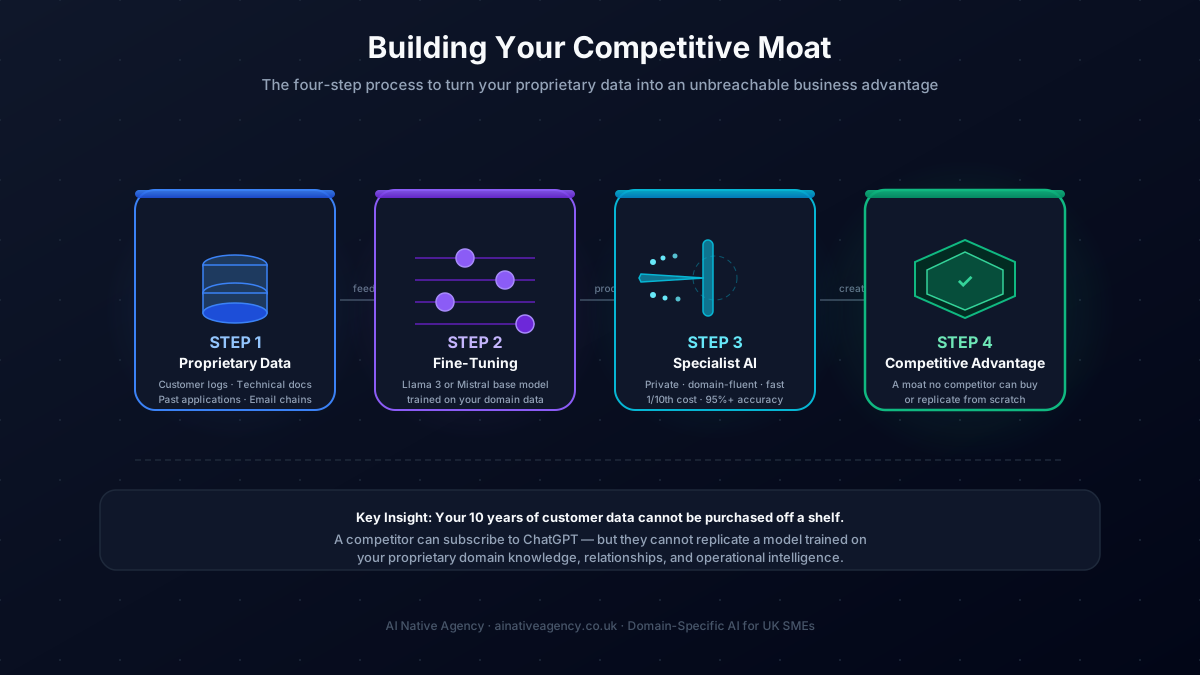
The Specialist Advantage: Reliability and Privacy
Beyond cost and performance, there are two "silent killers" for SMEs using generalist AI: Hallucinations and Data Sovereignty.
Reducing Hallucinations
Generalist models are designed to be "creative," which is another way of saying they are designed to guess the next likely word. When they don't know a UK tax rule, they might make one up that sounds incredibly convincing. Specialist models, because they are trained on a narrower, "cleaner" dataset, are far less likely to hallucinate on domain-specific tasks. The model simply knows what it knows — and what it doesn't.
Data Privacy and Sovereignty
For many UK SMEs in sectors like finance, law, or healthcare, sending sensitive client data to a US-based generalist AI provider is a compliance nightmare. Because specialist models are smaller (often 7B to 8B parameters), they can be “self-hosted.” You can run your AI on your own secure servers or private cloud — keeping your data entirely within your control and well within the requirements of the UK GDPR guidance from the Information Commissioner’s Office.
The AI Native Agency Perspective: Why Speed to Specialisation Matters
At AI Native Agency, we see the UK market splitting into two camps.
The first camp is waiting for the "perfect" AI to arrive from Silicon Valley. They are paying high monthly fees for generalist tools that get them 70% of the way there, but require constant human babysitting.
The second camp — the AI-native SMEs — are building their own specialized tools today. They are using "Scalpel AI" to automate the "boring" 20% of their business that takes up 80% of their time.
By the time the first camp realizes that "one size fits all" doesn't work in the UK's complex business landscape, the specialist firms will have models that are so deeply integrated into their operations that they will be impossible to catch.
If you are considering the journey toward a domain-specific AI, a useful starting point is understanding where your business sits on the 2026 AI Maturity Scorecard for UK Businesses — a practical self-assessment that maps your current state against the five pillars needed to move from generalist tools to a specialist advantage.
Conclusion: Your Business, Your Intelligence
The shift from generalists to specialists isn't just a technical trend; it's a fundamental shift in business strategy.
You wouldn't hire a general "office worker" to handle your complex corporate tax filing or your precision engineering designs — you'd hire a specialist. It's time we started holding our AI to the same standard.
Stop trying to force a Swiss Army Knife to do a surgeon's job. Look at your data, identify your unique expertise, and start building your specialist AI today. That is how you build a moat that no competitor, no matter how big, can cross.
Frequently Asked Questions
- What is domain-specific AI?
- Domain-specific AI is a smaller language model (typically 7B–8B parameters) fine-tuned on industry-specific proprietary data — such as legal contracts, medical records, or financial invoices — to outperform large generalist models in accuracy, speed, and cost for that specific domain.
- How much cheaper is a specialist AI model than GPT-4?
- A fine-tuned 7B-parameter specialist model typically runs at 1/10th the inference cost of a frontier generalist like GPT-4, because it requires far less compute per query while delivering higher domain accuracy.
- Can a small UK business build its own AI model?
- Yes. UK SMEs can fine-tune open-source base models like Llama 3 or Mistral on their own data using cloud GPU services. An AI-native agency can deliver a working specialist model in 4–8 weeks for a fraction of the cost of building from scratch.
- What is an AI competitive moat?
- An AI competitive moat is a defensible advantage built by training models on proprietary data that competitors cannot access. While any business can use ChatGPT, only your business has models trained on your specific workflows, customers, and domain knowledge.
- Is domain-specific AI GDPR compliant?
- Domain-specific AI can be fully GDPR compliant when hosted on private UK/EU infrastructure with proper data governance. Unlike sending data to third-party APIs, self-hosted specialist models keep proprietary and personal data within your controlled environment.