Technical
Advanced RAG vs. Long-Context Windows: Which Architecture Should Your Business Choose?
12 min read
The debate between Retrieval-Augmented Generation and long-context windows is reshaping how businesses build AI knowledge systems. This guide breaks down Advanced RAG, million-token context windows, and the emerging GraphRAG standard, with a clear decision framework for UK technical leaders in 2026.
✦Key Takeaways
- Standard RAG breaks on multi-hop queries that span multiple documents because vector search retrieves by semantic similarity, not logical dependency.
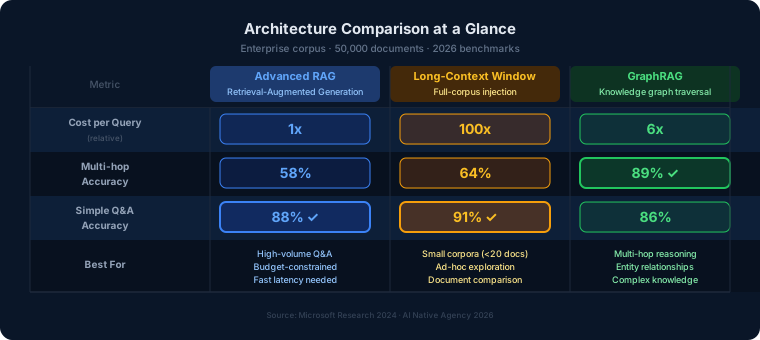
- Long-context windows (1M to 2M tokens) eliminate retrieval failures but cost 100x more per query and suffer from attention degradation on information buried in the middle of large contexts.
- Advanced RAG techniques, including hybrid search, cross-encoder reranking, and semantic chunking, close most of the precision gap without requiring expensive full-context inference.
- GraphRAG replaces vector similarity with a knowledge graph, enabling AI to traverse entity relationships and answer complex analytical questions that span entire corporate data networks.
- Microsoft Research benchmarks showed GraphRAG outperforming standard RAG and 128K-context GPT-4 by 20 to 40% on multi-hop reasoning tasks over financial and legal corpora.
- The optimal 2026 architecture for most UK enterprises is a routing layer: Advanced RAG for high-volume queries, GraphRAG for complex analytical tasks over interconnected data.
The way AI systems access external knowledge is changing faster than most teams can track. For the past two years, Retrieval-Augmented Generation (RAG) has been the dominant pattern: chunk your documents, embed them in a vector database, and retrieve the most relevant chunks before generating a response. It works well enough for simple Q&A over a document library.
But two forces are now disrupting that pattern. First, frontier AI models are shipping with context windows that have grown from 8,000 tokens in 2022 to over 2 million tokens in 2025. Google Gemini 1.5 Pro, Anthropic Claude 3.7, and GPT-4o all support context windows large enough to ingest entire corporate document libraries in a single prompt. Second, Microsoft's GraphRAG research demonstrated that treating knowledge as a graph rather than a bag of indexed chunks dramatically improves performance on complex, multi-hop reasoning tasks.
So which approach is right for your business? The answer is not one-size-fits-all. This guide breaks down how each architecture works, where each one breaks down, and how to choose based on your specific data and query types.
How Standard RAG Works (and Where It Falls Short)
Standard RAG follows a straightforward pipeline. Documents are split into chunks (typically 512 to 2,048 tokens), each chunk is embedded into a high-dimensional vector, and those vectors are stored in a vector database such as Pinecone, Weaviate, or pgvector. At query time, the user's question is embedded, the nearest vectors are retrieved via cosine similarity, and the top chunks are passed to the LLM as context.
The approach works reliably for a narrow class of query: 'What is our refund policy?' or 'Summarise the key risks in this contract.' The relevant information lives in a single location, cosine similarity finds it, and the model returns an accurate answer.
The Vector Search Bottleneck
The problem emerges when queries require information distributed across multiple documents or require understanding relationships between entities. A question like 'How did our 2023 procurement policy change affect supplier contracts in the Northern region?' requires the model to locate the 2023 policy document, identify the specific clauses that changed, cross-reference those clauses against the Northern region's supplier contracts, and synthesise the impact.
Vector search retrieves chunks by semantic similarity, not by logical dependency. If no single chunk contains all three entities in the same passage, the retrieval step returns disconnected fragments, and the model either hallucinates connections or admits it cannot answer. This multi-hop failure is the most common complaint organisations report after deploying RAG in production.
When Simple RAG Fails
Research published on arXiv analysed RAG failures across enterprise deployments and identified three recurring failure patterns: retrieval precision failures (wrong chunks retrieved), context window fragmentation (the relevant answer spans chunks that were never co-retrieved), and entity disambiguation failures (when two documents use the same term to mean different things). These are not edge cases. In a corporate document corpus of 50,000 files, all three patterns occur daily.
The Rise of Long-Context Windows
The obvious engineering response to retrieval fragmentation is to stop retrieving and start including. If you can fit your entire knowledge base in the context window, you eliminate chunking, embedding, and retrieval entirely. The model sees everything and reasons directly over the full corpus.
As of mid-2025, Google Gemini 1.5 Pro supports 2 million tokens, Anthropic Claude 3.7 Sonnet supports 200,000 tokens, and OpenAI's GPT-4o supports 128,000 tokens. At 2 million tokens, you can fit approximately 1,500 PDF pages or the full text of a dozen average-length enterprise reports.
What 1M-Token Windows Actually Mean
The engineering appeal is real. Long-context retrieval removes the chunking step, eliminates embedding index maintenance, and avoids retrieval precision failures. For some use cases, particularly document comparison tasks or in-context few-shot prompting with large example sets, the long-context approach delivers meaningfully better results.
Studies from Stanford's Human-Centered AI group confirm that for tasks where the relevant information is cleanly contained in a small number of documents, long-context models outperform RAG systems on answer quality. The issue is not capability but cost and attention.
The Hidden Costs of Long-Context
Inference with a 1 million token context costs roughly 100 times more than a typical RAG query that passes 4,000 tokens of retrieved context. For a business running 10,000 queries per day, this is the difference between a manageable API bill and an infrastructure crisis.
More critically, long-context models do not maintain uniform attention across the full window. Research from the Lost in the Middle study showed that LLM accuracy degrades significantly for information placed in the middle of a very long context. Critical facts at positions 40% to 80% through a 500-page document are frequently missed or misweighted. This makes long-context an unreliable architecture for precision-critical enterprise queries.
Advanced RAG: The Middle Path
Advanced RAG refers to a class of improvements applied to the standard RAG pipeline that address retrieval precision, context fragmentation, and entity disambiguation without requiring a full context window injection.
The core advanced techniques are hybrid search, reranking, hierarchical chunking, and contextual compression. Together, they substantially close the gap between simple vector retrieval and the accuracy of much more expensive long-context approaches.
Hybrid Search: Combine dense vector search (semantic similarity) with sparse BM25 keyword search. Vector search catches semantic paraphrases; BM25 catches exact term matches. The two signals are fused via reciprocal rank fusion or a learned reranker. This alone reduces retrieval failures by 20 to 40% on typical enterprise corpora.
Reranking: After the initial retrieval step, a smaller cross-encoder model scores each retrieved chunk against the query in full context, re-ordering them before passing to the LLM. Cross-encoders like Cohere Rerank or BGE-Reranker-Large dramatically improve the precision of what the model actually sees.
Hierarchical and Semantic Chunking: Instead of fixed-size token splits, chunk documents at semantic boundaries: paragraph breaks, section headers, and sentence boundaries. Store both coarse-grained chunks for high-level context and fine-grained chunks for precise answers, retrieving at the appropriate level of granularity based on query type.
Contextual Compression: Before passing retrieved chunks to the LLM, use a smaller model to compress each chunk to only the information relevant to the specific query. This reduces noise in the context window and improves answer precision.
For the majority of enterprise Q&A workloads, a well-engineered Advanced RAG pipeline outperforms naive long-context retrieval on cost, latency, and precision. Our earlier guide on LLM integration for UK businesses covers the practical implementation steps for getting a retrieval pipeline into production.
GraphRAG: The Emerging Challenger
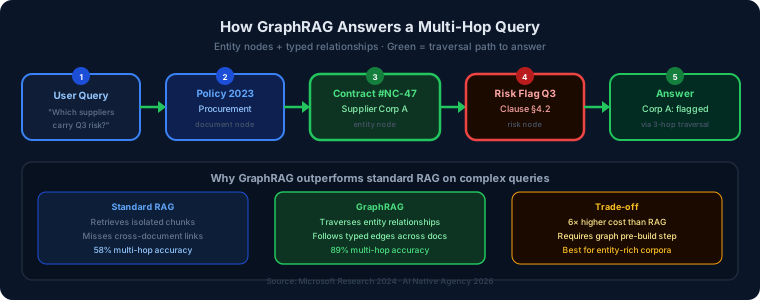
GraphRAG replaces the vector similarity model with a structured knowledge graph. Rather than asking which chunks are semantically closest to this query, GraphRAG asks which entities are relevant and how they are connected.
The approach works in three phases. During indexing, an LLM extracts named entities and their relationships from your document corpus. These relationships are stored as a property graph in a database such as Neo4j or Amazon Neptune. At query time, the query is parsed to identify its entity and relationship intent. The graph is traversed to locate relevant subgraphs: the nodes and edges that are logically relevant to the question, regardless of whether they appeared together in the same source document. The retrieved subgraph is then serialised and passed to the LLM as structured context.
Microsoft's GraphRAG and What It Proved
Microsoft Research published GraphRAG in 2024 and released the open-source implementation shortly after. Their benchmarks compared standard RAG, long-context models, and GraphRAG on a corpus of financial reports and legal documents. On multi-hop reasoning tasks, GraphRAG outperformed both standard RAG and 128K-context GPT-4 by 20 to 40% on answer comprehensiveness and factual accuracy. On simple lookups, the difference was negligible.
The intuition behind this result is worth understanding. Corporate knowledge is not a bag of text snippets. It is a network: people, organisations, projects, contracts, policies, and events connected by relationships. A vector database treats that network as isolated fragments. A knowledge graph treats it as the structured network it actually is.
When to Choose GraphRAG
GraphRAG earns its complexity cost when your queries require traversing entity relationships across a large, interconnected corpus. The clearest enterprise use cases include:
- Compliance and risk analysis: which suppliers are connected to entities flagged in last quarter's risk review?
- Mergers and acquisitions due diligence: what contractual obligations does the target company have with counterparties that also appear in your existing portfolio?
- Customer knowledge management: the full history of interactions, support cases, and commercial terms for a client, and which internal teams have been involved.
- Regulatory mapping: which products are affected by Article 6 of the EU AI Act, and what obligations do those products carry?
For these workloads, vector similarity search is fundamentally the wrong retrieval model. Our post on agentic AI for London businesses covers how multi-step reasoning agents pair naturally with graph-based retrieval for complex analytical tasks.
The Architectural Decision Matrix
Choosing between these approaches requires matching your workload to the architecture's strengths. The decision comes down to four variables: query complexity, corpus interconnectedness, query volume, and acceptable cost per query.
High-volume, low-complexity queries (document Q&A, search, summarisation): Advanced RAG with hybrid search and reranking is the right choice. It delivers good accuracy at low cost and is operationally straightforward to maintain.
Moderate-complexity queries where relevant information sometimes spans two or three documents: consider adding a parent-document retriever to your Advanced RAG pipeline. This retrieves fine-grained chunks for precision but also pulls the surrounding parent document sections for context.
High-complexity, multi-hop analytical queries over a highly interconnected corpus: GraphRAG is the correct architecture. Accept the higher indexing cost in exchange for accuracy on the queries that matter most.
Document-comparison tasks with a small, bounded corpus (fewer than 20 documents): long-context injection remains a valid choice. The corpus fits in the window, the cost is bounded, and comparison accuracy is excellent.
The mistake most teams make is assuming one architecture must serve all query types. A production AI knowledge system in 2026 typically runs two or three retrieval strategies in parallel, routing queries to the appropriate backend based on query classification.
What UK Businesses Should Do in 2026
The practical implication for UK businesses evaluating or upgrading their AI retrieval architecture is this: stop treating RAG as a single technology and start treating it as a design space.
If you are still running a basic chunking-and-cosine-similarity pipeline with no reranking, implementing hybrid search and a cross-encoder reranker is the highest-leverage improvement available with minimal additional infrastructure. A competent AI engineering team can implement this in two to three days and measure a meaningful accuracy improvement on the same query set.
If you have implemented Advanced RAG and are still seeing failures on complex analytical queries, GraphRAG is now production-ready. Microsoft's open-source implementation is a viable starting point, and vendors including Neo4j, Diffbot, and AWS offer managed graph indexing pipelines that significantly reduce the engineering burden.
If your team is excited about long-context models, use them selectively: for document comparison, for few-shot prompting with large example sets, and for one-off analytical tasks where cost is not the primary constraint. Do not use them as a replacement for retrieval infrastructure at query-serving scale.
The organisations that will have the most capable AI knowledge systems in 2026 are those that invest now in structured knowledge extraction, not just embedding pipelines. GraphRAG requires more upfront investment in entity extraction and graph schema design. That investment compounds: every document added to the graph makes the entire graph smarter, because new entities and relationships link to the existing network rather than existing in isolation.
Conclusion
The RAG vs. long-context debate is a false binary. Standard RAG works for simple retrieval. Long-context windows work for bounded document comparison. Advanced RAG closes the precision gap for most enterprise Q&A workloads. GraphRAG solves the multi-hop reasoning problem that neither vector databases nor context windows handle well.
The choice of retrieval architecture is now one of the most consequential technical decisions an AI-deploying business makes. Get it right and your AI systems surface accurate, well-reasoned answers from complex corporate knowledge. Get it wrong and you get a confident-sounding system that hallucinates connections or admits ignorance on the queries that matter most.
The UK businesses building competitive advantage from AI in 2026 are not just using better models. They are building better architectures for connecting those models to the knowledge that makes them useful.
Frequently Asked Questions
- What is the difference between RAG and a long-context window?
- RAG retrieves relevant document chunks before generation; only a small portion of your knowledge base is passed to the model as context. Long-context windows allow you to include the entire knowledge base in a single prompt without a retrieval step. RAG is cheaper and faster for large corpora; long-context is simpler but expensive and prone to attention failures when critical information sits in the middle of a very large input.
- What is GraphRAG and how does it differ from standard RAG?
- GraphRAG is a retrieval architecture developed by Microsoft Research that replaces vector similarity search with a knowledge graph. Standard RAG finds the text chunks most semantically similar to your query. GraphRAG traverses entity relationships to locate information that is logically connected to the query, even when it spans many different source documents. This makes GraphRAG significantly more accurate on complex, multi-hop analytical questions.
- When should I use GraphRAG instead of standard RAG?
- Use GraphRAG when your queries require multi-hop reasoning across interconnected entities, such as compliance risk analysis, mergers and acquisitions due diligence, customer relationship mapping, or regulatory impact assessment. For simple document Q&A and search use cases, Advanced RAG with hybrid search and reranking is more cost-effective and easier to maintain.
- How much does long-context inference cost compared to RAG?
- At typical API pricing in 2025, passing 1 million tokens in a single context costs roughly 80 to 100 times more than a RAG query that passes 4,000 tokens of retrieved context. For businesses running thousands of queries per day, this cost difference makes long-context an impractical replacement for a well-designed retrieval pipeline at production scale.
- What is hybrid search in Advanced RAG?
- Hybrid search combines dense vector search (semantic similarity via embeddings) with sparse keyword search (BM25). The two signals are merged via reciprocal rank fusion or a learned reranker model. It outperforms either approach alone because vector search catches paraphrases and semantic equivalents while keyword search catches exact term matches. Studies show hybrid search reduces retrieval failures by 20 to 40% on typical enterprise corpora.
- What is the 'lost in the middle' problem with long-context models?
- Research from Stanford showed that large language models do not maintain uniform attention across very long contexts. Information placed in the middle portion of a long prompt (roughly 40% to 80% through the input) is frequently missed or misweighted compared to information at the start or end. This means that stuffing a million-token context with corporate documents does not guarantee the model will reliably use facts buried deep in the middle of that corpus.
- Can I run GraphRAG and Advanced RAG simultaneously?
- Yes. Many production systems use a query routing layer that classifies incoming queries and directs them to the appropriate retrieval backend. Simple lookups and Q&A queries go to the Advanced RAG vector pipeline; complex analytical and multi-hop queries go to the GraphRAG knowledge graph. This hybrid routing approach delivers the cost efficiency of RAG for common queries and the accuracy of GraphRAG for the queries that matter most.
- Is GraphRAG production-ready in 2026?
- Yes. Microsoft's open-source GraphRAG implementation has been deployed in production at enterprise scale since 2024. Managed graph database services from Neo4j AuraDB, Amazon Neptune, and DataStax now support graph-backed retrieval pipelines. The main barrier to adoption is the additional engineering effort required for entity extraction schema design and graph maintenance, but commercial tooling has significantly reduced this overhead.
- What vector databases are recommended for Advanced RAG?
- Common production choices include Pinecone, Weaviate, Qdrant, Milvus, and PostgreSQL with the pgvector extension. For corpora under 100,000 chunks, pgvector on a managed Postgres instance is often the simplest and most cost-effective option. For larger corpora with high query throughput requirements, purpose-built vector databases offer better indexing performance and horizontal scaling.