Strategy
What Is an AI Forward Deployed Engineer (FDE)? Roles, Skills, and Responsibilities
13 min read
The AI Forward Deployed Engineer is the role closing the gap between AI capability and real business outcomes. This guide explains what an AI FDE actually does, the skills the role demands, how it differs from a software engineer or solutions architect, and when your organisation needs one.
✦Key Takeaways
- An AI Forward Deployed Engineer (FDE) is an engineer who works directly inside the customer's environment to turn AI capability into a deployed, measurable business outcome, owning the work end to end rather than handing it off.
- The model originated at Palantir and has been adopted by AI labs such as OpenAI and Anthropic because frontier models are easy to demo but hard to operationalise inside a specific company's processes and data.
- The role is defined by a rare combination: genuine engineering ability, business process fluency, and client-facing communication, all in one person.
- An FDE differs from a traditional software engineer (who builds the product) and a solutions architect (who designs the system) by being measured on customer adoption and outcomes, not code shipped or diagrams produced.
- Companies need an FDE when deploying AI into complex, messy enterprise environments where the hard part is integration, change management, and workflow fit rather than the model itself.
- The biggest failure mode in enterprise AI is the proof-of-concept that never reaches production; the FDE exists specifically to close that last mile.
There is a strange gap at the centre of the AI boom. Models have never been more capable, demos have never been more impressive, and budgets have never been larger. Yet inside most enterprises, the AI that reaches production and changes a real number on a real dashboard is a fraction of the AI that gets piloted. The capability is there. The deployment is not.
A 2024 RAND study of why AI projects fail found that most do not stumble on the algorithm at all; they fail on the gap between a working model and a working deployment inside the organisation's actual data, processes, and people. The hard part was never the model. The hard part is everything around it.
This is the gap the AI Forward Deployed Engineer was created to close. The role has moved quickly from a niche title at a handful of data companies to one of the most sought-after positions in the industry, and understanding what an AI FDE actually does tells you a great deal about how enterprise AI really gets built. This guide covers the definition, the day-to-day responsibilities, the skills the role demands, how it differs from a software engineer or solutions architect, and when your organisation genuinely needs one.
What Is an AI Forward Deployed Engineer (FDE)?
An AI Forward Deployed Engineer is an engineer who works directly inside a customer's environment to turn AI capability into a deployed, measurable business outcome. The word forward is borrowed from military logistics, where forward deployed units operate in the field rather than at headquarters. An FDE does the same thing: instead of building a product in isolation and shipping it over the wall, they embed with the customer and build the solution where the problem actually lives.
The distinction matters. A conventional engineer is measured by what they ship. An FDE is measured by what the customer achieves. That shift in success criteria reshapes everything about how the role operates, from the skills it demands to the way the work is sequenced.
The Origins of Forward Deployed Engineering
The Forward Deployed Engineer model was pioneered at Palantir, where engineers were sent to work alongside government and commercial customers to make complex data software produce real operational results. The insight was that the most valuable engineering work in a messy enterprise is not the platform itself but the configuration, integration, and workflow design that makes the platform fit a specific organisation.
As large language models moved from research curiosity to enterprise tool, the same pattern reappeared with greater force. AI labs discovered that a model that dazzles in a demo can stall completely inside a customer's real systems. So the model spread. Companies including OpenAI and Anthropic now run forward deployed teams that work directly with enterprise customers to ship AI into production rather than leaving them to figure it out alone.
Why AI Companies Are Adopting This Model
The economics are straightforward. A frontier model is a horizontal capability; a business outcome is vertical and specific. Closing the distance between the two is expensive, high-skill work, and it is the difference between a customer who renews and a customer who churns after the pilot. Putting an engineer in the room with the customer is the fastest known way to close it, and it doubles as a product feedback loop of unusual quality, because the people building the product are watching it fail and succeed in real conditions.
The Core Purpose of an AI FDE
Strip away the title and the FDE exists to do one thing: bridge business needs and technical implementation so that AI capability becomes a measurable business outcome. That bridge has three load-bearing pillars.
- Bridging business needs and technical implementation. The FDE sits between the customer's operational reality and the AI systems that could improve it, and is fluent enough in both to make them meet in the middle.
- Working directly with customers to solve operational challenges. The work happens on the customer's ground, against the customer's data and constraints, not in a sanitised internal sandbox.
- Turning AI capabilities into measurable business outcomes. Success is defined in the customer's terms: hours saved, error rates reduced, revenue influenced, cases resolved, not lines of code or model accuracy in the abstract.
That last pillar is the one that separates the role from everything adjacent to it. An FDE who builds an elegant system that no one adopts has failed. An FDE who builds a plain system that the customer uses every day and that moves a real metric has succeeded. The outcome is the product.
Why AI Forward Deployed Engineers Are Becoming Essential
To understand why demand for the AI Forward Deployed Engineer has grown so sharply, it helps to look at where enterprise AI adoption actually breaks down.
The Challenges in Enterprise AI Adoption
- Complex business processes. Real workflows are full of exceptions, approvals, and unwritten rules that no model has seen and no specification captures.
- Data integration challenges. Useful data is scattered across CRMs, ERPs, spreadsheets, and legacy databases, much of it inconsistent, duplicated, or locked behind awkward APIs.
- User adoption barriers. A tool that staff do not trust or do not understand simply goes unused, regardless of how good the underlying model is.
- Long deployment cycles. Procurement, security review, and change management can stretch a project for months, by which point the original momentum is gone.
None of these are model problems. They are organisational and engineering problems that sit between the model and the outcome, which is exactly the territory an FDE owns.
How FDEs Address These Challenges
The FDE attacks each barrier directly. Direct customer engagement replaces guesswork about requirements with first-hand observation of how the work is really done. Rapid prototyping and iteration turn months of specification into days of working software that stakeholders can react to. Custom AI workflow design fits the solution to the existing process rather than forcing the process to bend around a generic tool. And by owning the path to production end to end, the FDE compresses deployment cycles and gets to value realisation while the project still has energy behind it.
This is the same operational discipline that underpins our work on building AI agents that fit an existing toolchain rather than replacing it; the methods we describe in building AI agents that work with your existing stack are the FDE playbook applied to real UK systems like Shopify, Xero, and HubSpot.
Key Roles and Responsibilities of an AI Forward Deployed Engineer
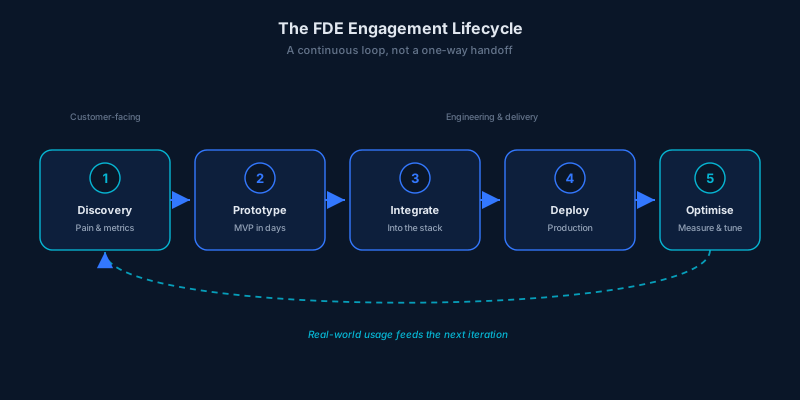
The responsibilities of an AI FDE map onto the full lifecycle of getting AI into production. They are best understood as a sequence, although in practice the stages overlap and loop.
Customer Discovery and Requirements Gathering
Everything starts with understanding the business objective, identifying the genuine pain points and opportunities, and defining the success metrics that the engagement will be judged against. The FDE is looking for the difference between what people say they want and what would actually move the needle. Agreeing on a measurable target at this stage, such as cutting document processing time by half, is what keeps the rest of the project honest.
AI Solution Design
Next comes mapping business processes to AI capabilities: deciding where a large language model, a retrieval system, or an autonomous agent genuinely helps, and where it does not. This means selecting appropriate models and technologies for the job rather than defaulting to the largest model available, and designing workflows that will scale beyond the pilot. The deeper question of whether a capability is defensible is one we explore in why domain-specific AI builds a competitive moat.
Rapid Prototyping and Proof of Concept Development
The FDE then builds a minimum viable version quickly, often in days rather than weeks, to validate the core business assumptions and gather stakeholder feedback against something real. A working prototype surfaces problems that no amount of planning would have revealed, and it converts abstract scepticism into concrete reactions that sharpen the next iteration.
AI Integration and Deployment
This is where many AI projects quietly die, and where the FDE earns the title. Connecting AI systems with existing software means wiring into CRMs, ERPs, databases, and third-party tools, handling authentication, rate limits, and data formats that no demo ever has to deal with. The FDE also takes responsibility for managing deployment environments, ensuring the solution runs reliably in production rather than only on a laptop.
Stakeholder Communication
Throughout, the FDE acts as a bridge between customers and engineering teams, translating technical concepts into business language and managing expectations and priorities in both directions. A model limitation has to be explained to a non-technical sponsor without alarm, and a vague business wish has to be turned into a precise engineering requirement. This translation work is constant, and it is one of the reasons the role is so hard to fill.
Performance Monitoring and Optimisation
Finally, the FDE tracks model and system performance once live, improves workflows based on real-world usage, and confirms that the business objectives agreed at discovery are actually being met. Deployment is the beginning of the relationship, not the end of it. The feedback gathered here feeds the next round of discovery, which is why the lifecycle is a loop.
Notably, much of this monitoring includes deciding where a human should stay in the decision path, a discipline we cover in detail in our piece on human-in-the-loop AI.
Essential Skills Every AI Forward Deployed Engineer Needs
The reason the AI FDE is rare is that the role demands three skill groups that rarely live in one person. Most engineers have the first, most consultants have the third, and very few have all three at once.
Technical Skills
At the foundation sits genuine engineering ability. On the AI side this means a working knowledge of large language models, machine learning fundamentals, retrieval-augmented generation, and AI agents and automation. On the software side it means Python and modern frameworks, API development and integration, comfort with cloud platforms such as AWS, Azure, and GCP, and solid database management. A useful reference point for the modern AI toolkit is the open documentation maintained by the labs, for example the OpenAI platform docs and Anthropic's developer documentation.
Beyond individual technologies, the FDE needs system architecture sense: scalable application design, real attention to security and compliance, and the experience to integrate cleanly with enterprise software rather than bolting something fragile onto the side.
Business and Product Skills
The second group is what separates an FDE from a strong engineer who happens to know AI. Business process analysis means understanding how an industry actually works and spotting where automation creates leverage. Product thinking means prioritising features by business impact and designing for the end user rather than for the demo. An FDE who cannot tell which of ten possible improvements matters most to the customer will build the wrong nine first.
Communication and Consulting Skills
The third group is client-facing. The FDE needs the communication skills to run a workshop, the consulting instinct to read a room of stakeholders with competing agendas, and the problem-solving and cross-functional collaboration to keep an engagement moving when it stalls. The defining test is simple: an effective AI FDE can hold their own in an engineering code review in the morning and in a boardroom conversation about return on investment in the afternoon.
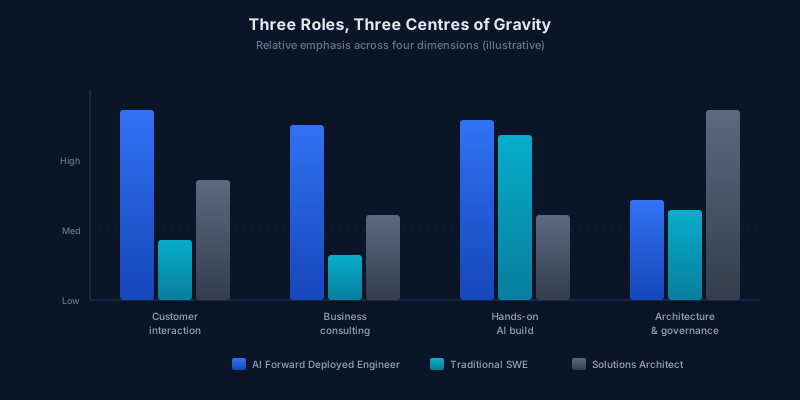
FDE vs Traditional Software Engineer vs Solutions Architect
The fastest way to understand the AI FDE is to place it next to the two roles it is most often confused with. The differences are not about seniority; they are about where each role spends its energy and how each is measured.
| Area | AI Forward Deployed Engineer | Traditional Software Engineer | Solutions Architect |
|---|---|---|---|
| Primary focus | Customer-specific AI implementation | Product and application development | System design and architecture |
| Customer interaction | Very high | Low to moderate | Moderate to high |
| AI implementation | Direct, hands-on | Varies by team | Usually strategic oversight |
| Business consulting | High | Low | Moderate |
| Prototyping | Frequent | Occasional | Limited |
| Deployment ownership | End to end | Technical delivery | Architectural guidance |
| Success metric | Customer outcomes and adoption | Code quality and feature delivery | Scalable system design |
Read down the success metric row and the distinction becomes obvious. The software engineer is judged on what ships, the architect on whether the design holds up at scale, and the FDE on whether the customer actually got the result they were promised. The architect draws the blueprint; the FDE stays on the construction site until the building works.
When You Need an AI FDE
You need an FDE when you are deploying AI into a complex enterprise environment, building customer-specific workflows, integrating AI into existing business systems, or trying to accelerate time-to-value. The common thread is that the hard part of the project lives outside the model.
When a Traditional Software Engineer Is Sufficient
A traditional software engineer is the right call for standard product development, internal platform enhancements, and any work with well-defined technical requirements. If the specification is clear and the customer is not in the room, you do not need the FDE skill set.
When a Solutions Architect Is Most Valuable
A solutions architect earns their keep on large-scale system planning, technology stack selection, and enterprise architecture governance. Where the central question is how the whole system should be shaped over years, the architect leads, often with an FDE delivering the customer-facing pieces underneath.
Industries Benefiting Most from AI Forward Deployed Engineers
The FDE model pays off most in industries where AI has to be woven into established, often regulated, operational systems rather than used as a standalone tool.
- Financial services: risk analysis, document processing, and customer service automation, where accuracy and auditability are non-negotiable.
- Healthcare: clinical workflow support, medical documentation, and data analysis, where integration with existing clinical systems is the whole challenge.
- Manufacturing: predictive maintenance and supply chain optimisation, where AI must connect to sensor data and operational systems.
- Retail and e-commerce: personalised recommendations, customer support automation, and demand forecasting tied directly to revenue.
- SaaS and technology companies: AI-powered product enhancements and customer-specific AI deployments, often delivered by the vendor's own forward deployed team.
In each case the FDE is the person who makes a general AI capability behave correctly inside a specific, complicated, real-world operation.
The Future of AI Forward Deployed Engineering
Demand for the role is set to grow as AI adoption deepens. McKinsey's research on the state of AI shows that the share of organisations using AI has climbed steeply, and that the next frontier is agentic systems that act rather than merely answer. As autonomous agents and self-directed workflows spread, the work of safely embedding them in a business becomes more demanding, not less, which plays directly to the FDE's strengths.
The emphasis on customer-specific implementation is also likely to intensify. As base models commoditise, the durable advantage shifts to how well a capability is deployed against a particular company's data and process, which is precisely the FDE's domain. Expect the role itself to evolve from deployment specialist toward strategic AI advisor, with the most senior FDEs shaping a customer's AI roadmap rather than only delivering individual projects.
For organisations weighing how to resource this, the practical question of whether to build an internal capability, hire freelancers, or bring in a specialist partner is one we break down in our comparison of AI-native agency versus freelance AI engineer versus big consultancy.
Conclusion
The AI Forward Deployed Engineer exists because the bottleneck in AI value has moved. The constraint is no longer the intelligence of the model; it is the distance between that intelligence and a working outcome inside a real organisation. The FDE is the role purpose-built to close that distance, combining engineering skill, business judgement, and client-facing communication into a single person who owns the result end to end.
For any organisation serious about AI, understanding the FDE function is no longer optional. It is the difference between an impressive pilot that quietly fades and a deployment that changes how the business runs. The companies that learn to deploy AI well, rather than merely to acquire it, will be the ones that pull ahead, and the Forward Deployed Engineer is how that deployment actually happens.
Frequently Asked Questions
- What does an AI Forward Deployed Engineer do?
- An AI Forward Deployed Engineer works on site or embedded with a customer to take an AI capability from idea to a deployed, working system inside that customer's real environment. The role spans discovery of the business problem, rapid prototyping, integration with existing systems such as CRMs and databases, deployment to production, and ongoing optimisation based on real usage. Unlike a pure engineer, the FDE owns the business outcome, not just the code.
- What is the difference between an AI FDE and a machine learning engineer?
- A machine learning engineer focuses on building, training, and optimising models, usually working on a product or platform that many customers use. An AI FDE rarely trains models from scratch; instead they apply existing models, often via APIs and frameworks like RAG and agents, to one customer's specific problem, and they spend a large share of their time on integration, business analysis, and stakeholder communication rather than model research.
- Do startups need AI Forward Deployed Engineers?
- Yes, often earlier than they expect. For an early-stage AI startup, the founding engineers frequently act as de facto FDEs, sitting with the first customers to make the product actually work in their environment. This direct deployment feedback loop is one of the fastest ways to learn what the product needs to become, which is why so many AI companies treat the FDE function as a growth engine rather than a cost centre.
- What skills are required to become an AI Forward Deployed Engineer?
- An effective AI FDE combines three skill groups: technical (LLMs, RAG, AI agents, Python, API integration, cloud platforms, and database knowledge), business and product (process analysis, prioritisation by impact, user-centric design), and communication (client-facing consulting, workshop facilitation, and translating technical concepts into business language). The defining trait is the ability to operate credibly in both an engineering review and a boardroom.
- Why are AI companies hiring more Forward Deployed Engineers?
- Because the bottleneck in AI value has shifted from model capability to deployment. Frontier models are now extremely capable in a demo, but every enterprise has unique data, processes, and systems that a model cannot navigate on its own. FDEs are the people who do that customer-specific implementation work, which is why demand for the role has grown sharply as AI adoption has scaled.
- Is an AI FDE the same as a solutions architect?
- No. A solutions architect typically provides strategic design and architectural guidance and may not write much of the implementation themselves. An AI FDE is hands-on through the entire lifecycle, building prototypes, writing integration code, and owning the deployment until the customer is achieving the agreed outcome. The architect designs the blueprint; the FDE lives on the construction site until the building works.
- Which industries benefit most from AI Forward Deployed Engineers?
- Industries with complex, regulated, or data-heavy workflows benefit most, including financial services (risk analysis, document processing), healthcare (clinical workflow support, medical documentation), manufacturing (predictive maintenance, supply chain), and retail (personalised recommendations, demand forecasting). Any sector where AI must be woven into established operational systems rather than used as a standalone tool is a strong fit for the FDE model.