Strategy
What is Human-in-the-Loop (HITL) Consulting? And Why It Matters for UK Businesses
6 min read
Most AI deployments fail not because the model is wrong, but because no one designed where the human stays in the loop. This guide explains Human-in-the-Loop (HITL) consulting, how to build a four-pillar HITL framework, and why EU AI Act compliance is making it non-negotiable for UK businesses.
✦Key Takeaways
- HITL is not about slowing AI down — it's about knowing precisely where human judgment prevents costly, hard-to-reverse failures.
- HITL consulting maps every AI-assisted decision by risk, confidence, and consequence, then designs the right oversight model for each.
- The EU AI Act's Article 14 mandates documented human oversight for high-risk AI systems; UK businesses in regulated sectors are already in scope.
- Poor HITL design causes two distinct failures: over-automation (AI decides things it shouldn't) and alert fatigue (humans rubber-stamp outputs they never scrutinise).
- Every human correction in a well-designed HITL system becomes a training signal that improves model accuracy over time.
- Enterprise clients, insurers, and investors now audit for AI oversight maturity — HITL is a commercial differentiator, not just a compliance checkbox.
AI is making decisions that affect your customers, your revenue, and your reputation, often in milliseconds, without a human in sight. Most businesses deploying AI rush to automate. Fewer pause to ask: at what point does a human need to stay involved?
That question is the heart of Human-in-the-Loop (HITL) consulting. And getting the answer wrong is one of the most common, and expensive, mistakes in AI deployment today.
What Does Human-in-the-Loop Actually Mean?
At its core, Human-in-the-Loop (HITL) refers to any AI system where humans are embedded in the decision-making process: reviewing outputs, correcting errors, making final calls, or providing feedback that retrains the model.
It is not a single technology. It is a design principle. And it comes in three distinct modes:
- Human-in-the-loop: A human reviews and approves AI output before any action is taken.
- Human-on-the-loop: AI acts autonomously, but a human monitors in real time and can intervene.
- Human-out-of-the-loop: Full automation with no human review, appropriate only for low-stakes, high-confidence, reversible decisions.
Most organisations running AI in production need all three modes operating in parallel across different workflows. The consulting challenge is knowing which mode belongs where.
What is HITL Consulting?
HITL consulting is the discipline of analysing AI systems and business workflows to answer four questions:
- Which decisions should be automated versus reviewed by a human?
- Where does human judgment add the most value relative to its cost?
- How do you design the interface and process so human review is fast, accurate, and low-friction?
- How do you capture human feedback to continuously improve model performance?
It sits at the intersection of AI engineering, UX design, risk management, and operational process design. A HITL consultant does not just build the model; they architect the human side of the system. That distinction matters enormously in practice.
Why HITL Design Fails Without Expert Help
Companies consistently underestimate HITL complexity in two opposing ways.
Over-automation removes humans from decisions where the stakes are too high. A loan rejection, a medical triage flag, a fraud alert, a content moderation call: when the AI gets these wrong and there was no human check, the fallout is severe and often irreversible.
Alert fatigue goes in the opposite direction. Teams add human review to every AI output, burying staff in a queue of low-stakes confirmations. Within weeks, reviewers begin rubber-stamping decisions without real scrutiny. The human "oversight" becomes performance rather than protection.
Good HITL design solves both simultaneously. It uses confidence thresholds, risk scoring, and decision mapping to route the right decisions to human eyes, and automate everything else cleanly. Without that design discipline, you will inevitably land in one failure mode or the other.
Regulatory Pressure Is Making HITL Non-Optional
The EU AI Act, which applies to UK businesses operating in European markets or handling EU citizen data, classifies AI systems in healthcare, credit, recruitment, and critical infrastructure as high-risk. Article 14 requires these systems to be designed to allow "effective human oversight," including the ability to understand, correct, and override AI outputs. Enforcement timelines are live. UK organisations without documented HITL frameworks face regulatory exposure as AI deployments scale.
The NIST AI Risk Management Framework identifies human oversight as a core pillar of trustworthy AI. Beyond regulation, enterprise procurement teams, insurers, and institutional investors increasingly audit for AI governance maturity, including HITL, before committing to AI-dependent partnerships. If you are selling AI-assisted services B2B, your buyers will ask for this.
The Four Pillars of a Robust HITL Framework
1. Decision Mapping
Classify every AI-assisted decision across four dimensions: consequence of error, frequency, model confidence, and reversibility. High-consequence, low-reversibility decisions, regardless of model accuracy, belong in human-in-the-loop mode. This mapping is the foundation everything else is built on.
2. Threshold Design
Set confidence thresholds that route AI outputs automatically when confidence is high and escalate to humans when it drops below. Thresholds must be calibrated empirically against real production data, not estimated upfront. A well-designed threshold system can route 80 to 90% of volume to full automation while ensuring human eyes see every decision that matters.
3. Review Interface Design
If reviewing an AI decision takes longer than making it manually, the system is broken. Good HITL interfaces surface the AI's reasoning, the input data it used, and the available decision options in under ten seconds of cognitive load. Speed matters: slow review interfaces are how alert fatigue starts.
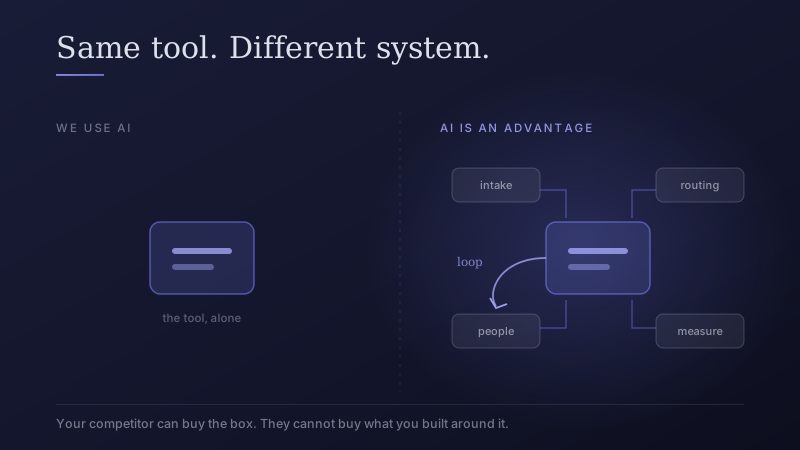
4. Feedback Loop Architecture
Every human correction is a training signal. Well-designed HITL systems capture reviewer overrides and disagreements, feeding them into retraining pipelines on a regular cadence. This is how AI systems improve over time under real-world conditions rather than degrading as data distribution drifts. For a deeper look at how this fits into your broader AI investment, see our guide on measuring the ROI of AI in your UK business.
HITL in Practice: Three UK Industry Examples
Healthcare
An NHS trust deploys an AI triage model for radiology scans. HITL design routes scans flagged as low-risk directly to a secondary scheduling queue, while high-risk flags go immediately to a radiologist with a priority tag. Human review time falls 40% while maintaining clinical oversight on every decision that carries diagnostic weight.
Financial Services
A UK fintech lender uses AI to pre-score loan applications. HITL is applied at two points: edge-case applications where model confidence falls below threshold, and every rejection, which requires a human final decision by design. The approach satisfies FCA requirements while keeping underwriting costs significantly below traditional models.
E-commerce
An AI content moderation system handles 94% of flagged product listings automatically. The 6% that fall in ambiguous categories route to a two-person review team with a 30-minute SLA. That team's override decisions feed a weekly retraining cycle. Six months in, the automatic approval rate had risen from 94% to 97%: the human loop was improving the model. For context on where HITL fits within a full AI transformation programme, our AI maturity roadmap for UK businesses covers how HITL evolves from early pilots to agentic deployments.
Do You Need HITL Consulting?
Consider it a priority if any of the following apply:
- Your AI system makes decisions with legal, financial, health, or safety consequences.
- You operate in a regulated sector: healthcare, financial services, legal, education, or HR.
- Your team is buried in AI alerts or approving outputs that never get challenged.
- You are preparing for an enterprise procurement process or AI governance audit.
- Your AI model's accuracy is declining as real-world data drifts from its training distribution.
Conclusion
Human-in-the-Loop consulting is not about limiting what AI can do. It is about deploying AI with precision, knowing exactly where to trust the model and exactly where a human still makes the difference between a good outcome and an expensive one. As AI takes on more consequential roles inside UK businesses, HITL design is no longer optional. The first question in any serious AI deployment is not "how do we automate more?" It is "where do humans still need to be in this loop?" For a practical next step, explore the research on HITL systems and human oversight in AI to understand the academic foundation behind these design principles.
Frequently Asked Questions
- What does Human-in-the-Loop (HITL) mean in AI?
- Human-in-the-Loop (HITL) refers to AI systems where humans are embedded in the decision-making process — reviewing outputs, making final calls, or providing corrections that retrain the model. It is a design principle rather than a specific technology, and it comes in three modes: human-in-the-loop (pre-action review), human-on-the-loop (real-time monitoring), and human-out-of-the-loop (full automation for low-risk decisions).
- Is Human-in-the-Loop required by UK law?
- For AI systems classified as high-risk under the EU AI Act — which applies to UK businesses operating in European markets or regulated sectors — human oversight is legally required under Article 14. While the UK has its own emerging AI governance framework, UK businesses in healthcare, financial services, and HR should treat documented human oversight as a compliance requirement today, not a future aspiration.
- What's the difference between HITL and human-on-the-loop?
- Human-in-the-loop requires a human to review and approve AI output before action is taken. Human-on-the-loop allows the AI to act autonomously while a human monitors and retains the ability to intervene. The right mode depends on the consequence and reversibility of the decision — high-stakes, hard-to-reverse decisions warrant in-the-loop; lower-stakes, monitorable decisions can be managed on-the-loop.
- How does HITL improve AI accuracy over time?
- Every human override or correction in a HITL system is a labelled training example. When these overrides are systematically captured and fed back into retraining pipelines, the model learns from its real-world errors. This feedback loop is one of the most underutilised advantages of HITL — most organisations treat human review as a cost rather than as a free data generation engine.
- Which industries need HITL consulting most urgently?
- Healthcare (diagnostic AI, triage, prescribing support), financial services (credit scoring, fraud detection, KYC), legal (document review, contract analysis), HR (CV screening, performance assessment), and any industry deploying AI in customer-facing or regulatory-facing workflows. Domains with high error costs and low error reversibility have the most to gain from structured HITL design.
- What happens if we skip HITL in our AI deployment?
- Without HITL design, organisations typically land in one of two failure modes: over-automation (AI makes consequential decisions it should not, creating liability when it fails) or alert fatigue (humans are overloaded with review tasks and stop engaging meaningfully). Both erode the value of the AI investment and, in regulated sectors, can create compliance exposure. The cost of retrofitting HITL after an incident is significantly higher than designing it in from the start.
- How long does it take to design a HITL framework?
- A focused HITL assessment and framework design for a single AI workflow typically takes two to four weeks, covering decision mapping, threshold calibration, interface design specification, and feedback loop architecture. For enterprise-scale deployments across multiple workflows, eight to twelve weeks is a more realistic timeline for a comprehensive programme.