Strategy
Why Digital Agencies Are Ditching Billable Hours for Outcome-Based + Agent Retainers in 2026
15 min read
AI collapsed production time by an order of magnitude and broke the billable hour as a proxy for value: bill the honest six hours and revenue collapses, bill the old forty and it is fiction. This deep dive explains the two models replacing it, outcome-based pricing and the agent retainer, the hybrid stack real agencies now run, and the playbook for switching, whether you sell agency work or buy it.
✦Key Takeaways
- The billable hour survived for decades because it was easy to administer and audit, not because it aligned anyone's interests. It punishes efficiency and rewards padding.
- AI broke the hour as a proxy for value: production time collapsed by an order of magnitude while the value of judgement, taste and accountability did not.
- Outcome-based pricing is inherited from the software agencies resell: Zendesk charges per automated resolution and Intercom's Fin prices at $0.99 per resolved conversation. Results, not effort, are the unit.
- The agent retainer is 2026's genuinely new model: a monthly fee for named workflows run by AI agents under human review, with SLAs, audit logs and continuous tuning. It gives agencies recurring revenue and finally aligns margin with efficiency.
- Most real agencies run a hybrid stack: fixed fees for strategy, milestones for builds, agent retainers for always-on operations, performance bonuses for upside.
- Clients should demand written definitions of done, human review gates, transparency about the AI share of the work, and exit terms that say who keeps the agents and briefs.
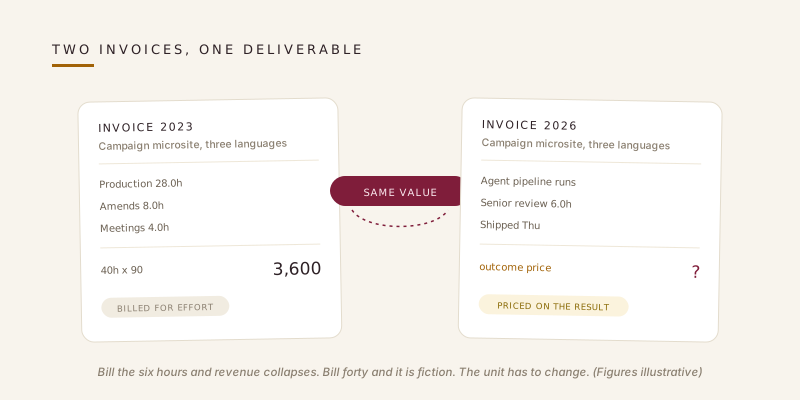
An agency principal we know describes 2026 with a story. A client brief arrived on a Tuesday: a campaign microsite, localised in three languages, with analytics wired in. In 2023 the same brief was quoted at three weeks. This time a two-person team with a fleet of AI agents shipped it on Thursday. The awkward question arrived with the invoice: what exactly do you bill for, the eleven hours it took, or the three weeks it is worth?
That question is dismantling the billable hour across the agency world, and two models are replacing it: outcome-based pricing, where clients pay for defined results, and the agent retainer, where clients pay monthly for a governed fleet of AI agents plus the human judgement that steers it. Together they are less a pricing tweak than a redefinition of what an agency sells.
This piece explains why the shift is happening now, how both models work, what a sensible hybrid looks like, and a playbook for making the move, whether you run an agency or buy from one.
How the Billable Hour Became the Default (and Why It Held So Long)
The hour crept into agencies from the professions. Law firms formalised time-based billing in the mid twentieth century, accountancies followed, and when advertising and then digital agencies needed a defensible way to invoice intangible work, the timesheet was waiting. It had real virtues: it is trivially easy to administer, it feels auditable, and it moves scope risk onto the client, since more work simply means more hours.
It also carried a rot everyone learned to live with. Hourly billing punishes the firm that gets faster and rewards the one that pads. Improve your process and you cut your own revenue; inflate a task and the client pays more for the same result. As Mohanbir Sawhney observed in Harvard Business Review’s Putting Products into Services, time-based fees actively discourage professional firms from productising and automating their own work, because every efficiency gain shows up as lost income. The model held anyway, because clients could compare day rates, procurement could audit timesheets, and nobody had a strong enough reason to renegotiate the whole basis of trade.
Then, in the space of about three years, the cost structure underneath it collapsed.
The AI Shock: When Effort Stopped Predicting Value
AI did not make agency work uniformly faster; it made production dramatically faster while leaving judgement roughly where it was. First drafts, code scaffolds, creative variants, research summaries, localisation, reporting: work that consumed the middle of every project now runs through agent pipelines in minutes. What did not compress is knowing what to make, why, for whom, and whether the thing produced is actually good. The blend of an agency's costs changed shape: less typing, more taste.
Run the arithmetic and the hour's problem becomes existential. Say a deliverable was honestly forty hours at 90 pounds an hour in 2023: a 3,600 pound invoice. The same deliverable now takes six supervised hours. Bill honestly and revenue falls by 85 per cent for identical client value. Bill forty anyway and you are selling hours that no longer exist, to a client who has used these tools personally and knows roughly what they compress. Neither branch is a business. The hour was only ever a proxy for value, and AI broke the proxy.
The pressure is arriving from the buying side too. Procurement teams in 2026 ask directly what share of delivery is AI-assisted and expect the economics to show up in the price. Meanwhile agencies that moved early stopped hiding the efficiency and started charging for what clients actually wanted all along: the result, and someone accountable for it. We covered the buyer’s view of these trade-offs in our cost and speed comparison of agencies, freelancers and consultancies.
Model One: Outcome-Based Pricing (Pay for the Thing, Not the Time)
Outcome-based pricing attaches the fee to a defined result rather than the effort behind it. In agency practice it takes three main forms. Per deliverable: a fixed price for a shipped website, a launched campaign, a migrated data set, regardless of hours consumed. Per result: a price per qualified lead, per booked appointment, per resolved support conversation, per ranking achieved. Milestone-based: staged fees released as agreed checkpoints are met.
What makes 2026 different is that the software agencies deploy has already normalised the logic. Zendesk introduced outcome-based pricing for its AI agents, charging per automated resolution, defined as a conversation the AI closes with no human escalation and no customer reply within 72 hours, at roughly 1.50 to 2 dollars each. Intercom prices its Fin agent at $0.99 per resolution. When the tools in the stack bill per outcome, an agency billing hours on top of them is running two incompatible economic systems in one invoice. Clients notice the seam.
Honest practitioners are equally clear about what the model demands. Outcomes need baselines measured before work starts, attribution rules agreed in writing, and a definition of done precise enough to survive a disagreement in month four. And some outcomes are bad candidates: results the agency cannot meaningfully control (an algorithm update, a client who never approves anything), outcomes with long lags, and metrics that can be gamed into vanity. The discipline of choosing measurable, controllable outcomes is the same one we set out in our framework for measuring AI ROI: baseline first, one metric per initiative, argue about definitions before launch rather than after.
Model Two: The Agent Retainer (Capacity as a Service)
The second model has no real pre-AI ancestor. An agent retainer is a monthly fee for a governed fleet of AI agents that runs defined workflows for the client, wrapped in human oversight, quality gates and continuous improvement. The client is not buying hours, and not strictly buying outcomes either. They are renting operational capacity: an always-on production layer with accountability attached.
A typical retainer specifies named workflows: a content pipeline that drafts, optimises and schedules; a reporting agent that assembles the weekly pack; an outreach agent that researches and personalises; a support triage agent that labels and drafts replies. Around those workflows sit the terms that make it a professional service rather than a software subscription: volume tiers, response and turnaround SLAs, named human reviewers and approval gates, audit logs of every agent action, a kill switch, and a monthly tuning session where briefs and prompts are refined against results.
The commercial logic explains why agencies are moving fast. For the agency, retainers convert lumpy project revenue into recurring revenue, and, for the first time in the industry’s history, margin improves when delivery gets more efficient, because the fee is fixed while the cost of running agents falls. The moat compounds too: every month of encoded briefs, tone guides and exception handling makes the fleet better and the relationship stickier. For the client, the appeal is a predictable line item, delivery that does not take holidays, no headcount added, and a dashboard that shows exactly what ran and what a human approved. It is the operating model of an AI-native agency expressed as a price.
It is worth pausing on the margin mechanics, because they explain the speed of adoption. Under hourly billing, an agency that halves its delivery time halves its invoice: efficiency is self-harm. Under a retainer, the fee is agreed against the value of the capacity, so when the cost of running the workflows falls, through better prompts, cheaper models or accumulated context, the saving lands with the agency, and the client's price simply stays flat and predictable. For the first time, both sides want the same thing: the work done better with less effort. That single reversal of incentives is doing more to modernise agency operations than any technology announcement.
Pricing anatomy varies, but a common structure has three parts: a base fee covering the platform, maintenance and governance; a usage component tied to volume or outcomes (posts shipped, resolutions achieved, reports delivered); and an oversight tier reflecting how much senior human review the workload needs. Illustratively, a small UK business might pay a four-figure monthly base for three workflows with defined volumes, with usage bands above it, where the equivalent human delivery would cost a multiple of that in salaries or hourly fees. The numbers are invented; the structure is the point.
The Hybrid Stack Real Agencies Run in 2026
Almost nobody prices everything one way. The pattern that has settled in looks like a stack, with the pricing model matched to the nature of each layer.
| Layer | What it covers | Pricing model | Why it fits |
|---|---|---|---|
| Strategy and discovery | Positioning, audits, roadmaps | Fixed fee | Value is judgement, effort is bounded |
| Build | Sites, integrations, agent setup | Fixed price per milestone | Scope is definable, AI compresses delivery |
| Run | Content, reporting, outreach, support | Agent retainer | Always-on capacity, efficiency accrues to both sides |
| Upside | Agreed growth metrics | Performance bonus | Aligns incentives where attribution is clean |
Put illustrative numbers on it and the shape is easy to read. A UK SME engagement might look like: a 6,000 pound discovery producing the roadmap and outcome definitions; a 15,000 pound build across three milestones standing up the site and the agent workflows; a 2,500 pound monthly agent retainer running content, reporting and support triage under human review; and a bonus tied to qualified pipeline above an agreed baseline. Every figure is invented, and every client is different; what matters is that each layer's price matches the kind of risk it carries.
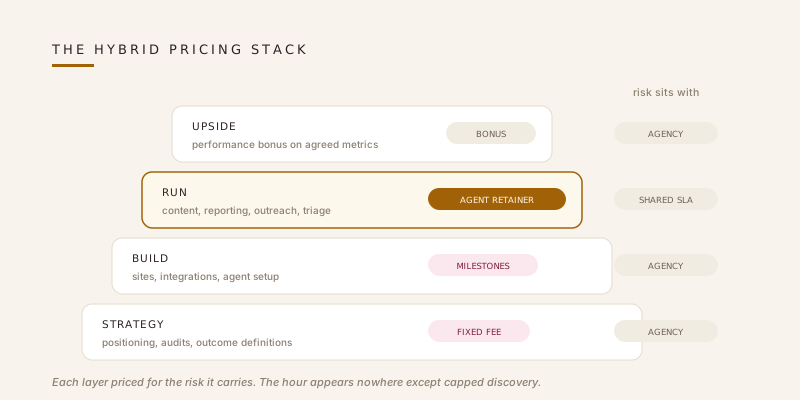
Two things make the stack work. The first is sequencing: strategy defines the outcomes, the build creates the machinery, the retainer runs it, and the bonus rewards results the earlier layers made measurable. The second is honesty about risk: fixed fees put efficiency risk on the agency, outcome fees put delivery risk on the agency, and retainers share operating risk through SLAs. Hourly billing, by contrast, put nearly all risk on the client, which is precisely why clients are declining to renew it.
Where does that leave the hour? Alive in one honest niche: genuine unknowns. Exploratory discovery, unscoped rescue work, novel R&D where nobody can define done yet. Even there, 2026 practice caps it: a bounded diagnostic at a fixed ceiling, converting to fixed or outcome pricing the moment the unknown becomes known.
Moving to Outcome-Based Pricing: An Agency Playbook and a Client Checklist
For agencies, the migration is less about pricing courage than operational hygiene. The steps that recur in every successful transition:
- Learn your cost per outcome. Instrument delivery until you know what a landing page, a campaign, a report pack actually costs you in agent spend and human hours. You cannot price outcomes you cannot cost.
- Productise two services first. Pick the two offerings you deliver most often, write definitions of done, and publish fixed prices for them. Leave the rest hourly while you learn.
- Price against value bands, not cost-plus. The client’s alternative (salaries, a bigger agency, doing nothing) sets the ceiling; your cost per outcome sets the floor. Choose a point, not a formula.
- Instrument the agents. Traces, logs and review records are not just governance; they are what lets you defend an invoice in an outcome dispute.
- Lead the client conversation with their number, not yours. The pitch is not “we are changing our pricing”; it is “here is what you paid last quarter, here is the same scope as outcomes and capacity, and here is where the risk moves from you to us”. Framed that way, most clients are being offered certainty and accountability, which is what they always wanted the hours to mean.
- Grandfather gently. Move legacy clients at renewal with a side-by-side quote. Some will prefer the old model for a year. Let them.
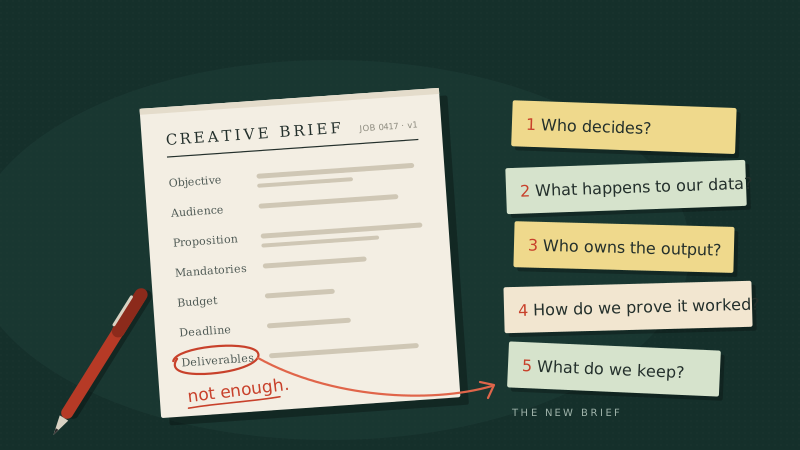
For clients, the models are better, but only with the paperwork to match. Before signing, demand: a written definition of every outcome and its measurement source; named human review gates and who staffs them; transparency about which work is AI-produced and how it is checked; data ownership and the right to the briefs, prompts and configurations your fees paid to refine; and exit terms that specify what happens to the agent fleet when you leave. An agency that resists the last one is telling you the lock-in is the product.
Both sides should also name the failure modes out loud. Outcome pricing can tempt corner-cutting, which is what quality gates and definitions of done exist to prevent. Retainers can drift into paying for idle capacity, which is what volume bands and quarterly reviews exist to correct. And badly chosen outcomes punish agencies for factors they never controlled, which is why the metric list is a negotiation, not a form field.
Conclusion: Selling Judgement, at Last
The billable hour asked clients to buy effort and hope value followed. AI ended the polite fiction that the two were the same thing. What replaces the hour is not one model but a repriced relationship: judgement sold at fixed fees, delivery sold by milestone, operations rented as governed agent capacity, upside shared where attribution is clean. Agencies get margins that improve with skill and revenue that recurs; clients get prices attached to things they actually wanted.
We practise what this article preaches: AI Native Agency prices strategy fixed, builds by milestone, and runs agent retainers with human review gates and full audit logs. If you want to see what your current hourly spend would look like re-cut as outcomes and capacity, we will map it with you.
Frequently Asked Questions
- What is outcome-based pricing for digital agencies?
- A model where fees attach to defined results rather than time spent: a fixed price per deliverable shipped, per qualified lead, per resolved conversation or per milestone reached. It requires a baseline measured before work begins, an agreed attribution method, and a written definition of done for every outcome.
- What is an agent retainer?
- A monthly fee for a governed fleet of AI agents running named workflows for a client, such as content production, reporting, outreach and support triage, wrapped in human review gates, SLAs, audit logs and monthly tuning. The client rents always-on operational capacity with accountability, rather than buying hours or individual deliverables.
- Why are billable hours disappearing in 2026?
- Because AI collapsed production time by an order of magnitude while leaving the value of the work intact, the hour stopped being a usable proxy for value. Billing honest hours collapses agency revenue; billing padded hours misleads clients who use the same tools and know what they compress. Both branches fail, so pricing is moving to results and capacity.
- Is hourly billing ever still appropriate?
- Yes, for genuine unknowns: exploratory discovery, rescue work on broken systems, and novel R&D where nobody can yet define done. Even then, current practice caps the engagement at a fixed ceiling and converts it to fixed or outcome pricing as soon as the scope becomes definable.
- How are agent retainers priced?
- The common anatomy is three parts: a base fee for the platform, governance and maintenance; a usage component tied to volumes or outcomes, such as posts shipped or resolutions achieved; and an oversight tier reflecting how much senior human review the work requires. Prices vary with scope, but the structure is consistent.
- What should a client check before signing an outcome-based contract?
- Written definitions of each outcome and its measurement source, named human review gates, transparency about the AI share of production, ownership of data and of the briefs and configurations refined with your fees, and exit terms covering what happens to the agent fleet if you leave. Resistance to exit terms is a warning sign.
- Does outcome pricing push agencies to cut corners?
- The incentive exists, which is why mature contracts pair every outcome with quality gates: definitions of done, human approval before publication, and audit logs. In practice the bigger risk runs the other way: agencies underestimating the human oversight an outcome needs and underpricing it.
- How does an agent retainer compare with hiring in-house?
- A retainer buys outcomes-per-month with governance included: the workflows, the human review, the maintenance and the improvements. Hiring buys a person who still needs tools, management and cover. For defined operational workloads at SME scale, retainers usually cost a fraction of the equivalent headcount; the crossover comes when a workload grows strategic enough to justify owning the capability.
- What happens to agency teams under these models?
- Headcount shifts from production to judgement. Fewer hands typing first drafts; more editors, strategists and reviewers who define briefs, set quality bars and own exceptions. New roles appear around running the fleet: prompt and workflow maintenance, evaluation, and client-facing reporting on what the agents did.