Small Language Models and Edge AI: Why Compact Models Are Winning in 2026
10 min read
Frontier models grab headlines, but the real productivity gains in 2026 are coming from compact 1B-8B parameter models like Phi-3, Gemma 2, and Llama-3-8B, fine-tuned for specific tasks and deployed directly on devices. This guide explains the cost, latency, and compliance case for SLMs in UK businesses.
✦Key Takeaways
Small Language Models (1B to 8B parameters) now match or exceed GPT-4-class performance on narrow, well-defined tasks when properly fine-tuned on domain data.
Edge AI deployment eliminates round-trip cloud latency and reduces per-inference costs to near zero at scale, shifting AI from a variable to a fixed infrastructure cost.
Models like Microsoft Phi-3, Google Gemma 2, and Meta Llama-3-8B are production-ready and freely available for commercial fine-tuning with no ongoing licence fees.
Fine-tuning an SLM using QLoRA costs between £50 and £200 in cloud GPU time and takes 4 to 12 hours, making it accessible to any engineering team.
UK GDPR compliance becomes structurally simpler when data never leaves the device or on-premise environment, eliminating the Article 28 third-party processor relationship.
The optimal 2026 AI architecture is a hybrid: SLMs for high-frequency narrow tasks on-device, frontier models reserved for complex reasoning and long-context workloads.
UK businesses routing high-volume, task-specific workloads through frontier APIs are paying 5 to 10 times more than equivalent SLM deployments at production scale.
The biggest AI story of 2026 is not about a bigger model. It is about a smaller one.
While OpenAI, Google DeepMind, and Anthropic continue pushing frontier models toward trillion-parameter territory, a quieter but economically significant shift is happening across enterprises, startups, and device manufacturers: the rapid adoption of Small Language Models (SLMs). These compact models, typically ranging from 1 billion to 8 billion parameters, are being fine-tuned for specific tasks and deployed directly on edge devices, from laptops and smartphones to medical monitors and factory floor sensors.
The result is AI that is faster, cheaper, and less dependent on cloud infrastructure than anything a frontier model can deliver at equivalent task specificity. For UK businesses weighing their AI investment decisions, this shift is not an academic curiosity; it is a practical restructuring of where the best return on AI investment now sits.
What Small Actually Means in 2026
The term Small Language Model is relative. In 2021, GPT-3 at 175 billion parameters was considered a breakthrough. Today, a 7-billion-parameter model is casually described as small because it runs on a consumer-grade GPU.
Concretely, SLMs occupy the 1B to 8B parameter range. Models in the 1B to 3B range run on high-end smartphones such as the Apple A17 Pro and Snapdragon 8 Gen 3, or on Raspberry Pi-class hardware. Models in the 4B to 8B range run comfortably on a laptop with an integrated GPU, a single NVIDIA RTX 4080, or an edge inference board like NVIDIA Jetson.
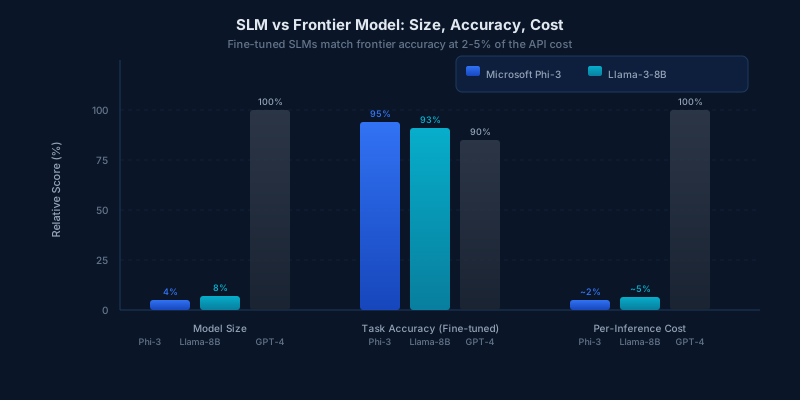
This is not marginal performance. Microsoft's Phi-3-mini at 3.8 billion parameters outperforms GPT-3.5 on standard reasoning benchmarks, according to Microsoft Research's 2024 technical report. Google's Gemma 2 9B scores comparably to Llama-3-70B on MMLU. Meta's Llama-3-8B delivers GPT-3.5-level instruction following at a fraction of operational cost. The performance gap between small and large models on task-specific workloads has closed faster than most forecasters predicted.
SLMs at 8B parameters deliver comparable task-specific performance at a fraction of the per-inference cost of frontier models
The Three Forces Driving SLM Adoption
1. Cost Economics at Scale
Running a frontier model via API is priced per token. For a business processing millions of requests per month, this creates a cost structure that scales with usage, not with infrastructure investment. An SLM deployed on-device or on-premise has a fundamentally different economic profile: a one-time fine-tuning cost and a flat compute cost per device. Once deployed, inference is essentially free.
Consider a UK retail company running 5 million product description requests per month. At GPT-4o pricing, generating a 200-token description costs roughly £3,500 per month in API fees alone. Running a fine-tuned Llama-3-8B on three on-premise servers costs approximately £800 per month, including amortised hardware and power. The break-even point arrives within two to three months. McKinsey's 2025 AI adoption survey found that infrastructure cost was the primary barrier preventing small and medium enterprises from scaling AI deployments. SLMs remove that barrier by decoupling AI capability from cloud consumption.
2. Latency for Real-Time Applications
Cloud inference requires a round trip: the device sends a request, the cloud processes it, and the response returns. On a reliable connection, this adds 300ms to 1,500ms of latency. For conversational applications, that delay is perceptible but tolerable. For real-time applications, it is disqualifying.
Consider an AI-assisted surgical instrument providing real-time guidance, a predictive maintenance system on a factory floor that must respond in under 100ms, or an offline-capable field inspection tool used in areas without mobile connectivity. These applications require decisions in milliseconds. Only edge AI can deliver that response profile. The healthcare and manufacturing sectors have been among the earliest adopters of SLMs precisely because their use cases cannot accommodate cloud round-trip latency.
3. Data Privacy and Regulatory Compliance
UK GDPR and the EU AI Act have made data residency and minimisation into compliance requirements, not optional preferences. Sending sensitive customer data, patient records, or proprietary business data to a third-party cloud API creates a data processing relationship that must be documented, disclosed, and managed under UK GDPR Article 28.
An SLM running entirely on-device or within an air-gapped on-premise environment eliminates that processing relationship. The data never leaves the organisation's control perimeter. For regulated industries including healthcare, financial services, and legal services, this is a structural compliance advantage that frontier cloud APIs cannot replicate. Microsoft's Phi-3 was designed with this constraint explicitly in mind.
The Three Leading SLMs in 2026
Microsoft Phi-3 (3.8B and 14B Variants)
Phi-3-mini and Phi-3-medium represent Microsoft's bet on high-quality synthetic training data over raw parameter count. Trained on filtered, curated data designed to teach structured reasoning, Phi-3 achieves disproportionate performance for its size. It is available via Azure AI Studio and as an open-weights download via Hugging Face. It runs on iOS and Android via ONNX Runtime. For organisations already on the Microsoft stack, it is the lowest-friction path to on-device AI.
Best fit: document analysis, internal knowledge assistants, on-device copilot features embedded in enterprise software.
Google Gemma 2 (2B and 9B)
Gemma 2 is Google's open-weights SLM family, optimised for high throughput at low memory footprint. The 2B variant runs on Pixel 8 and similar hardware. The 9B variant requires a discrete GPU but competes with models ten times its size on structured tasks. Gemma 2 integrates natively with Google Vertex AI for fine-tuning workflows and is supported on TensorFlow Lite for edge inference.
Best fit: mobile applications, developer tools, content classification, structured data extraction.
Meta Llama-3-8B
Llama-3-8B is the de facto community standard for open-weights fine-tuning. Its weights are freely available under a commercial-friendly licence via Meta AI, making it the first choice for organisations that want full ownership of their fine-tuned model with no ongoing licence dependency. Llama-3-8B is supported by every major inference runtime: Ollama, vLLM, and llama.cpp.
Best fit: organisations requiring maximum fine-tuning flexibility, community-driven iteration, and complete model ownership.
Fine-Tuning for Hyper-Specific Tasks
The off-the-shelf performance of a general-purpose SLM is rarely the reason organisations adopt it. The reason is fine-tuning: the process of taking a pre-trained model and training it further on a domain-specific dataset so it behaves as a specialist rather than a generalist.
Fine-tuning an 8B model using QLoRA, which stands for Quantised Low-Rank Adaptation, requires a dataset of 1,000 to 10,000 examples in the target domain, a single A100 GPU or equivalent cloud instance, 4 to 12 hours of compute time, and approximately £50 to £200 in cloud GPU costs using spot instances.
The result is a model that outperforms a frontier model on the narrow task it was trained for, at a fraction of the inference cost. A legal document classification model fine-tuned on UK contract law will outperform GPT-4o on UK contract classification tasks because it has been optimised for exactly that distribution. GPT-4o is a generalist. The fine-tuned SLM is a specialist with the same domain depth and none of the per-token cost.
Hugging Face's PEFT library has made QLoRA fine-tuning accessible to engineering teams without deep ML research backgrounds. The tooling has matured to the point where a competent software engineer, not a machine learning researcher, can produce a production-quality fine-tuned SLM in a working weekend.
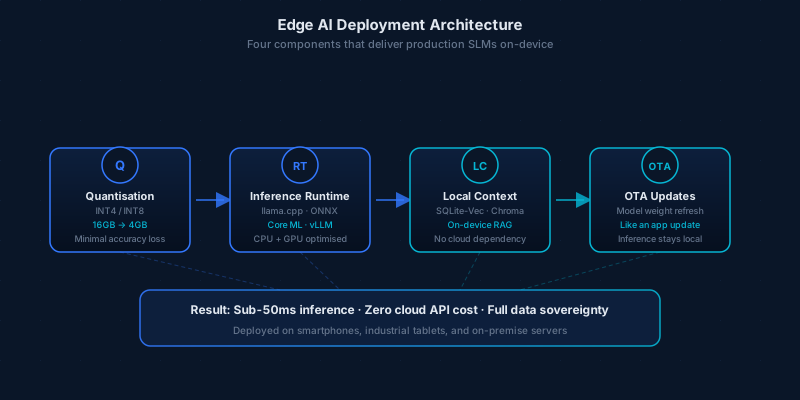
A production edge AI deployment combines quantisation, an optimised inference runtime, local context storage, and an OTA update pipeline
What Edge AI Architecture Looks Like in Practice
Deploying an SLM at the edge involves four components working together. Model quantisation converts the model to INT4 or INT8 precision, reducing memory footprint by 4 to 8 times with minimal accuracy loss. A 16GB Llama-3-8B becomes a 4GB INT4 model that fits in a modern smartphone's unified memory.
The inference runtime handles efficient execution on non-datacenter hardware. Tools like llama.cpp for CPU-optimised workloads, ONNX Runtime for cross-platform deployments, and Core ML for Apple Silicon have been highly optimised over the past two years and now deliver performance within 20 percent of datacenter inference on equivalent hardware.
Local context management stores conversation state and retrieval data on-device. Unlike cloud deployments, edge models maintain this state locally, removing per-turn API cost. SQLite-Vec and Chroma running locally handle retrieval-augmented generation at the edge with no cloud dependency.
The over-the-air update pipeline keeps fine-tuned model weights current when the model requires new domain knowledge, similar to a standard app update. This maintains model currency without requiring internet connectivity for inference.
Several UK products have already shipped on this architecture. A mental health companion application running a fine-tuned Llama-3-8B on iOS processes all conversations entirely on-device, with zero data leaving the phone. A construction site inspection tool runs a vision-language SLM on a ruggedised tablet with no connectivity requirement. These are not research prototypes; they are revenue-generating products built by small engineering teams in under six months.
Where SLMs Do Not Replace Frontier Models
Clarity on SLM limitations prevents misallocation of engineering effort. SLMs are not suitable for tasks requiring broad general reasoning across unfamiliar domains, since a fine-tuned SLM trained on customer service data will not handle unexpected legal or technical questions outside its training distribution reliably.
Complex multi-step agentic workflows still benefit from frontier model capabilities. Tasks requiring sustained reasoning across many steps, tool use across multiple APIs, and error recovery belong with the larger model, though SLMs can efficiently handle individual steps within an agent pipeline.
Long-context document processing is another frontier use case. Frontier models with 128K or 200K token context windows handle documents that exceed an SLM's smaller context budget. Legal due diligence, financial report analysis, and technical documentation review remain frontier territory.
The practical architecture for most mid-market UK businesses in 2026 is a hybrid: SLMs handle the high-frequency, narrow, cost-sensitive workloads on-device or on-premise, while frontier models handle the low-frequency, high-complexity tasks that justify the API cost. For a deeper look at structuring this hybrid approach within your existing stack, see our guide on building AI agents on your existing stack and our analysis of advanced RAG versus long context windows.
Conclusion
The narrative that AI requires massive cloud infrastructure, large opaque models, and expensive API contracts is being revised by the organisations building on SLMs. The shift is not ideological; it is economic. Compact models that are fine-tuned for specific tasks, deployed at the edge, and running without cloud dependency deliver better ROI, lower latency, and cleaner regulatory compliance profiles than frontier APIs for the majority of enterprise AI workloads.
The organisations winning the AI productivity race in 2026 are not the ones with the biggest models. They are the ones with the right model for the right task, running in the right place.
If your organisation is currently routing high-volume, task-specific workloads through a frontier API, the conversation about SLM adoption is already overdue.
Frequently Asked Questions
What is the difference between a Small Language Model and a Large Language Model?
Small Language Models (SLMs) typically have 1 billion to 8 billion parameters, while Large Language Models have tens or hundreds of billions. SLMs are designed to run efficiently on consumer hardware and edge devices. They trade breadth of general knowledge for lower cost and higher speed on specific tasks, making them preferable for narrow, well-defined workloads at scale.
Can a Small Language Model really compete with GPT-4 on business tasks?
On narrow, task-specific workloads where the model has been fine-tuned on domain data, yes. Microsoft Phi-3-mini outperforms GPT-3.5 on standard reasoning benchmarks despite being fifteen times smaller by parameter count. A fine-tuned Llama-3-8B trained on your company's specific data will consistently outperform a general-purpose frontier model on that task. For broad, complex, or creative tasks, frontier models remain the stronger choice.
How much does it cost to fine-tune a Small Language Model?
Fine-tuning an 8B parameter model using QLoRA typically costs between £50 and £200 in cloud GPU time using spot instances and takes 4 to 12 hours on a single A100-class GPU. Dataset preparation, which involves curating 1,000 to 10,000 quality examples in the target domain, is usually the more time-intensive part of the process.
What is Edge AI and how does it differ from cloud AI?
Edge AI refers to running AI inference directly on the device where data is generated, such as a smartphone, laptop, factory sensor, or medical instrument, rather than sending data to a remote cloud server. Edge AI eliminates cloud round-trip latency (300ms to 1,500ms), removes per-inference API costs at scale, and keeps sensitive data within the organisation's control perimeter.
Which Small Language Model should a UK business start with in 2026?
For organisations already in the Microsoft ecosystem, Phi-3 is the natural starting point with strong Azure integration. For teams wanting maximum community support and fine-tuning flexibility, Llama-3-8B is the most widely adopted option. For mobile-first applications, Gemma 2 2B has the strongest mobile runtime optimisation across iOS and Android.
How do SLMs help with UK GDPR compliance?
When an SLM runs on-device or on-premise, data never leaves the organisation's environment, eliminating the third-party data processor relationship that cloud APIs create under UK GDPR Article 28. Industries handling sensitive personal data, including healthcare, financial services, and legal services, benefit most from this structural compliance advantage.
How long does it take to deploy an SLM in production?
A well-resourced engineering team can move from model selection to a production-grade edge deployment in four to eight weeks. This includes dataset preparation, fine-tuning, quantisation, runtime integration, and testing. Cloud API deployments without fine-tuning can be faster but sacrifice the cost and performance advantages that make SLMs worth adopting.
What hardware do I need to run an SLM on-premise?
For 7B to 8B parameter models at production throughput, a single NVIDIA RTX 4090 or A10G GPU is sufficient for low-to-medium request volumes. Quantised 4-bit models at the 3B to 4B parameter range run on Apple Silicon MacBook Pros and high-end ARM servers without a discrete GPU, reducing hardware costs substantially.