AI Trends
Claude's Invisible Watermark Explained: How It Works, Why It Exists, and What It Means for Users
12 min read
Claude now embeds an invisible watermark in the text it generates. It is not a hidden character, it cannot be prompted away, and it proves far less than people assume. Here is how the mechanism actually works, why the EU AI Act forced it into existence, what a detected mark does and does not prove, and what UK businesses should do about it.
✦Key Takeaways
- The watermark is not hidden Unicode characters. It is a statistical bias in Claude's word choices, which is why tools promising to strip it with find and replace are solving the wrong problem.
- Marking happens at the model level, so it applies across the Claude apps, the API, Claude Code and cloud partners worldwide, with no user-facing off switch.
- A detected mark means content may have been processed by Claude, not authored by it. Proofreading, translating or reformatting your own writing can trigger it.
- Length decides detectability. Long prose carries the signal well, while short passages, heavy paraphrasing and code diffs often carry too little entropy to mark reliably.
- Text watermarks survive copy and paste. C2PA file metadata does not survive a screenshot or a re-save. Two technologies, opposite failure modes.
- The mark is live now, but Anthropic has not yet published detection tooling, so nobody outside Anthropic can currently verify a claim about Claude-marked text.
- Article 50 of the EU AI Act binds the model provider. If you ship Claude inside a product, your own visible-labelling duty as a deployer is separate and still yours.
On 2 August 2026 a clause in European law changed what a sentence written by an AI model is allowed to be. Within days, Anthropic confirmed that text produced by Claude now carries an invisible mark, and the internet reacted the way it usually does: with alarm, a wave of misinformation, and people pasting their own writing into detectors that do not exist yet.
The alarm is understandable. The misinformation is worth clearing up, because most of what is being said about how this watermark works is wrong. It is not a hidden character. It is not a zero-width space you can strip with find and replace. It is not something you can ask Claude to turn off.
It is also not quite the thing people fear. A detected watermark does not say “a machine wrote this.” It says something weaker and stranger than that, and the gap between those two statements is where every practical decision sits, whether you publish forty articles a month, ship Claude inside a product, or simply used it to tidy up a board paper.
What Anthropic Actually Announced
The mechanics are set out in Anthropic's own support documentation on how Claude marks AI-generated content. Two separate things are happening, and conflating them causes half the confusion.
The first is a text watermark. Claude models launched on or after 2 August 2026 embed an imperceptible statistical marker directly into the words they generate. In Anthropic's phrasing, because the watermark is part of the text, it travels with the text when it is copied and pasted elsewhere, and may persist through some editing.
The second is file provenance. When Claude generates or processes supported file types, currently
.svg, .png and .jpg, it attaches signed metadata following the C2PA standard, the same content credentials system used across the camera and creative software industries.Three details matter more than the headline. Marking happens at the model level, not the product level, so it applies across the Claude apps, the Claude Platform API, Claude Code, Claude Cowork and Claude Tag, and it follows the model onto AWS, Google Cloud and Microsoft Foundry. It applies worldwide, not only to European users. And there is no user-facing switch to disable it.
How the Text Watermark Works
It Is Not Hidden Characters
The first thing to unlearn is the zero-width space theory. A large amount of online advice assumes AI watermarking means invisible Unicode characters smuggled between words, and sells watermark removers on that basis.
That approach would be useless, and vendors know it. Anything you can find with a search can be removed with a replace. A single pass through a plain text editor would destroy it. Anthropic's mark is not sitting between the words. It is the words.
Biasing the Choice Between Near-Equivalent Words
When a language model writes, it is rarely choosing the one correct next word. At most points in a sentence there are several continuations that are statistically near-equivalent, a handful of options any of which would read naturally. That surplus of acceptable choices is called entropy, and it is the raw material a watermark is built from.
Anthropic has not published its exact algorithm. What it describes is consistent with the published research on generative text watermarking, best documented in Google DeepMind's SynthID-Text paper in Nature, which uses a technique called tournament sampling. The model's candidate next tokens are scored against a secret key and effectively play off against each other, so the winner is nudged in a direction only the key holder can recognise.
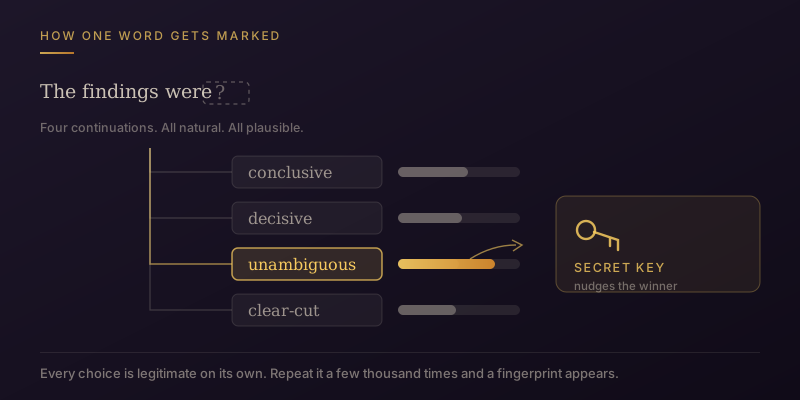
Do that thousands of times across a passage and you get a statistical fingerprint. Any individual word choice looks entirely unremarkable, because it is: each one was a legitimate option the model might have picked anyway. The pattern only emerges in aggregate, which is why the Nature evaluations found no measurable drop in text quality or model capability.
Two consequences follow directly. Because the biasing happens in the sampling layer beneath the model, you cannot prompt it away, and asking Claude to write without a watermark achieves nothing. And because it is a statistical pattern rather than a tag, detection is probabilistic. There is no moment where a hidden flag flips to true.
Why Length Decides Everything
A statistical signal needs sample size. Anthropic states plainly that a mark may not be detected when a passage is very short, leaving too little text for a reliable signal, or when text has been heavily edited, paraphrased or translated.
This is why the watermark behaves so differently across content types. A 2,000 word article carries thousands of scoreable decisions. A product description, a subject line or a Slack reply may carry too few. Code is the weakest host of all, because syntax is rigid and identifiers must match their declarations, so the entropy per token is far lower than in prose. A pull request body will likely mark. The diff itself is a much harder case.
The Second Mark: Why Files Behave Differently
C2PA metadata is a cryptographically signed manifest attached to a file, recording that Claude was involved in producing it. It is tamper-evident, meaning you cannot quietly alter it without breaking the signature.
You can, however, remove it completely and trivially. Re-saving through any image editor, converting the format, taking a screenshot or uploading to a platform that rewrites metadata strips it entirely. That is not a flaw in Anthropic's implementation; it is a known property of every metadata-based provenance scheme, and it is why the European Commission's own guidance notes that machine-readable marking alone does not satisfy deepfake disclosure duties.
The practical rule is simple. The text watermark survives copy and paste. The file watermark does not survive re-encoding. They are different technologies solving the same problem with opposite failure modes.
| Text watermark | C2PA file metadata | |
|---|---|---|
| What it is | Statistical bias in word selection | Signed manifest attached to the file |
| Applies to | Generated text, everywhere Claude runs | .svg, .png, .jpg |
| Survives copy and paste | Yes | Not applicable |
| Survives re-saving or screenshotting | Not applicable | No |
| Survives paraphrasing | Usually not | Yes, the file is untouched |
| Removable on purpose | Hard, but possible with rewriting | Trivial |
| Detection available today | Not yet published | Yes, standard C2PA tooling |
Anyone selling you a single tool that handles both is describing two different jobs.
Why It Exists
The immediate cause is regulatory. Article 50 of the EU AI Act took effect on 2 August 2026 and requires providers of generative AI systems to mark outputs in a machine-readable format that allows them to be detected as artificially generated or manipulated. The obligation sits with the provider of the model, which is precisely why Anthropic implemented it at model level and applied it globally rather than trying to geofence European traffic.
Anthropic is not acting alone. As TechCrunch reported at launch, it signed the Commission's Code of Practice on Transparency of AI-generated Content alongside Google, Meta, Microsoft, OpenAI, Synthesia and Black Forest Labs. Watermarking is becoming table stakes rather than a differentiator.
There is a second, quieter motivation. As synthetic text saturates the open web, model developers face a real problem in telling human writing from machine writing in their own training data, and publishers face an equivalent problem in moderating what they host. Provenance signals are infrastructure for both. Anthropic is building a capability it needs regardless of what Brussels requires, which is worth remembering when assessing how permanent this is.
What the Watermark Proves, and What It Does Not
This is the part institutions will get wrong, and it is worth being precise about.
Anthropic's own documentation states that a detected mark tells you content may have been processed by Claude. It does not confirm the full provenance of the content, and the absence of a detected mark does not mean content was not AI-generated.
Read that carefully. Processed, not authored. If you write a paragraph yourself and ask Claude to fix the grammar, the returned text is regenerated by the model and can carry the mark. Same for translation, summarising, reformatting or tightening. The signal fires on assistance, not on authorship, and it cannot distinguish between the two.
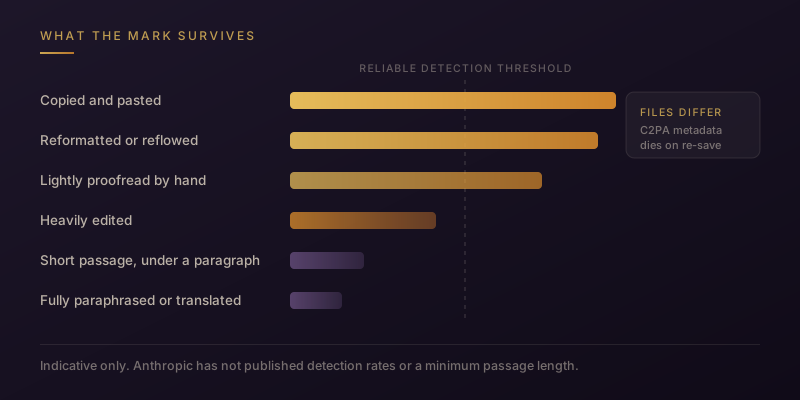
The false negative side is equally uneven. Heavy editing, paraphrasing, short passages, output from pre-August models and text from any other provider all come back clean. A detector that fires on a lightly proofread human paragraph and stays silent on a wholly synthetic one is not measuring what a university or an employer thinks it is measuring.
There is also a timing problem. The mark is in the text now, but Anthropic has said detection details will follow in forthcoming technical documentation. During that window, the honest answer to whether something was written by AI is that nobody outside Anthropic can check.
The Backlash, and Which Parts of It Are Fair
Reaction was fast and largely negative. Coverage in Forbes captured the recurring complaint: writers who use Claude only to proofread objected that work they authored would carry a mark suggesting Claude did it. Radio host Erick Erickson put it bluntly, saying that material he had written would be watermarked as though Claude had done the work.
That objection is fair. The proofreading case is the sharpest edge of the processed versus authored distinction, and it is entirely foreseeable that a hiring manager or an editor will read a detector hit as a confession.
The lack of an opt-out drew similar anger, though the logic is harder to argue with. A watermark users can disable is not a compliance mechanism. An Anthropic engineer quoted in launch coverage was candid about the limits, acknowledging that the system is not perfect and can be edited around, but describing it as a first step.
Two other concerns are more overstated. The idea that watermarking degrades output quality is not supported by the published research, which found no measurable capability difference. And the fear of a secret channel leaking your content back to Anthropic misreads the mechanism: the mark encodes no information about your prompt, your identity or your document. It is a detectable statistical pattern, not a payload.
The one genuinely underrated concern is confidentiality. Strategy documents, legal drafts and internal memos now carry a durable, detectable trace of AI involvement that survives copy and paste into other systems. In litigation, journalism or a competitive process, that is a real consideration and it deserves a policy rather than a shrug.
What This Means in Practice
If You Publish Content
Nothing changes about whether you should use AI, and everything changes about whether you should pretend you have not. Assume any Claude-assisted text on your site is detectable, and write a short, public disclosure line rather than waiting to be asked. The organisations that will look bad in twelve months are the ones that claimed purely human production while shipping marked text.
Search visibility is a separate question from watermarking, and the two are frequently confused. Google's guidance still rewards useful content regardless of production method, which is the same principle underpinning how brands are adapting to AI Overviews eating organic traffic.
If You Ship Claude Inside a Product
Anthropic's marking satisfies the provider-side obligation. It does not satisfy yours. If your product generates content for users, you need to assess your own Article 50 duties as a deployer, including visible labelling where the content could be mistaken for human-produced material. Machine-readable marking is not a substitute for a label a person can see.
This belongs in your existing controls rather than a separate workstream. If you already maintain an agentic governance blueprint for monitoring and auditing AI systems, provenance and disclosure are new rows in a register you already own.
If You Work With Sensitive Material
Decide now which document classes are allowed to touch a hosted model. For most UK businesses the answer is still nearly all of them, and the watermark changes little. For legal drafting, regulatory submissions, M&A material or investigative journalism, it is worth setting a policy, and it is one input into the wider data residency and sovereign AI question that already shapes model selection in regulated sectors.
A Sensible 90 Day Response
- Write the disclosure line. One sentence on how your organisation uses AI in content production, published somewhere findable.
- Classify your documents. Name the small set of material that should not pass through a hosted model, and say why.
- Separate the two obligations. Anthropic's marking covers the provider duty. Your visible labelling duty as a deployer is yours alone.
- Ban detector-based accusations. No hiring, disciplinary or academic decision should rest on a tool that cannot distinguish proofreading from authorship.
- Wait for the detection documentation before buying anything that claims to check for Claude marks. Nothing on the market today can validate that claim.
Conclusion
Claude's invisible watermark is a smaller technical event and a larger cultural one than the reaction suggests. Technically it is a probability nudge across thousands of word choices, robust to copy and paste, fragile under paraphrase, and unreliable on anything short. Culturally it ends the era of unprovable AI assistance, and it does so with an instrument far blunter than the decisions people will try to make with it.
The organisations that handle this well will not be the ones hunting for removal tricks. They will be the ones that decided what they are comfortable disclosing, wrote it down, and stopped treating AI assistance as something to hide.
Frequently Asked Questions
- Does Claude add invisible characters to its text?
- No. That is the most common misconception. Claude's watermark is a statistical pattern in which words the model selects, not a zero-width space or any other hidden character inserted between words. A character-based mark would be pointless because anything you can find with a search you can remove with a replace. The signal is carried by the text itself.
- Can you remove Claude's watermark?
- Substantially rewriting or paraphrasing the text will degrade the signal, and a short passage may never carry enough of it to detect in the first place. An Anthropic engineer quoted at launch acknowledged the system is not perfect and can be edited around, describing it as a first step. Tools advertising one-click watermark removal are generally targeting hidden characters, which is not the mechanism in use.
- Will my own writing be flagged as AI-generated if I use Claude to proofread it?
- Possibly, and this is the sharpest problem with the technology. When Claude proofreads, translates or reformats your text, it regenerates that text, so the output can carry the mark even though the ideas and most of the wording are yours. Anthropic's own documentation is explicit that a detected mark indicates content may have been processed by Claude and does not confirm authorship.
- Can I turn off Claude's watermark or opt out?
- There is no user-facing setting to disable it. Marking is implemented at the model level rather than as a product feature, which means it follows the model across the Claude apps, the Claude Platform API, Claude Code and cloud partners such as AWS, Google Cloud and Microsoft Foundry. A watermark users could switch off would not satisfy the regulation that prompted it.
- Does Claude watermark code as well as prose?
- Claude Code is inside the stated coverage, but code is a poor host for this kind of watermark. Syntax is rigid and identifiers must match their declarations, so there are far fewer near-equivalent choices per token than in prose. In practice the prose around code, such as a pull request description, is far more likely to carry a detectable mark than the diff itself, and running a formatter or linter can disturb what little signal exists.
- How can I check whether text carries a Claude watermark?
- At the moment you cannot. Anthropic has said it will publish detection mechanisms in forthcoming technical documentation, but that tooling is not yet available to the public. Any product currently claiming to detect Claude's text watermark cannot substantiate that claim, so treat such claims with scepticism until the specification is released.
- Does watermarking make Claude's output worse?
- There is no evidence that it does. Anthropic states the watermark does not change the meaning, quality or readability of responses, and the published research on comparable generative text watermarking, including Google DeepMind's SynthID-Text work in Nature, found no measurable drop in model capability across standard benchmarks and human side-by-side ratings.
- Does the watermark apply outside the EU?
- Yes. Although the trigger was Article 50 of the EU AI Act, which took effect on 2 August 2026, Anthropic implemented marking at the model level and applies it wherever Claude is offered rather than restricting it to European users. UK and international users get the same behaviour.
- If I use Claude in my product, does its watermarking cover my legal obligations?
- No. Anthropic's marking addresses the provider-side machine-readable marking duty. If you deploy Claude in a product that generates content for users, you have separate deployer obligations, which can include a visible label that a person can read without any detection tool. The European Commission's guidance is clear that machine-readable marking alone does not satisfy disclosure duties for content that could be mistaken for human-produced material.