AI Trends
ChatGPT Ads and Conversational Commerce: The New Discovery Layer for Brands
15 min read
OpenAI started selling ads inside ChatGPT, then stepped back from running checkout itself. Those are the same story: a new discovery layer is being built in public. Here is what the ad unit actually is, how the Agentic Commerce Protocol works underneath it, why the published conversion figures contradict each other, and what a UK brand should do in the next two quarters.
✦Key Takeaways
- You cannot pay to be recommended in ChatGPT. Ads sit below the answer, labelled and separated, and OpenAI's stated design is that they do not influence the response.
- Targeting has no keyword list. Advertisers supply context hints, plain descriptions of the conversations where their product is relevant, which shifts the core skill from match types to positioning.
- Ads reach free and Go tier users only, so senior enterprise buyers on paid seats are structurally outside the addressable audience.
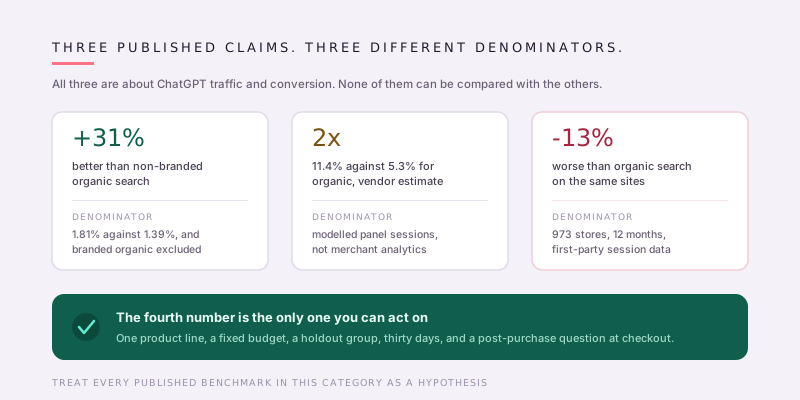
- The largest independent study, covering 973 ecommerce sites over twelve months, found ChatGPT delivering under 0.2% of traffic and converting below organic search, while improving month over month.
- Published conversion benchmarks for this channel contradict each other because they use different denominators, data sources and attribution windows. None of them substitutes for a thirty-day test on your own catalogue.
- OpenAI deprioritised its own Instant Checkout in March 2026 in favour of merchant apps, which tells you the interface layer is unstable and the product data layer is not.
- Feed completeness is the new ranking factor. Structured product data, not landing page design, decides whether a model can name you.
Two things happened to ChatGPT within a few months of each other, and read together they say more about the next five years of brand discovery than any conference keynote. OpenAI started selling advertising inside the assistant. Then it stepped back from running checkout itself and handed the transaction back to merchants.
Most coverage treated those as separate stories. They are the same story. A discovery layer is being assembled in public: a surface where someone describes a problem in their own words, receives a shortlist, sees a small number of clearly labelled paid placements, and increasingly completes the purchase without opening a browser tab. It is the first genuinely new discovery surface since the mobile app store.
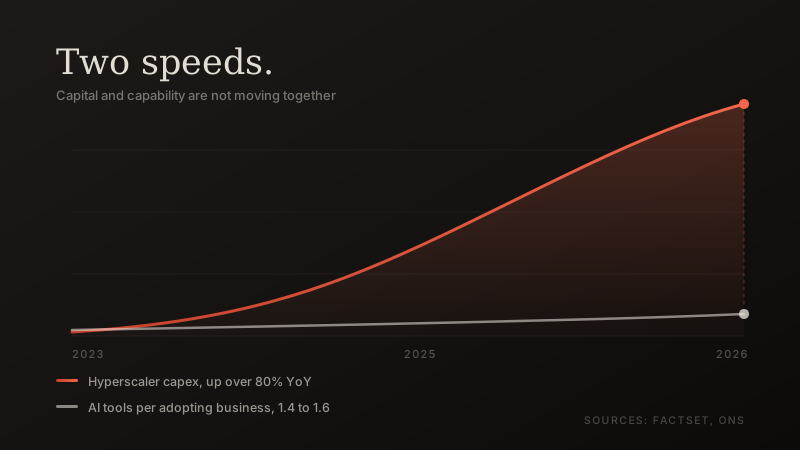
It is also, right now, small. In the largest independent study published so far, ChatGPT accounted for less than 0.2% of traffic to nearly a thousand ecommerce sites. Both facts are true at once, and the gap between them is where the strategy lives. This article covers what the ad unit actually is, how the commerce plumbing works underneath it, what the honest data says about performance, and what a UK brand should do about all of it over the next two quarters.
What ChatGPT Ads Actually Are
OpenAI began testing advertising inside ChatGPT in early 2026, starting with free-tier users in the United States, then opened a self-serve Ads Manager, then widened the country list. Digiday reported that ads began appearing for UK users in early June 2026, alongside OpenAI setting out how it would handle consent under UK and EU privacy law. By late summer the platform had moved from a hand-held partner programme to something any business could open an account on.
The speed matters less than the shape. What OpenAI has shipped is deliberately conservative, and understanding its constraints tells you more than any rate card.
The Unit Itself
There is essentially one ad format in the pilot: a sponsored placement that appears below the assistant's answer, visually separated from it and clearly labelled. It carries a brand name, a logo or favicon, a short headline, a line of description and a link, as OpenAI's own help documentation sets out. It does not appear inside the answer text, and it is not woven into the model's recommendation.
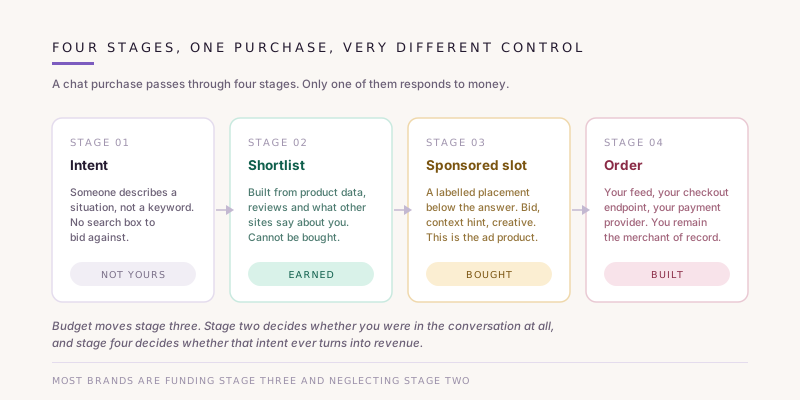
That last point is the one to hold on to. OpenAI's stated design is that ads do not influence the response. The commercial consequence is easy to miss: you cannot pay to be recommended. You can pay to appear next to a recommendation, in the moment it lands. That is a meaningfully different product from a search ad sitting above ten organic results, and it puts a hard ceiling on what budget alone can achieve.
Targeting Without Keywords
There is no keyword list. Advertisers instead supply what OpenAI calls context hints: plain-language descriptions of the kinds of conversations where the product is relevant. Matching happens against the context of the conversation itself.
This quietly retires two decades of muscle memory. The core skill in a keyword auction was finding strings nobody else had bid on. The core skill here is describing a customer situation precisely enough that a language model recognises it when it appears. Teams that are strong on positioning will find this easier than teams that are strong on match types.
The account structure will feel familiar. A campaign holds the objective, budget, dates and country targeting. An ad group holds the bid and the targeting input. The ad holds the creative. Beta reporting covers impressions, clicks, spend, click-through rate, average CPC, average CPM and conversions, and bidding moved from CPM only to CPC during 2026. There was no minimum spend at launch, which makes this unusually cheap to test properly.
Be sceptical of the benchmark content already circulating. Search for ChatGPT ad costs and you will find confident tables of CPCs by industry, published by sites with no stated methodology and no access to platform data. Treat every one of those numbers as a hypothesis rather than a benchmark. Thirty days of your own spend will tell you more than all of them combined.
Who Sees the Ads
Ads are shown to logged-in adult users on the free and Go tiers. Plus, Pro, Business, Enterprise and Education accounts remain ad-free.
For consumer brands that is broadly fine, since the free tier is where most of the audience sits. For B2B it is a real constraint worth saying out loud: the enterprise buyer who expensed a Business seat is, by definition, not in your addressable audience on this platform. If your ideal customer is a senior operator at a mid-market company, model that honestly before building the plan.
The Commerce Half: From Answer to Order
Advertising is only half of what is being built, and arguably the less interesting half. The other half is the ability to complete a purchase without leaving the conversation, which is where the phrase conversational commerce stops being a slogan and becomes an integration project. We looked at the broader shift in the agentic shopping revolution; this is the part of it that has now been standardised.
The Agentic Commerce Protocol in Plain Terms
OpenAI launched Instant Checkout with Stripe, built on the Agentic Commerce Protocol, an open standard the two companies published together. Strip away the naming and a merchant has three things to implement.
- A product feed, refreshed regularly, carrying identifiers, descriptions, pricing, inventory, media and fulfilment options.
- Checkout endpoints that follow the Agentic Checkout Spec, which receive a checkout session, validate the data, work out fulfilment and tax, and decide whether to accept or decline the order.
- A payment provider compatible with the Delegated Payment Spec, so the payment credential can be handled safely.
The detail most write-ups skip is the ownership model, and it is the reassuring part. OpenAI is not the merchant of record. Checkout state and payment processing happen on the merchant's systems, and the merchant keeps the customer relationship and the order record. This is closer to a new sales channel with a strict integration spec than to selling through a marketplace. OpenAI has been reported to take 4% of completed Instant Checkout purchases, with shoppers paying nothing extra.
Why OpenAI Stepped Back From Running Checkout
In March 2026 OpenAI deprioritised Instant Checkout in favour of purchases happening inside merchants' own ChatGPT apps. Target had launched an app in November 2025, Instacart and DoorDash in December, The Knot in February 2026. The protocol survives; the interface for it moved.
Shopify's president Harley Finkelstein put the reason plainly when he noted that checkout integrity is not just payments: it is subscriptions, inventory, shipping, taxes and every merchandising rule a real retailer runs. Forrester covered the retreat as a significant moment for the category, which it is. The leader in agentic commerce discovered that the hard part was never moving the money. It was reproducing the thousand pieces of state that sit behind a working checkout.
There is a useful lesson there for anyone about to spend six figures preparing for agentic shopping. The interface layer is unstable and will change again. The layer underneath it, clean structured product data and an API that can quote a real price against real availability, is valuable no matter which interface wins. Fund the stable layer.
The Numbers Nobody Puts in the Deck
The Largest Independent Study So Far
Maximilian Kaiser and Christian Schulze, of the University of Hamburg and the Frankfurt School of Finance and Management, examined twelve months of data covering 973 ecommerce sites with roughly 20 billion dollars in combined annual revenue. Digiday reported the findings, and they are not what the category's marketing suggests.
ChatGPT accounted for less than 0.2% of total traffic across the dataset, roughly two hundred times smaller than Google organic search. On conversion, affiliate links performed 86% better than ChatGPT referrals, and organic search performed around 13% better. Revenue per session put ChatGPT behind both paid and organic search, though ahead of paid social. The authors noted their results contradict widespread expectations of superiority for AI referrals.
Two things stop this being a reason to ignore the channel. Conversion from ChatGPT referrals rose steadily month over month across the study period even as traffic volume grew, which is the opposite of what a saturating channel looks like. And Schulze's explanation for the gap is behavioural rather than structural: people do not treat the assistant as the final step. They read the answer, check other sources, then buy. That is what an early channel looks like, not a broken one.
Why the Conversion Figures Contradict Each Other
You will also find credible-sounding reports saying the opposite. Search Engine Land covered analysis showing ChatGPT ecommerce traffic converting 31% better than non-branded organic search, at 1.81% against 1.39%. Other vendors have published figures putting ChatGPT above 11% against roughly 5% for organic.
These are not reconcilable, and pretending otherwise is how bad budget decisions get made. Four things differ underneath the headline numbers.
- The denominator. All organic traffic, or non-branded organic only. Excluding branded search removes the highest-converting segment from the comparison.
- The data source. A panel-based estimate and a merchant's own analytics do not count a session the same way.
- The sample. A vendor measuring its own customer base is measuring a self-selected group of businesses that already invested in the channel.
- The attribution window. This matters enormously where research and purchase happen days apart, often on different devices.
The practical rule is simple. Only compare figures that share a denominator, prefer first-party data over panel estimates, and treat any single-source claim about this channel as directional at best.
Where the Traffic Actually Lands
There is a concentration problem worth planning around. Amazon has been reported to capture the majority of ChatGPT's retail referral traffic, and Walmart said roughly one in five of its referral clicks came from ChatGPT. If a marketplace already dominates your category, a large share of chat-driven demand for your products will arrive at that marketplace rather than at your own site.
That reframes the question. It is not only how do I win in ChatGPT, it is at which point in this chain do I want to be visible, and does my marketplace listing carry the same quality of product data as my own site. For plenty of UK brands the honest answer is that the marketplace listing needs the attention first.
Why This Is a Discovery Layer, Not Just Another Ad Network
The Shortlist Matters More Than the Click
In search, the user supplies the words and a list of pages competes for the click. In an assistant, the user supplies a situation and the model composes a shortlist. Three or four products get named. Everything else is not ranked lower, it is absent.
That shortlist sits upstream of the ad. A sponsored placement can put you next to the answer, but it cannot put you in it. Which means the strategically important work is not the media buy at all. It is becoming the kind of brand a model can confidently name: specific, verifiable product information, third-party corroboration, clear pricing, and a reputation that shows up consistently across the sources these systems read. That is the same discipline set out in our guide to optimising a brand for generative engine search, applied to products rather than pages.
The Feed Is the New Landing Page
For twenty years the object you optimised was a page. Headline, hero image, layout, call to action. In a conversational surface none of that is read. What gets read is structured product data: title, attributes, price, availability, returns terms, review signals, fulfilment options.
OpenAI's own commerce documentation makes the incentive explicit. Required fields keep price and availability accurate, while recommended attributes such as rich media, reviews and performance signals improve ranking, relevance and user trust. Feed completeness is a ranking factor on the new shelf.
That has an uncomfortable implication for a lot of marketing teams. The most valuable asset in conversational commerce is currently owned by whoever maintains the product information system, and it is usually the least glamorous data in the business. Stale prices, missing attributes, thin descriptions and inconsistent variant naming are no longer tidy-up jobs. They are the difference between being recommended and being unavailable.
What the Rest of the Market Tells You
Look at the whole field rather than one platform, because the field is telling you something about durability.
Google is putting Search and Shopping ads inside AI Overviews and rolling out Gemini-powered formats in AI Mode. Microsoft has extended its existing advertising machine into Copilot, assembling ads from assets already held in Microsoft Advertising and adding an ad voice that explains why a recommendation appears. Perplexity pioneered in-chat advertising in 2024 with sponsored follow-up questions, stopped taking new advertisers in late 2025, and stepped away from advertising entirely in February 2026. Anthropic has no advertising programme at all.
Two incumbents extending what they already run, one challenger that tried it and withdrew, one major lab that has not entered. That is not a settled market. Build capability that survives a format change: portable creative, first-party measurement, and a product data layer that works for any recommender. Do not build a team, an agency retainer or a reporting stack that only makes sense if this specific ad unit persists in this specific form.
The UK Specifics: Consent, Labelling and the CAP Code
UK and EU rules shape the product differently from the US, and that affects performance.
OpenAI has said it will rely on explicit user consent rather than legitimate interest as its legal basis for personalised advertising in the region, which is the stricter and more defensible reading of GDPR. In practice that creates two tiers of ad. Personalised ads, for users who have consented, can draw on past chats, memory, ad history and advertiser-provided data. Generic ads, for everyone else, use limited signals such as the conversation itself, coarse location and time of day.
The planning consequence is that a meaningful share of your UK audience will sit in the generic bucket. Targeting sophistication will not rescue a weak context hint. The quality of your description of the customer situation carries more weight here than any audience list you can upload.
On the advertising rules themselves there is less novelty than people expect. The UK Advertising Codes contain no AI-specific rules yet, and the Committee of Advertising Practice has been clear that existing rules apply in full regardless of how an ad is produced or where it is served. Ads must be obviously identifiable as marketing, claims must be substantiated, and the ASA has said it is scaling its AI-based Active Ad Monitoring to find non-compliance proactively. The genuinely new risk is claim propagation: if your marketing copy makes a claim, an assistant may restate it in its own words to a user, without your qualifiers. Write claims you would be happy to defend in paraphrase.
A Practical Playbook for the Next Two Quarters
1. Fix the Feed Before You Fix the Bid
Audit your product data the way an agent would read it. Is every price current, is availability accurate to the hour, are variants named consistently, do descriptions contain the attributes customers actually ask about, are delivery and returns terms present as text rather than trapped in a PDF or an image. Most brands find the work here is worth more than the entire ad test that follows it.
2. Buy a Small Test With an Honest Measurement Plan
Pick one product line, set a budget you would not mind losing, run for thirty days, and decide the success criteria before you start. Add a post-purchase question asking how the customer heard about you, because last-click attribution will systematically undercount a channel where discovery and purchase happen on different days and often different devices. If you can hold a comparable product line out of the test as a control, do it.
3. Decide Your Agentic Checkout Posture
There are three defensible positions, and doing nothing is not one of them.
| Posture | Who it suits | Main cost | Main risk |
|---|---|---|---|
| Implement protocol endpoints | High-volume retailers with a clean catalogue and engineering capacity | Engineering time plus a transaction fee on completed orders | Building against an interface the platform has already deprioritised once |
| Build a ChatGPT app | Brands whose purchase involves configuration, subscription or scheduling | A real product build and ongoing maintenance | Distribution inside the assistant is not guaranteed by shipping it |
| Feed only, and watch | Most UK SMEs and mid-market brands | Disciplined product data maintenance | Slower to transact, but no wasted build if formats change |
For most UK SMEs the third position is correct, and it is not the same as doing nothing. It is the position that keeps you eligible for every one of the other two later.
4. Instrument the Funnel You Actually Have
Capture AI referrers properly in analytics and separate them from generic direct traffic. Watch branded search volume as a leading indicator, because a good share of assistant-driven demand shows up as someone searching your name a day later. Track engaged sessions on decision-stage pages rather than raw session counts. The wider measurement shift is covered in our analysis of how AI Overviews are eating organic traffic, and the same logic applies to assistants.
5. Write for the Recommender, Not Just the Ranker
Content that gets a brand named in an answer looks different from content that ranks. It states specifics rather than gesturing at them: numbers, prices, dimensions, compatibility, exclusions. It compares honestly against named alternatives, including the cases where you are not the right choice. It answers awkward buying questions instead of routing them to a sales form. That reads as strange advice for a marketing team, which is precisely why it works. Models reward the specific and the checkable.
Conclusion: Spend Small, Build Deep
The discovery layer is real, the commerce plumbing underneath it is being standardised in public, and the current traffic numbers are small. Those three facts are not in conflict. They describe a channel in its first eighteen months, which is the point at which the cost of experimenting is lowest and the cost of ignoring it is deferred rather than avoided.
The sensible posture is asymmetric. Spend a little on the ad unit, because the test is cheap and the learning is not available any other way. Spend seriously on the things that pay off regardless of which assistant wins: accurate structured product data, a checkout that can be quoted against programmatically, specific and honest content, and measurement that does not depend on last click. If the conversational surface becomes a major channel, you are ready. If it does not, you have still fixed the product data, which was overdue anyway.
If you want to know how your brand currently appears inside AI assistants, whether your product data is good enough to be recommended, and which of these moves would pay back first, AI Native Agency runs AI visibility and readiness audits for UK brands, covering paid placements, feed quality and agentic checkout readiness.
Frequently Asked Questions
- Are ChatGPT ads available in the UK?
- Yes. Ads began appearing for UK users on ChatGPT's free and Go tiers during 2026, and OpenAI's self-serve Ads Manager opened to UK advertisers alongside the rollout. Users on Plus, Pro, Business, Enterprise and Education plans do not see ads.
- How much do ChatGPT ads cost?
- OpenAI runs an auction and moved from CPM-only pricing to CPC bidding during 2026, with no minimum spend at launch. Published CPC benchmarks by industry should be treated with caution, since most come from sites with no stated methodology or platform data access. A thirty-day test on one product line will give you a more reliable number than any benchmark table.
- Can you pay to get your brand recommended by ChatGPT?
- No. Sponsored placements sit below the answer, labelled and visually separated, and OpenAI's stated design is that advertising does not influence the model's response. Being named inside an answer is earned through product data quality, third-party corroboration and reputation, not through bidding.
- What is the Agentic Commerce Protocol?
- It is an open standard co-developed by OpenAI and Stripe that lets an AI agent complete a purchase with a merchant. The merchant provides a product feed, implements checkout endpoints that validate orders and calculate tax and fulfilment, and uses a payment provider that supports delegated payments. The merchant remains the merchant of record.
- Does OpenAI take a cut of sales made through ChatGPT?
- OpenAI has been reported to charge merchants around 4% on completed Instant Checkout purchases, in addition to normal payment processing fees, with no extra cost to the shopper. Purchases made through a merchant's own ChatGPT app follow that merchant's usual commercial terms.
- How do I track ChatGPT traffic and conversions?
- Capture the referrer in your analytics and give AI assistants their own channel grouping rather than letting them fall into direct traffic. Supplement that with a post-purchase question asking how the customer heard about you, and watch branded search volume, since much assistant-driven demand converts a day or two later through a branded search.
- Is ChatGPT traffic worth more than organic search traffic?
- The published evidence disagrees with itself. A study of 973 ecommerce sites found ChatGPT converting below organic search, while other analyses report ChatGPT converting better than non-branded organic. The discrepancies come from different denominators, data sources and attribution windows, so the only figure worth planning against is your own.
- What should a small UK business do first?
- Fix the product data before buying any media. Accurate prices, complete attributes, consistent variant names and machine-readable delivery and returns terms determine whether an assistant can recommend you at all. Once that is in place, a small, well-measured ad test becomes a genuine experiment rather than a guess.