UK AI adoption tripled in under three years, but the average adopter went from 1.4 tools to 1.6. Hyperscaler capex is up over 80% year on year while most organisations still cannot detect AI in their EBIT. This is what the Q2 and Q3 2026 data actually establishes, which famous failure statistics do not survive their own methodology, and what it means if you run a business.
✦Key Takeaways
- The 95% of AI pilots fail statistic is January to June 2025 fieldwork, was not peer reviewed, and defined success as measurable P&L impact within about six months. It is being quoted as evidence about 2026.
- UK adoption tripled from roughly 12% of businesses in September 2023 to around 35% by June 2026, but the average adopter went from 1.4 AI technologies to 1.6, and only 10% describe their use as extensive.
- US adoption went flat. The Census Bureau measured 19.8% of businesses using AI in May 2026, within a 17% to 20% band held since December 2025.
- McKinsey found 88% of organisations use AI in at least one function while only 39% attribute any EBIT impact to it, and most of those put the figure below 5%.
- Three respected surveys put US adoption at 18%, 41% and 78% for the same period, because they count firms, workers and workers at adopting firms respectively. Always ask what the denominator is.
- The capital side moved much faster than the results side: hyperscaler capex is guided above $690bn for FY26, over 80% year on year growth, with incremental debt rising from 9% of capex to 32%.
- Returns concentrate where the raw material is already text, code or structured data, which is why Information sits at 39.7% adoption against a 19.8% national rate.
- Only 11% of UK businesses have trained more than half their workforce on AI, which is the cheapest unclosed gap in the data.
Two facts from the same few months of 2026. The five largest hyperscalers are on track to spend more than $690bn on capital expenditure this year, growth of over 80% year on year. And in the UK, the average business using AI is using 1.6 AI technologies, up from 1.4 in late 2023.
Both numbers are real. Read together they describe the gap better than any survey headline, because they show two systems moving at completely different speeds: capital deploying at the pace of a land grab, adoption deepening at the pace of a rounding error.
This article goes through what the Q2 and Q3 2026 data actually establishes, what it does not, and which of the widely quoted failure statistics do not survive contact with their own methodology. A note on timing: Q3 2026 is only part-complete as of late August, so the Q3 evidence here is partial by definition and I have flagged where that matters.
The Number Everyone Quotes Is From Last Year
Start by retiring a statistic. If you have sat in a board meeting in 2026, someone has told you that 95% of AI pilots fail.
That figure comes from MIT's NANDA programme, and it is worth knowing what produced it. The research ran from January to June 2025. It drew on a review of roughly 300 publicly disclosed AI initiatives, 52 structured interviews and 153 survey responses gathered at industry conferences. It was not peer reviewed. Its definition of success was deployment beyond pilot with measurable P&L impact within about six months.
Three problems follow. The six-month window excludes most enterprise deployments, which do not clear procurement and integration in two quarters. The sample is small and self-selected. And the programme publishing it had a commercial interest in the conclusion that existing enterprise AI was failing.
The deeper issue is age. It is 2025 fieldwork being quoted as evidence about 2026. Anyone using it to make a decision this quarter is navigating with a chart drawn eighteen months ago. There is better data now, and it says something more specific and more useful than most of it fails.
The UK Picture: Widening, Not Deepening
The Office for National Statistics has been tracking AI use in UK businesses since 2023, and its 2023 to 2026 release is the most reliable read available on the British market.
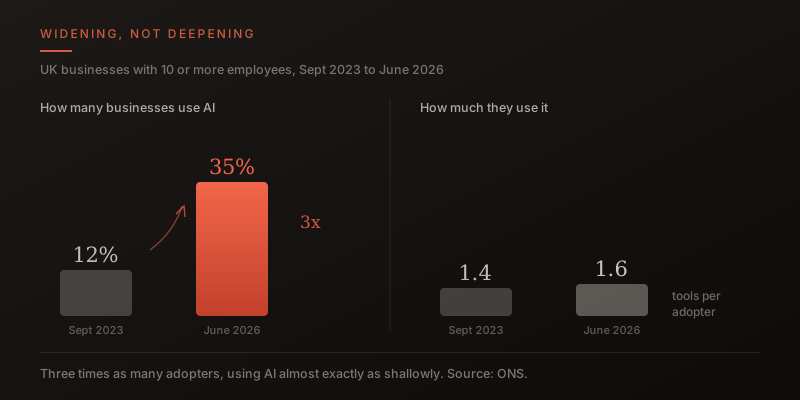
Headline adoption looks like a success story. As of June 2026, around 35% of UK businesses with 10 or more employees report using at least one AI technology, up from roughly 12% in September 2023. Nearly a threefold rise in under three years. Among businesses with 250 or more employees, adoption reaches 49%.
Then look at depth, and the story inverts. Over that same period, the average number of AI technologies per adopting business moved from about 1.4 to 1.6. Only 10% of adopting businesses describe their use of AI as extensive.
That is the finding that matters. Adoption is spreading sideways across the economy while barely moving downwards into any individual business. Three times as many firms are using AI, and they are using it very nearly as shallowly as the first cohort did in 2023.
The composition confirms it. Large language models lead at 18% of businesses, followed by visual content creation at 16%, machine learning for data processing at 12%, image processing at 6% and robotics at 2%. Close to 60% of adopters report using AI to improve existing operations, while developing new products or entering new markets are reported by much smaller proportions.
In other words: most UK AI adoption in 2026 is one general-purpose tool, used by some staff, to do the existing job slightly faster. That is a real benefit. It is not the transformation the spending implies, and it is not what most AI business cases were underwritten on.
One more number worth sitting with. Only 11% of UK businesses report that more than half their workforce has had any AI-related training. A capability nobody is trained to use does not compound.
The US Numbers Say the Same Thing
The US Census Bureau runs the Business Trends and Outlook Survey, which asks a large sample of firms whether they have used AI in producing goods or services. It is among the better instruments available because it is government-run, high-frequency and covers the actual firm population rather than a conference audience.
As of early May 2026, 19.8% of US businesses reported using AI. The more telling detail is the trend: the rate has sat between 17% and 20% from December 2025 through May 2026. After three years of near-vertical narrative, measured adoption went flat for two quarters.
The size gradient mirrors the UK. Around 37% of firms with 250 or more employees report AI use, against under 20% of firms with four or fewer. Sector variation is wider still, with Information at 39.7% and Finance and Insurance at 33.9% against a national rate of 19.8%.
The enterprise picture completes it. McKinsey's State of AI survey work through this period found that while 88% of organisations report using AI in at least one business function, only 39% attribute any EBIT impact to it at all, and most of those put the figure below 5%. Roughly two-thirds say they have not begun scaling AI across the enterprise.
Note what that is not saying. It is not saying AI does not work. It is saying that in most organisations it has not yet been deployed at a scale where it could plausibly show up in the accounts.
Nobody Agrees How to Measure Any of This
Here is the finding that should make you sceptical of every number above, including the ones I have just quoted.
In April 2026 the Federal Reserve published a note comparing the major AI adoption surveys. The Business Trends and Outlook Survey put adoption at about 18% of firms at year-end 2025. The Real-Time Population Survey put work-related generative AI use at about 41% of the workforce. The Survey of Business Uncertainty found that 78% of the labour force works at a firm that has adopted AI.
Eighteen, forty-one, seventy-eight. Same economy, same period, three answers.
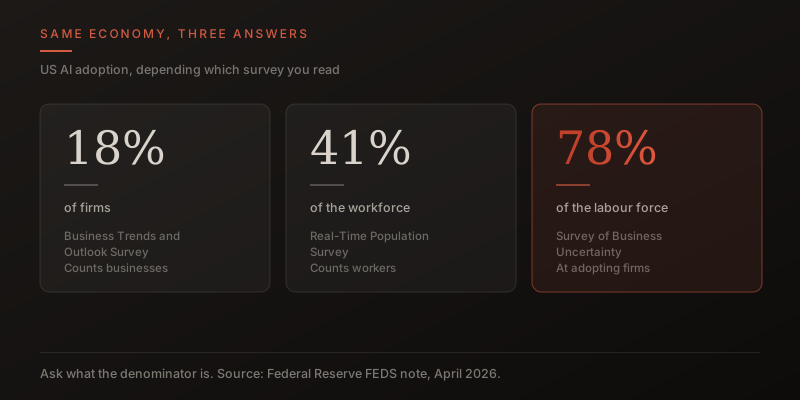
They are not contradictory so much as answering different questions. One counts firms, one counts workers, one counts workers at adopting firms, which weights heavily towards large employers. A country of many small firms and a few enormous ones produces exactly this spread depending on what you count.
The Fed also names the biases. Respondents may not know what their own organisation is doing. And firm representatives face pressure to report AI use as an efficiency initiative, which pushes numbers up in a way nobody can correct for.
The practical instruction: when someone quotes an AI adoption or failure percentage at you, ask what the denominator is. If they cannot tell you, the number is decoration. This is the same discipline we argue for in measuring AI ROI properly rather than by proxy.
Where the Results Are Genuinely Real
None of this means the returns are imaginary. It means they are concentrated, and the data shows fairly clearly where.
Look at the sector spread in the US figures. Information sits at 39.7% adoption and Finance and Insurance at 33.9%, against a national rate of 19.8%. In the UK, the single most adopted category is large language models at 18% of businesses, ahead of every other AI technology measured.
The pattern is consistent and not mysterious. Returns land first where the raw material of the work is already text, code or structured data, where output can be checked quickly, and where a wrong answer is cheap to catch. Drafting, summarising, classifying, coding, first-line support. Those are the places the technology fits the shape of the work without anything else having to change.
The corollary is the useful part. If your operation is physical, relational, heavily regulated or dependent on data that lives in people's heads, slower progress is not a maturity failure on your part. It is a fit problem, and the honest response is to pick the two or three text-shaped processes in your business and go deep on those rather than pursuing a general transformation the evidence does not yet support.
The Other Half of the Gap Is Capital
The results side of the ledger is only half the story. The investment side is where Q2 2026 produced its most striking data.
FactSet's analysis of the five largest hyperscalers, Alphabet, Amazon, Meta, Microsoft and Oracle, puts expected FY26 capital expenditure above $690bn, growth of more than 80% year on year, against roughly $490bn in the twelve months to May 2026. Including finance leases and customer prepayments, calendar 2026 approaches $800bn.
How that is being funded changed materially during the first half of 2026. Incremental debt as a share of capex rose from 9% in FY24 to 32% in the twelve months before June 2026, taking aggregate debt across the five to around $700bn. Alphabet raised $84.75bn in equity in June 2026, with $44.75bn earmarked for AI capital expenditure. Lease-related commitments not recognised on balance sheets run to roughly $820bn across the group.
The consequence shows up in cash. FY26 free cash flow is expected to fall close to zero or turn negative for all five except Alphabet and Microsoft.
None of that is a prediction of collapse, and I am not making one. It is a timing observation, and FactSet states it plainly: AI costs are front-loaded while returns are expected over a longer horizon. The capital is being committed now against revenue expected later, and the honest position is that nobody knows the date at which those cross.
That matters to a UK business owner for one narrow but important reason. The pricing you are being quoted today sits on top of infrastructure that is not yet paying for itself. Assume compute pricing is more likely to firm up than to keep falling, and build your business case so it survives that. We went through the mechanics of how those costs behave in production in the AI ROI trap.
Three Gaps, Moving in Different Directions
Is the gap closing? is the wrong question, because there are three of them and they are not moving together.
- The adoption gap is closing. More firms use AI every year. UK adoption tripled in under three years. This one is genuinely going well.
- The depth gap is widening. Tools per adopter moved 1.4 to 1.6 while the adopter base tripled. Most new adopters are arriving at the shallow end and staying there, which drags the average experience down even as the headline rises.
- The capital gap is widening fastest. Capex is growing over 80% year on year against enterprise EBIT impact that most organisations still cannot detect.
The uncomfortable synthesis: the AI economy is being financed as though depth were arriving quickly, while the measured evidence shows breadth arriving quickly and depth arriving very slowly.
What to Do With This
Benchmark Against the Real Distribution, Not the Narrative
If your business uses one or two AI tools, some staff use them regularly, and you have automated a handful of workflows, you are not behind. On the ONS data you are roughly average for a UK adopter, and ahead of the 65% of businesses with 10 or more employees not using AI at all. Decisions made from the fear of being behind are usually worse than decisions made from where you actually are.
Go Deeper Before You Go Wider
The single clearest signal in the 2026 data is that breadth without depth produces no measurable return. Another tool added to the pile will not change your numbers. Taking one workflow that already runs on AI and pushing it from assisted to genuinely automated, with measurement attached, is the move the data supports. If you want a structured read of where you sit, the AI maturity scorecard covers this.
Fix the Training Gap, Because It Is Cheap
11% of UK businesses have trained more than half their workforce. Training is the least glamorous line in any AI budget and, at current adoption depths, probably the highest return, because it converts licences you already pay for into use you currently do not get.
Underwrite on Payback, Not on Narrative
Given the capital picture, build every case on a payback period you would accept if the tooling cost 30% more. If it only works at today's prices, it is a bet on someone else's balance sheet.
Conclusion
The gap between AI hype and results in 2026 is real, but it is not the one the failure statistics describe. It is not that AI does not work. The evidence is that it is being adopted broadly, used shallowly, trained for barely, measured poorly, and financed as though all four of those were already solved.
For an individual business, that is unexpectedly good news. The competitive bar is far lower than the discourse suggests. Most of your competitors are running one tool at the shallow end with no measurement attached. Depth, training and honest measurement are all available, all unglamorous, and all still rare.
Frequently Asked Questions
- Is it true that 95% of AI projects fail?
- That figure comes from MIT NANDA research conducted between January and June 2025, based on a review of around 300 publicly disclosed initiatives, 52 interviews and 153 survey responses. It was not peer reviewed and defined success as measurable P&L impact within roughly six months, a window that excludes most enterprise deployments. It is a real finding about a narrow question, and it is routinely quoted as though it were a general law of 2026.
- What percentage of UK businesses use AI in 2026?
- According to the Office for National Statistics, around 35% of UK businesses with 10 or more employees reported using at least one AI technology as of June 2026, up from roughly 12% in September 2023. Adoption reaches 49% among businesses with 250 or more employees. Large language models are the most used category, at 18% of businesses.
- Why do AI adoption statistics vary so much?
- Because they measure different things. A Federal Reserve note published in April 2026 compared three surveys covering the same period and found adoption of 18% of firms, 41% of the workforce and 78% of the labour force. The first counts businesses, the second counts workers, and the third counts workers at adopting firms, which weights heavily towards large employers. None is wrong; they answer different questions.
- Is AI actually delivering ROI in 2026?
- At use-case level, frequently. At enterprise level, rarely so far. McKinsey found that only 39% of organisations attribute any EBIT impact to AI, and most of those put it below 5%, while roughly two-thirds say they have not begun scaling AI across the enterprise. The more accurate reading is not that AI fails to work, but that in most organisations it has not been deployed at a scale where it could show up in the accounts.
- Where is AI genuinely delivering results?
- Where the raw material of the work is already text, code or structured data, output can be checked quickly, and a wrong answer is cheap to catch. Drafting, summarising, classifying, coding and first-line support. The sector data reflects this: US adoption reaches 39.7% in Information and 33.9% in Finance and Insurance against a national rate of 19.8%.
- Are we in an AI bubble?
- The data supports a narrower claim than that. Capital is being committed now against revenue expected later: hyperscaler capex is guided above $690bn for FY26 with incremental debt rising from 9% to 32% of capex, and FY26 free cash flow is expected near zero or negative for most of the group. That is a timing mismatch, which is a statement about sequencing rather than a prediction of collapse. Nobody currently knows the date at which AI profits overtake the build-out.
- If adoption is rising, why is measured impact still so low?
- Because adoption is spreading sideways rather than downwards. UK adopter numbers tripled while tools per adopter moved from 1.4 to 1.6 and only 10% of adopters use AI extensively. Close to 60% use it to improve existing operations rather than to build new products or reach new markets. Breadth without depth does not produce effects large enough to appear in company accounts.
- What should a UK SME actually do about this?
- Go deeper rather than wider. Take one workflow that already uses AI and push it from assisted to genuinely automated with measurement attached, instead of adding another tool. Close the training gap, since only 11% of UK businesses have trained more than half their workforce and that converts licences you already pay for into use you currently do not get. And underwrite every case on a payback period that still works if tooling cost 30% more.