SEO & Content
AI Overviews Are Eating Organic Traffic: How Brands Are Fighting Back
15 min read
Pew found users click a result in 8% of searches with an AI summary versus 15% without, and Ahrefs measured a 34.5% clickthrough drop for position one. But the losses are not evenly spread, and the traffic that survives converts better. This is what the data actually shows, why the change is structural rather than temporary, and the six moves brands are using to defend their pipeline.
✦Key Takeaways
- The effect is measured, not anecdotal: Pew found users clicked a result in 8% of searches with an AI summary versus 15% without, roughly half.
- Only 1% of visits involved clicking a link inside the summary itself, so being cited is not the same as being visited.
- Ahrefs measured a 34.5% clickthrough decline for the top-ranking position on informational keywords, and 99.2% of AI Overview keywords are informational.
- Longer, natural-language queries trigger summaries far more often: 8% of one or two word searches versus 53% of searches with ten or more words.
- The traffic that survives converts better, because users who click through after reading a summary are further along in their decision.
- Ranking and traffic have decoupled. Measuring position alone now tells you almost nothing about commercial outcome.
- The winning response is portfolio surgery, not panic: shift investment away from content AI answers for free and toward content it cannot.
For twenty years the deal between Google and the web was simple. Publish something useful, earn a ranking, receive visitors. Everybody understood their side of it. That deal is being rewritten in public, and most brands are discovering the new terms from their analytics dashboard rather than from an announcement.
The mechanism is the AI Overview: the generated summary that now sits above the traditional blue links for a large share of searches. It answers the question on the results page. For the user it is genuinely convenient. For the business whose content was used to compose the answer, it is a toll booth that collects nothing.
The instinct in most marketing teams is to treat this as another algorithm update to be weathered. It is not. Ranking well and receiving traffic have come apart as concepts, which breaks the assumption underneath every content strategy written before 2025. This article covers what the data actually shows, why the drop is structural rather than temporary, the surprising thing about the traffic that survives, and the six things brands are doing that are demonstrably working.
What the Data Actually Shows
Start with the most credible source, because this space is full of vendor claims with an interest in the answer.
The Pew Research Center analysed 68,879 real Google searches from the browsing data of 900 US adults. When an AI summary appeared, users clicked a traditional search result in 8% of searches. When no summary appeared, they clicked in 15%. That is close to half the traffic, from the same search, for the same query intent.
Two secondary findings matter more than the headline. First, clicking a link inside the summary happened in just 1% of visits, which demolishes the comfortable idea that citation is a substitute for ranking. Being named in an AI Overview is worth something for brand visibility, but as a traffic channel it barely registers. Second, users were more likely to end their browsing session entirely after a page with a summary, 26% versus 16%, meaning the answer often concludes the journey rather than beginning it.
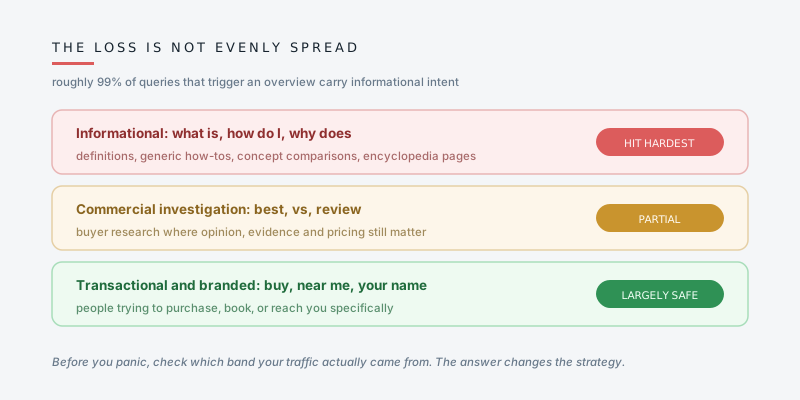
The industry data agrees on direction. Ahrefs studied 300,000 keywords, half with AI Overviews and half without, and found a 34.5% lower clickthrough rate for the top-ranking position when an Overview was present. Their sample was informational-intent keywords, which matters because roughly 99% of queries that trigger Overviews carry informational intent.
That last detail is the most actionable thing in the data, and most coverage skips it. The losses are not evenly spread. They concentrate almost entirely on the informational end of the search spectrum: definitions, how-to explanations, comparisons of concepts, “what is” and “why does” queries. Transactional and navigational searches, someone looking for a supplier, a price, a location, a specific brand, are far less affected. If your organic traffic was mostly top-of-funnel explainer content, you have taken a serious hit. If it was mostly people trying to buy something, you may barely have noticed.
Query length tells the same story from another angle. Pew found summaries on 8% of one and two word searches but 53% of searches of ten words or more. As people learn to ask search engines conversational questions, the share of queries that get answered without a click keeps rising.
Why This Is Not Another Algorithm Update
Marketing teams have absorbed a decade of updates: Panda, Penguin, Hummingbird, the helpful content updates. Every one rearranged who ranked. This is categorically different, and the difference determines the correct response.
Previous updates changed the winners. This changes the transaction. Google is no longer primarily routing users to answers; it is composing the answer, using your content as raw material. You can hold position one and still see traffic fall by a third, because the click that used to follow the ranking no longer does. The metric that governed content investment for twenty years, position in the results, has quietly stopped predicting the outcome that mattered.
It is also not reversible. AI Overviews exist because users prefer them, which means competitive pressure keeps them in place regardless of what publishers think. ChatGPT, Perplexity and Copilot apply the same pressure from outside Google. Any strategy premised on this receding is a strategy premised on a search engine choosing to make its product worse.
There is a live policy dimension too, and UK brands should know where it stands. In October 2025 the Competition and Markets Authority designated Google as having Strategic Market Status in general search under the Digital Markets, Competition and Consumers Act, a designation running to 2030, and AI Overviews fall explicitly within its scope. That gives the regulator power to impose conduct requirements covering things like attribution and publisher control. Something may eventually change. None of it will arrive fast enough to matter to your next four quarters of planning, so it belongs in your risk register rather than your strategy.
The correct mental model is not a penalty to recover from. It is a permanent change in the price of a click for informational queries, and like any permanent price change it should trigger a reallocation of investment rather than an appeal.
The Counter-Intuitive Part: What Survives Is Better
Here is where the panic narrative gets something wrong. Volume fell; quality rose.
Think about who still clicks. The AI Overview has already answered the casual question. The person who reads the summary and then chooses to click has a reason the summary did not satisfy: they want depth, evidence, a supplier, a price, a demonstration. They have been pre-qualified by the very thing that removed the casual traffic.
The reported numbers vary enormously, and much of the reporting comes from vendors with an interest in the story, so treat specific multiples sceptically. But the direction is consistent across first-party datasets. Ahrefs, publishing their own traffic data, found AI search drove around 0.5% of visits but a meaningfully larger share of signups. Retail analytics from Adobe and Shopify have reported AI-referred sessions converting materially better than organic ones. Different methodologies, wildly different multiples, same conclusion: a visitor arriving from an AI answer is further down the funnel than a visitor arriving from a blue link.
This reframes the problem usefully. Your traffic chart looks like a disaster while your pipeline may be close to flat. Any brand still reporting content performance in sessions is measuring the thing that broke rather than the thing that pays, and will make bad decisions as a result, cutting exactly the content that is now doing the qualifying work.
How Brands Are Fighting Back
Six responses, roughly in order of how quickly they pay.
1. Optimise to be the cited source, not just the ranked one
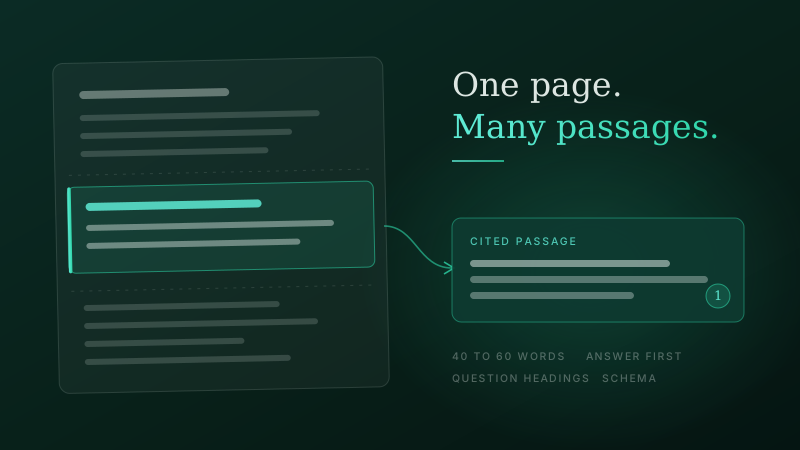
Being quoted in the answer is now a distinct discipline from ranking. The formats that get extracted share a shape: a direct answer in the first two sentences under a question-shaped heading, specific numbers rather than vague claims, clear attribution, and structure a machine can parse. Google’s own guidance on AI features in Search is explicit that the technical fundamentals still apply: crawlable pages, useful content, and structured data using schema.org vocabulary.
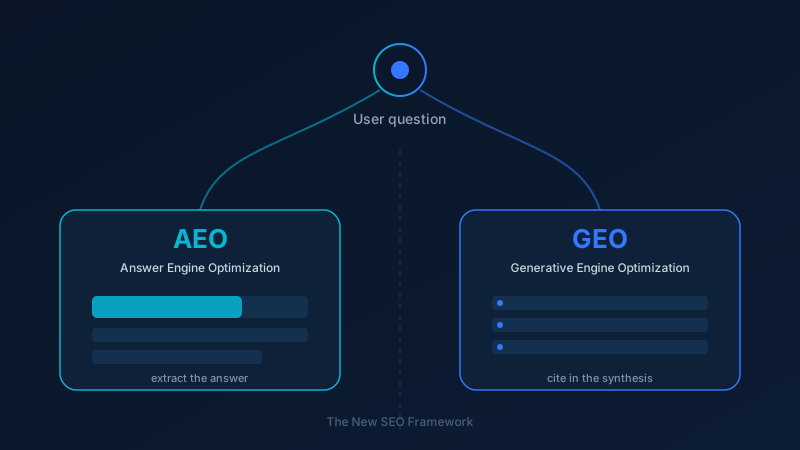
The practical move is to rewrite your most valuable pages so the answer comes first and the supporting argument follows. Journalists have known this as the inverted pyramid for a century. It happens to be exactly what an extraction model needs. Our guides to generative engine optimisation and the AEO and GEO technical split go deeper on the mechanics.
2. Do portfolio surgery on your content
Audit every page against one question: can an AI answer this completely in a paragraph? If yes, that page is now a liability, consuming maintenance budget and returning steadily less. This is the hardest recommendation because it usually condemns content that took years to build.
What holds value has a consistent character. Proprietary data nobody else has. Original research. Genuine expertise with a named author and an opinion. Case studies with real numbers. Tools and calculators that do something rather than explain something. Anything requiring judgement, taste or a point of view. What loses value is the encyclopedia layer: definitions, generic how-tos, listicles assembled from other people's listicles.
A concrete version of the audit: take your top 100 organic pages by historic traffic, and sort them into three piles. Pile one is content a summary fully replaces, the “what is” and “how do I” pages; freeze new investment here and consolidate the survivors into fewer, better pages. Pile two is content a summary can partially replace but that carries your evidence, pricing or opinion; rewrite these answer-first so they are extractable and worth clicking through to. Pile three is content no summary can produce, your data, tools and case studies; this is where the freed budget goes.
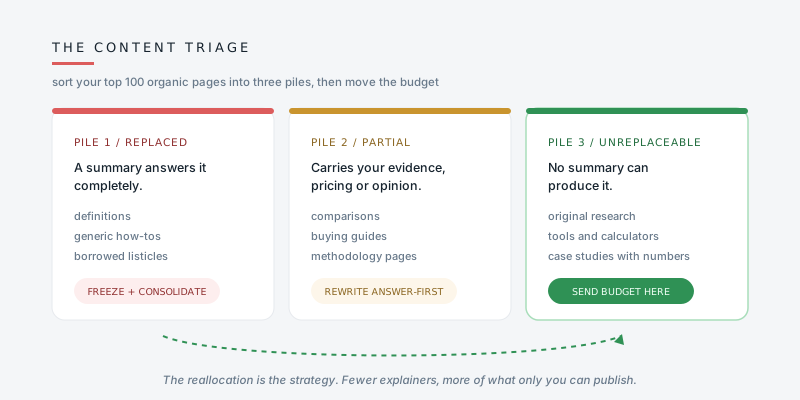
The reallocation is the strategy. Ten explainer articles a month were a reasonable investment in 2022. One piece of original research a quarter is a better one now, because AI can summarise the explainer and cannot generate your data. This is the same logic behind treating generative engine optimisation as a distinct UK discipline rather than a rebranded SEO checklist.
3. Capture demand where the answer ends
If the summary answers the question, the remaining opportunity sits immediately after it: the moment the user needs to do something rather than know something.
That means investing in the assets an Overview cannot replace. Interactive tools, calculators and configurators. Product comparison pages with live pricing and availability. Anything requiring an account, a quote or a conversation. Community and expert access. In practical terms this often means shifting budget from the blog to the parts of the site that produce a transaction, because the top of the funnel now happens inside somebody else's interface.
4. Build channels that cannot be intermediated
The uncomfortable strategic lesson is that a business whose demand depends entirely on a channel it does not control was always exposed. AI Overviews simply presented the invoice.
Brands responding well are rebalancing toward owned and direct channels: email lists, communities, podcasts, events, YouTube, and the kind of consistent presence that makes people search for you by name. Branded search is the one query type Overviews barely touch, because there is no ambiguity to resolve. Every pound spent making people ask for you by name is a pound spent outside the summary's reach. The same principle applies to being present in the AI systems themselves: brands mentioned consistently across credible sources get selected as sources more often, which is why visibility work and brand work have started to converge.
5. Fix the technical layer, and decide your crawler policy
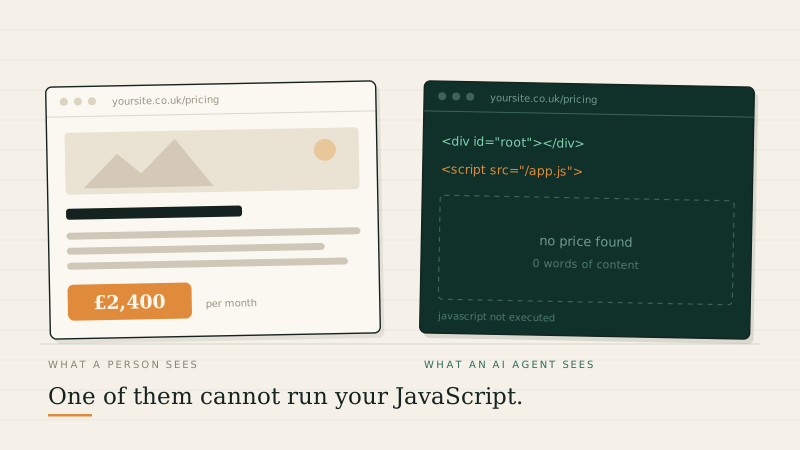
Two technical jobs. The first is being readable: server-side rendered content, clean markup, valid structured data, fast pages, and correct handling of the AI crawlers in
robots.txt. Many sites are accidentally invisible to the systems composing the answers.The second is a genuine strategic decision most teams have not consciously made: whether to allow AI crawlers at all. Some publishers now block or charge them, an option Cloudflare has productised with pay-per-crawl. For most brands, blocking is the wrong call, because invisibility in AI answers is worse than uncompensated citation. For content businesses whose entire product is the content, the calculation genuinely differs. Either way it should be a decision, not a default.
6. Change what you measure, immediately
Reporting sessions and rankings in an AI Overview world produces panic and bad calls. The measurement set has to change with the mechanism.
Track share of AI answers: how often your brand appears in Overviews and in ChatGPT, Perplexity and Copilot responses for your priority questions. Track branded search volume as the cleanest proxy for whether awareness is holding. Track conversion rate by source, separating AI referrers, so you can see the quality effect rather than only the volume loss. Track assisted conversions and self-reported attribution, because a customer who read your name in three AI answers before searching for you directly is invisible in last-click reporting.
The Measurement Reset
It is worth being blunt about the reporting change, because it is where most internal arguments happen.
| Old metric | Why it now misleads | Track instead |
|---|---|---|
| Organic sessions | Falls even when demand is flat | Conversions and pipeline by source |
| Keyword rankings | Position one no longer implies the click | Share of AI answers for priority questions |
| Total pageviews | Rewards the content losing value fastest | Engaged sessions on decision-stage pages |
| Last-click attribution | Misses AI-mediated discovery entirely | Branded search volume, self-reported attribution |
The pattern is consistent: stop measuring the volume of attention you received and start measuring the quality of the attention and the influence you had on decisions.
What Not to Do
Three responses that reliably waste money.
Do not publish more of the same content, faster. The most common reaction to falling traffic is to increase output, usually with AI assistance. This produces more of exactly the content that AI answers for free, at higher volume and lower quality, accelerating the decline.
Do not chase the algorithm with tricks. Prompt injection in page copy, keyword-stuffed FAQ blocks and other manipulation attempts are short-lived and carry real risk. The systems are being tuned against them continuously.
Do not block everything in a panic. Blocking AI crawlers because citation feels unfair removes you from the surface where discovery increasingly happens. Unless you sell content itself, absence costs more than uncompensated presence.
Conclusion: The Channel Changed, the Job Did Not
Organic search as a volume channel for informational content is genuinely diminished, and no amount of optimisation restores 2022 numbers. That is worth saying plainly, because strategies built on hoping otherwise are the most expensive kind.
What has not changed is the underlying job: be the source that people and machines find most worth citing, and give the people who do arrive a reason to act. Brands adapting well made three moves. They stopped producing content a summary can replace. They started measuring influence and conversion rather than sessions. And they invested in the channels and assets that sit outside anybody else's interface.
If your traffic charts have turned down and you want to know how much of it is structural, which pages are worth defending and where the budget should move, AI Native Agency runs AI visibility audits for UK brands, covering both traditional search and the generative engines now sitting in front of it.
Frequently Asked Questions
- How much traffic do AI Overviews actually take?
- Pew Research found users clicked a traditional result in 8% of searches with an AI summary versus 15% without, roughly halving clicks. Ahrefs measured a 34.5% clickthrough decline for the top position on informational keywords. Losses concentrate heavily on informational queries; transactional and branded searches are far less affected.
- Does appearing in an AI Overview bring traffic?
- Barely, as a direct channel. Pew found link clicks inside AI summaries occurred in just 1% of visits. Citation is worth pursuing for brand visibility and influence on the eventual decision, but it should not be treated as a replacement for the clicks that used to follow a top ranking.
- Which types of content lost the most traffic?
- Informational content: definitions, generic how-to guides, basic comparisons and encyclopedia-style explainers, which is precisely what AI summarises well. Content with proprietary data, original research, named expertise, interactive tools and transactional intent has held up considerably better.
- Is traffic from AI search worth more than normal organic traffic?
- Per visitor, generally yes, though the specific multiples reported by vendors vary too widely to trust individually. The mechanism is straightforward: the summary already handled the casual question, so someone who still clicks has a reason, which puts them further along the buying journey than an average blue-link visitor.
- Should I block AI crawlers from my website?
- For most brands, no. Blocking removes you from the surface where discovery increasingly happens, and invisibility usually costs more than uncompensated citation. The calculation genuinely differs for publishers whose product is the content itself, and tools now exist to charge for crawling rather than simply allowing or blocking it.
- How do I get my brand cited in AI Overviews and ChatGPT?
- Answer the question directly in the first two sentences under a question-shaped heading, use specific figures rather than vague claims, publish information nobody else has, keep pages crawlable and server-rendered, and implement valid structured data. Being widely cited elsewhere also raises the odds of being selected as a source.
- What should I measure now that rankings do not predict traffic?
- Share of AI answers for your priority questions, branded search volume, conversion rate segmented by source including AI referrers, engaged sessions on decision-stage pages, and self-reported attribution. Sessions and average position are still worth watching, but neither should drive investment decisions on their own.
- Is SEO dead?
- No, but it has split. The technical foundations, crawlability, structure, speed and authority, matter as much as ever, because they determine whether you can be cited at all. What has changed is the goal: optimising to be the source of an answer rather than only to occupy a position in a list of links.