Strategy
The AI ROI Trap: Why Your Prototype is Cheap but Your Production is Not
15 min read
Your AI proof-of-concept ran up a £200 bill. Your production deployment is heading for £20,000 a month. This guide explains the three structural forces behind runaway LLM costs: compounding context windows, reasoning model economics, and the four infrastructure leaks that an AI audit will always find.
✦Key Takeaways
- Every conversation turn you preserve in the context window adds tokens to the input cost of every subsequent message — costs compound, not scale linearly.
- Reasoning models like o3 can cost 10 to 50 times more per call than standard GPT-4o and are routinely used on tasks that do not need them.
- A POC typically processes 200 to 800 tokens per request; a production chatbot with multi-turn memory regularly exceeds 15,000 input tokens per request.
- Unbounded conversation history is the single biggest cost leak in production LLM applications — a sliding window fix alone reduces bills by 40 to 70 percent.
- Prompt caching and model tiering together can cut monthly API spend by 50 percent or more without any user-visible quality degradation.
- Most engineering teams price production using output token costs — the real driver is input tokens, which grow with conversation length and prompt size.
- Enterprise LLM budgeting must simulate production conversation patterns, not extrapolate from POC averages.
When your proof-of-concept AI assistant ran up a £200 cloud bill last quarter, it felt like proof. Proof that AI was finally affordable, scalable, and ready for the enterprise. You showed the board, secured the budget, and handed the project to engineering. Three months later, the same application serving 2,000 active users is costing £18,000 a month.
Nobody lied to you. The prototype was cheap. The problem is that generative AI billing does not behave like traditional software infrastructure. A SaaS application with ten times the users costs roughly ten times the hosting. An LLM-based application with ten times the users can cost one hundred times more, for reasons that are invisible in the prototype phase.
This article is written for CTOs, Product Owners, and VCFOs who are currently staring at an unexpected cloud bill or who are about to approve a production rollout and want to understand the economics before they commit. It covers the three structural forces that turn a cheap prototype into an expensive production system: the compounding cost of context windows, the hidden economics of reasoning models, and the four most common infrastructure cost leaks that an AI audit will find.
Why POC Costs Are Deceptively Low
The first reason prototypes look so cheap is arithmetic. At the proof-of-concept stage, you are making a small number of carefully crafted requests with clean, short prompts. Your demo runs ten user queries. Your usability testing session runs forty. The entire POC phase might generate five thousand API calls over six weeks, spread across a handful of test users who understand the system and write short, precise inputs.
Now consider what happens in production. A customer-facing chatbot at a mid-sized UK retailer, serving 2,000 monthly active users, each having three conversations per month with an average of six turns per conversation, generates 36,000 conversations a month. That is not ten times the POC traffic. It is seven hundred and twenty times the POC traffic, and that is before you account for the compounding token effect described in the next section.
The Low-Volume Illusion
The danger of the low-volume illusion is not that the maths is wrong: it is that the maths is right for the wrong model. Engineers often estimate production costs by taking the average cost per query from the POC and multiplying by expected query volume. That calculation is accurate only if every query is independent and roughly the same size as the POC queries. In a stateless request-response API, that assumption is valid. In an LLM application, it almost never is.
The Toy Dataset Problem
The second deceptive factor is the toy dataset. POC retrieval systems are typically built against a curated set of twenty to fifty documents. The chunks are clean, the embeddings are precise, and the retrieval is accurate. In production, the same pipeline ingests thousands of documents: PDFs with inconsistent formatting, Word files with embedded tables, email threads with quoted history. Retrieval precision drops, the application compensates by passing more context to the LLM, and the average tokens per request climbs. The cost per query increases even before user volume grows.
The Context Window Trap
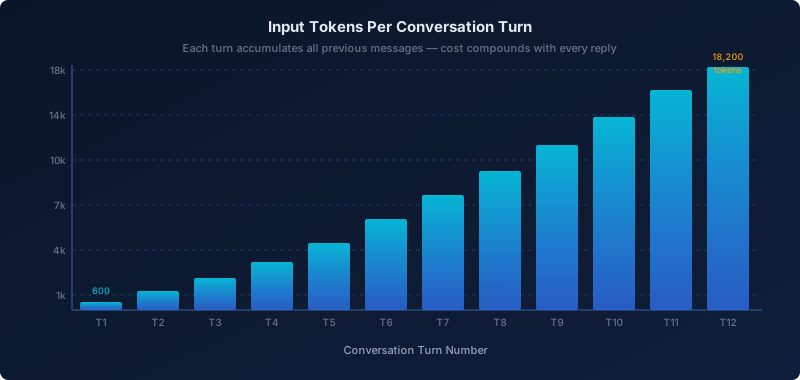
This is the mechanism most engineering teams miss, and it is responsible for the majority of AI production cost overruns. When you use a large language model in a conversational application, you do not send only the latest message to the API. You send the entire conversation history: every message the user has sent, every response the model has returned, plus your system prompt, any retrieved documents, and any tool outputs. Every single call includes all of this as input.
This means that the input token count for a conversational application grows with every turn of the conversation. Unlike a stateless API where each request is the same size, every follow-up question a user asks carries the full weight of every previous exchange.
How Input Token Costs Compound
Assume a system prompt of 500 tokens and an average user message of 100 tokens. In turn one, you send 600 tokens of input. In turn two, you send 600 (previous context) plus 100 (first model response) plus 100 (second user message) — 800 tokens. By turn six, you are sending over 2,000 tokens per request just to maintain context. By turn twelve, 4,000 or more. The bill does not scale with users. It scales with users multiplied by conversation depth.
Most developers calculate cost using the output token price. Output tokens are the tokens the model generates in its response, and they are typically shorter than the input. Developers see a per-response cost, forget to add the growing input cost, and underestimate the real economics by a factor of three to ten. In GPT-4o pricing as of early 2026, input tokens cost around $2.50 per million while output tokens cost $10 per million — but input volume dominates in conversational applications because each turn resends everything. For a deep technical breakdown of how retrieval architectures affect token economics, see our guide on Advanced RAG vs long-context windows.
A Real-World Example
A B2B SaaS company built an AI-powered onboarding assistant. The POC, running over two months with a test group of thirty users, cost £600. The team calculated that production deployment to 1,500 users would cost approximately £30,000 per year. Within sixty days of launch, the monthly bill was £7,200 — an annualised cost of £86,400.
What went wrong? The system prompt included 2,200 tokens of onboarding documentation. User conversations averaged eleven turns. Retrieved product documentation added an average of 1,500 tokens per query. By turn six, each request carried over 12,000 tokens of input. The team had priced production using their POC average of 800 tokens per request. The actual production average was 14 times that.
Reasoning Models Change the Economic Equation
Standard large language models generate a response in a single forward pass. You send the prompt, the model predicts tokens sequentially until it produces a complete response. The compute used is proportional to the number of output tokens generated.
Reasoning models — such as OpenAI o3, Anthropic Claude's extended thinking mode, and Google Gemini 2.0 Flash Thinking — work differently. Before generating the final response, they produce an internal chain-of-thought: a reasoning trace that can be thousands of tokens long, in which the model plans, self-corrects, and checks its work. This reasoning trace is invisible in the response but is fully counted in the billing.
Chain-of-Thought Thinking Tokens
A reasoning model asked a question that triggers significant deliberation may generate 2,000 to 8,000 thinking tokens before producing a 400-token answer. Those thinking tokens are billed at the output token rate, which is typically two to four times the input token rate. On OpenAI's pricing, o3 output tokens cost around $60 per million compared to $2.50 per million for GPT-4o input tokens. A single o3 call on a complex task can cost $0.50 or more. The same task on GPT-4o mini costs $0.002.
Teams that default to reasoning models across their entire application stack, rather than reserving them for genuinely complex tasks, can inflate their API bill by a factor of 10 to 50 compared to a properly tiered architecture. This is one of the most expensive and most avoidable mistakes in AI production deployments.
When Reasoning Models Are Worth It
Reasoning models earn their cost on tasks where accuracy has high business value and errors are expensive: legal document review, medical record summarisation, complex financial modelling, and multi-step agentic workflows with irreversible actions. If a wrong classification costs £0.50 to fix downstream, spending £0.20 on a reasoning model is justified. If a wrong classification costs nothing because a human reviews it anyway, using a reasoning model is pure waste.
The economic test is straightforward: what is the cost of a wrong answer, and what probability improvement do you get from a reasoning model over a standard model for this specific task? If the product of those two numbers exceeds the per-call cost premium, use the reasoning model. If it does not, use the standard model.
The Four Biggest Production Cost Leaks
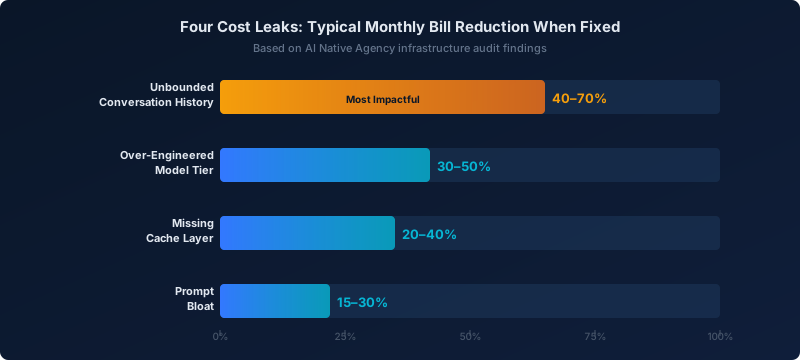
When an AI agency audits an existing production LLM deployment, four cost leaks appear in the majority of cases. None are difficult to fix once identified. All are invisible in a POC.
1. Unbounded Conversation History
The most common and most expensive leak. The application passes the full conversation history to every API call with no truncation, summarisation, or pruning. A power user with a twenty-turn conversation is generating 40,000 or more input tokens per request. The fix is a sliding window: keep only the last N turns of conversation, or summarise older context into a compressed memory block. A sliding window of the last six turns, combined with a summary of earlier context, reduces average input tokens by 60 to 80 percent in most conversational applications without meaningfully degrading response quality.
2. Over-Engineering the Model Tier
Every call goes through the premium frontier model, regardless of task complexity. Formatting a date, extracting a product code, generating a one-line acknowledgement — all processed by GPT-4o or Claude Sonnet. This is the equivalent of using a neurosurgeon to apply a plaster. The fix is model tiering: routing simple, deterministic tasks to smaller, cheaper models such as GPT-4o mini or Claude Haiku (which cost around 15 to 20 times less per token), and reserving frontier models for tasks that require nuanced reasoning or long-context synthesis.
Most enterprise LLM applications can route 60 to 70 percent of their calls to mini-tier models without user-visible quality degradation. Our post on Human-in-the-Loop AI consulting covers how to match model tier selection to task risk profiles — the same logic applies to cost optimisation.
3. Missing Caching Layers
Two types of caching dramatically reduce costs in production. Semantic caching stores the responses to common queries and returns the cached response for semantically similar future queries, bypassing the LLM entirely. Prompt caching — supported natively by Anthropic and increasingly by OpenAI — caches the beginning of a prompt, including the system prompt and any fixed context, so that repeated prefixes are not re-tokenised on every call.
In a document Q&A application where the same system prompt and document set are used for every query, prompt caching can reduce effective input token costs by 50 to 90 percent on repeated requests. Anthropic's prompt caching documentation estimates savings of up to 90 percent on repeated context blocks. Most teams implement neither cache until an audit forces the issue.
4. Prompt Bloat
Prompts tend to grow over time. Engineering teams add instructions to fix edge cases, examples to improve reliability, and safety guardrails to handle misuse. A system prompt that started at 300 tokens frequently reaches 3,000 tokens over six months, with much of the added content either redundant or ineffective. Since the system prompt is sent with every single API call, a 2,700-token bloat multiplied by one million monthly calls is 2.7 billion unnecessary input tokens per month. Regular prompt audits should measure the marginal impact of each instruction block on output quality using automated evaluation, and remove instructions that do not measurably improve results.
How an AI Agency Audits Infrastructure for Cost Leaks
A structured AI infrastructure audit follows a four-stage methodology, typically running over two to three weeks. The goal is not to identify problems in the abstract but to quantify them in pound terms and rank them by the effort required to fix them.
Stage 1: Token economics baseline. The production application is instrumented to log input tokens, output tokens, thinking tokens (where applicable), model tier used, and request cost per call — broken down by feature and user cohort. Most teams discover that 10 percent of their users generate 60 percent of their API costs, driven by high-volume or high-turn-count usage patterns.
Stage 2: Conversation structure analysis. The distribution of conversation lengths is analysed to identify the point at which context growth becomes the dominant cost driver. The ratio of input tokens to output tokens is mapped per feature. A healthy ratio in a well-optimised application is typically 3:1 to 8:1. Applications with ratios above 15:1 almost always have an unbounded history or prompt bloat problem.
Stage 3: Model routing review. Every API call type in the application is classified by task complexity, required output quality, and cost of errors. A routing map is then built matching each task type to the appropriate model tier, including mini models, standard models, and reasoning models. The cost reduction from implementing optimal routing is estimated before any code is written.
Stage 4: Caching and infrastructure opportunities. The audit identifies which queries repeat frequently enough to justify semantic caching, which prompts are stable enough to benefit from prompt caching, and whether the application architecture supports the necessary caching layer. Embedding and vector storage costs are also reviewed, as they are frequently over-provisioned in early production deployments. McKinsey's analysis of generative AI economics notes that infrastructure cost management is the most underrated factor in achieving positive ROI on AI investments.
A typical audit engagement identifies cost reduction opportunities of 40 to 70 percent of the current monthly API bill, with most of the reduction achievable through configuration changes rather than architectural rewrites.
How to Build for Production Economics from Day One
If you are about to move from POC to production, the following design decisions, made now, will save significant cost later. These are not premature optimisations. They are architectural defaults that cost nothing to implement at the start and are expensive to retrofit later.
Set token budgets per feature. Define the maximum input token budget for each feature type before building. A customer FAQ bot does not need a 4,000-token system prompt. A document summariser does not need to receive the same document on every turn of a multi-turn conversation.
Implement conversation window management at the architecture layer. Do not let conversation history grow unbounded. Decide on a window size and a summarisation strategy before writing the first line of production code. Six turns with a rolling summary is a sensible default for most conversational applications.
Build model routing from the start. Identify which tasks in your application genuinely require a frontier model and which do not. Default to mini-tier models for all new feature development and require explicit justification to use a more expensive tier. OpenAI's model documentation provides current pricing and capability comparisons to support tier selection decisions.
Log costs by feature, not just by total. Standard cloud billing tells you your total API spend. It does not tell you which feature is responsible for 40 percent of that spend. Structured cost logging — tagging every API call with the feature name, user cohort, and task type — is essential for cost management at scale.
Run a pre-production cost simulation. Before launching, simulate production traffic patterns using your instrumented token logging. Run synthetic conversations at the expected volume and length distribution. The cost-per-user figure that emerges from this simulation will be far more accurate than any calculation derived from POC data. Google Cloud's Vertex AI pricing documentation provides token cost tables for all major model families that feed directly into these simulations.
The Numbers That Should Inform Your Rollout Decision
Before signing off on a production AI deployment, the following benchmarks help calibrate whether your cost estimates are realistic. These are derived from AI Native Agency's audit work across UK enterprise and scale-up clients.
- A typical POC processes 200 to 800 input tokens per request. A production chatbot with 8-turn average conversation depth processes 8,000 to 20,000 input tokens per request.
- Switching from GPT-4o to GPT-4o mini for eligible tasks reduces per-token cost by approximately 94 percent, from $2.50/million to $0.15/million on input tokens.
- Implementing prompt caching for a 2,000-token system prompt across one million daily requests saves approximately $5,000 per month at Anthropic's caching rate of $0.30/million for cached input tokens versus $3.00/million for uncached.
- A conversation sliding window capping history at 6 turns, applied to an application averaging 12-turn conversations, reduces total input token volume by approximately 50 percent.
- Reasoning model thinking tokens, at $60/million output tokens for o3, cost 24 times more than GPT-4o input tokens. Routing 30 percent of calls away from o3 to GPT-4o on appropriate tasks can reduce that component of the bill by 70 percent.
Conclusion
The AI ROI trap is not a story about technology failing. It is a story about miscalibrated expectations transferred from one cost model to another. Traditional software infrastructure scales predictably. LLM-based applications scale according to token economics, conversation dynamics, and model selection decisions that have no equivalent in conventional development.
The gap between a £200 prototype and a £20,000 monthly production bill is not evidence that AI is too expensive to productionise. It is evidence that the economic model was not understood before the commitment was made. Understood correctly, LLM costs in production are highly controllable: context window management, model tiering, and caching can reduce bills by 50 to 70 percent without touching the user experience.
If you are planning a production AI rollout and want an independent review of your architecture before you commit, AI Native Agency provides infrastructure cost reviews as a standalone engagement. We have helped companies reduce LLM API spend by an average of 55 percent within the first three months of production operation.
Frequently Asked Questions
- Why is my AI chatbot much more expensive in production than in testing?
- In testing you send short, isolated queries. In production, every API call includes the full conversation history, system prompt, and any retrieved documents. This input token count grows with every turn. A chatbot averaging 10 conversation turns can send 15,000 or more input tokens per request, compared to the 600 tokens per request typical of a POC demo.
- What are input tokens and why do they cost more as a conversation grows?
- Tokens are the units language models use to process text — roughly 4 characters per token. Every API call to an LLM requires you to send the entire conversation context as input. As conversations grow longer, the input token count grows with every turn, and since each turn must re-send all previous turns, costs accumulate faster than most developers expect.
- What is the difference between a reasoning model and a standard LLM in terms of cost?
- Standard models generate a response directly. Reasoning models such as OpenAI o3 produce a hidden chain-of-thought trace first — thousands of tokens of internal deliberation that are invisible in the response but fully billed at the output token rate. A single o3 call on a complex task can cost $0.50 or more, versus $0.002 for the same task on GPT-4o mini.
- How do I reduce my monthly LLM API bill without degrading quality?
- The highest-ROI changes are: implement a conversation sliding window to prevent unbounded history growth; route simple tasks to mini-tier models (15 to 20 times cheaper per token); enable prompt caching for your system prompt and fixed context; and audit your system prompt for bloat, removing instructions that do not measurably improve output quality.
- What is prompt caching and how much money can it save?
- Prompt caching stores the processed representation of repeated prompt prefixes so they do not need to be re-tokenised on every API call. Anthropic's native prompt caching and OpenAI's equivalent can reduce effective input token costs by 50 to 90 percent for applications where the system prompt and document context are the same across many requests.
- What is model tiering in AI applications?
- Model tiering means routing different task types to different model sizes based on their complexity requirements. Simple tasks like classification, extraction, and short-form generation go to mini-tier models such as GPT-4o mini or Claude Haiku. Frontier models are reserved only for tasks requiring nuanced reasoning or long-context synthesis. Most applications can route 60 to 70 percent of calls to mini-tier models.
- How should I budget for enterprise LLM costs?
- Budget based on simulated production token economics, not POC averages. Instrument your application to log input tokens, output tokens, and thinking tokens per request type. Run synthetic conversations at expected volume and conversation-length distribution before launch. Build in a 3x safety margin for power users and viral content spikes, and set per-feature cost alerts from day one.
- What does an AI infrastructure audit involve?
- An AI infrastructure audit instruments your production application to log token economics by feature, analyses conversation length distributions to find where context growth becomes the dominant cost driver, reviews model routing decisions, and identifies caching opportunities. A typical audit finds 40 to 70 percent cost reduction potential, most of it achievable through configuration changes rather than architectural rewrites.
- What is semantic caching in an LLM application?
- Semantic caching stores the responses to common queries and returns the cached response for semantically similar future queries, bypassing the LLM entirely. It is particularly effective for FAQ-style applications where a large proportion of queries cluster around common themes. Combined with prompt caching, it can reduce billable API calls by 30 to 60 percent in appropriate workloads.
- When should I use a reasoning model vs a standard model?
- Use a reasoning model when the cost of a wrong answer exceeds the per-call cost premium multiplied by the expected frequency of errors. Legal document review, medical record analysis, complex financial modelling, and multi-step agentic workflows with irreversible actions are good candidates. FAQ answering, document classification, content formatting, and simple extraction tasks are not.