Strategy
AI Glossary for Executives: The Technical Terms You Actually Need to Know (and the Ones You Can Ignore)
8 min read
Vendor pitches are dense with AI jargon, and most of it is noise designed to borrow credibility. This executive glossary cuts through it: the handful of terms that actually change decisions, the ones you can safely delegate to your engineers, and a 30-second test for telling signal from sales talk.
✦Key Takeaways
- You do not need to understand how a transformer works to make good AI decisions. You need to understand what a model can and cannot do, and roughly what it costs.
- Seven terms cover almost every boardroom conversation: tokens, context window, RAG, fine-tuning, inference versus training, agent and hallucination. Master these and you can challenge any vendor.
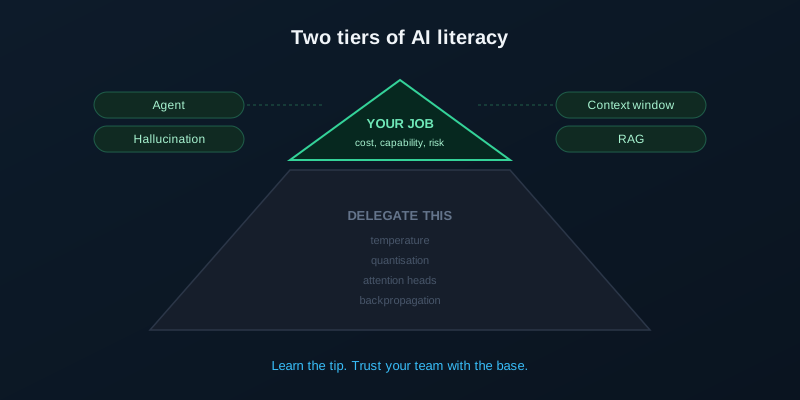
- Terms like parameters, temperature, quantisation and attention heads are real, but they are engineering knobs, not strategy concepts. Delegate them to your technical team without guilt.
- Hallucination is the one term every executive must internalise, because it defines the boundary between where AI can run unsupervised and where a human must stay in the loop.
- Context window (how much a model can read at once) and tokens (how usage is billed) are the two terms that most directly drive both capability and cost.
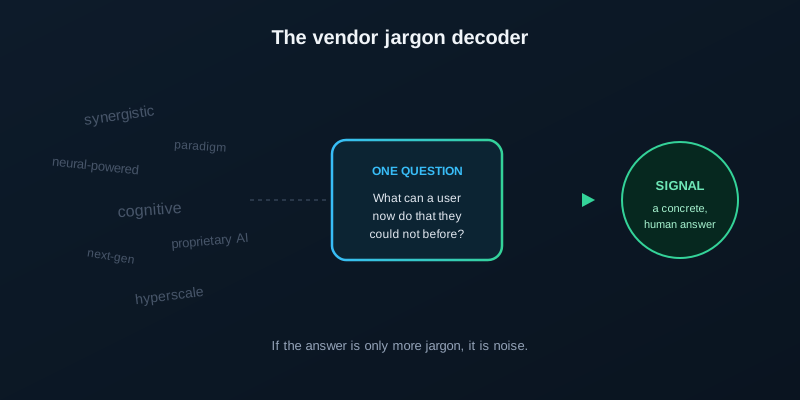
- A single question decodes most vendor jargon: what can a user now do that they could not do before? If the answer is only more jargon, it is noise.
Sit through enough AI vendor pitches and a pattern emerges. The slides are dense with terminology, the demo is slick, and you leave unsure whether you just saw something genuinely transformative or were skilfully bamboozled. The jargon is not an accident. In a field moving this fast, vague language is how mediocre products borrow the credibility of impressive ones.
Here is the reassuring part. As an executive, you do not need to understand how a neural network is trained any more than you needed to understand TCP/IP to make decisions about the internet. You need a working vocabulary: enough to ask sharp questions, spot nonsense, and know which details to delegate. This glossary is exactly that. The terms that change decisions, the terms you can safely ignore, and a quick test for telling them apart.
We have kept every definition deliberately plain. If a term is not on the first list, that is usually a sign it belongs to your engineering team and not your strategy deck.
Why the Vocabulary Matters More Than the Maths
The cost of AI illiteracy at the top is not embarrassment in a meeting. It is overpaying for capability you will not use, buying the wrong tool for the problem, and being unable to challenge a confident vendor who is quietly overselling. The opposite failure, diving into technical rabbit holes, wastes the scarcest resource you have, which is your attention. The target is decision-relevant literacy: the dozen or so concepts that actually move a budget, a risk assessment, or a roadmap.
A useful analogy is the car you drive to work. You need to know what it costs to run, what it can and cannot do, and when it is unsafe. You do not need to understand combustion, valve timing, or the chemistry of the catalytic converter. AI is the same. The terms below are split on exactly that line: the dashboard you read versus the engine internals you leave to a mechanic.
The Terms You Actually Need to Know
These are the concepts that come up in real decisions about cost, capability and risk. If you are comfortable with the ten below, you can hold your own in almost any AI conversation.
| Term | In plain English | Why it changes a decision |
|---|---|---|
| LLM | The large language model, the engine behind tools like ChatGPT and Claude | It is the commodity layer; your advantage comes from how you use it, not which one you pick |
| Token | A chunk of text, roughly three-quarters of a word, the unit AI is billed in | Your usage cost is measured in tokens, so it drives the bill directly |
| Context window | How much the model can read at once, measured in tokens | Bigger windows handle whole contracts or histories, but cost more per call |
| RAG | Retrieval-augmented generation: feeding the model your own documents at query time | It is how an off-the-shelf model learns your business without retraining |
| Fine-tuning | Further training a model on your specific data to specialise it | Powerful but costly; usually the wrong first move when RAG would do |
| Inference vs training | Training builds the model once; inference is every time you use it | You pay per inference, so that, not training, is your running cost |
| Agent | An AI that takes actions and uses tools, not just answers questions | The 2026 shift from systems that inform to systems that do work |
| Hallucination | A confident, fluent, false answer | It defines where AI can run alone and where a human must check it |
| Multimodal | A model that handles images, audio or video, not just text | Expands the use cases, from reading documents to analysing photos |
| MCP | A standard way to connect AI to your tools and data | It is becoming the plumbing for agents that work across your stack |
Four of these deserve a sentence more. Context window and tokens are joined at the hip: the window is what the model can see, and tokens are how that consumption is priced. The major labs publish their own primers, such as OpenAI on tokens and Google Cloud on what an LLM is, if you want the deeper version.
Hallucination is the single most important word in this article. Because a hallucination is fluent and confident, it looks exactly like a correct answer, which is precisely why it is dangerous. It is the concept that tells you which tasks can be automated end to end and which need a person in the loop. RAG is the practical workhorse, the technique that lets a general model answer questions about your business; IBM has a clear explainer, and we go deeper in our piece on advanced RAG versus long context windows.
The last pair to really absorb is agent and MCP, because together they describe where enterprise AI is heading in 2026. An agent does not just answer; it acts, chaining several steps and calling your systems to actually complete a task. MCP, the Model Context Protocol that Anthropic introduced and the rest of the industry has since adopted, is the standard that lets those agents plug into your tools safely. You do not need the protocol details, but you do need to recognise that this is the plumbing turning chat into genuine work, and to ask whether a vendor supports it.
The Terms You Can Safely Ignore (For Now)
These are real, legitimate concepts. They are simply not your job. Each is an engineering knob that your technical team should manage, and none of them should ever be the deciding factor in a purchase or a strategy. If a vendor leans hard on these to impress you, that itself is a signal worth noting.
| Term | What it is | Why you can skip it |
|---|---|---|
| Parameters / billions | A rough measure of model size | Bigger is not better; capability and cost matter, not the headline number |
| Temperature | A setting for how random the output is | A tuning dial your developers set, not a strategy choice |
| Quantisation | Shrinking a model to run cheaper or faster | An implementation detail with no boardroom relevance |
| Attention / transformer internals | How the model works under the hood | Fascinating, but irrelevant to what you should buy or build |
| Backpropagation / epochs | Mechanics of the training process | Only relevant if you are training models, which you almost certainly are not |
| GPU vs TPU | The specialised chips that run AI | Your infrastructure team or cloud provider handles this, not you |
A 30-Second Test for Vendor Jargon
When the terminology starts flying, you do not need to match it. You need one question that cuts straight to substance: what can a user actually do now that they could not do before? A good answer is concrete and human. A weak answer just stacks more jargon, and that tells you everything.
Follow it with three more and you have a complete diligence script in under a minute. Where does this fail or get things wrong? What does each use cost us at our volume? And who is accountable when the AI is confidently wrong? Any vendor worth hiring will answer all four plainly. The ones who retreat into terminology are usually hiding the absence of a real answer.
Two of these terms have outsized strategic weight, and we have given each its own deep-dive: the move from chatbots to action-taking systems in chatbot versus AI agent, and the connective standard behind agents in what is an MCP server. If you only chase two terms beyond this glossary, make it those.
Conclusion: Literacy, Not Expertise
You will never out-jargon a vendor whose job is to sound impressive, and you do not need to. The executives who make the best AI decisions are not the ones who memorised the most acronyms. They are the ones who learned the handful of concepts that map to cost, capability and risk, delegated the rest, and kept asking what a tool actually lets people do. Learn the ten terms that matter, ignore the ones that do not, and keep that one question in your pocket. That is the whole skill.
Frequently Asked Questions
- Do executives really need to learn AI terminology?
- You need a working vocabulary, not an engineering degree. The goal is to ask sharp questions, spot nonsense in a vendor pitch, and know which details to delegate. Roughly a dozen terms cover almost every decision an executive will face; the rest can safely stay with your technical team.
- What is the difference between training and inference?
- Training is the expensive, one-off process of building a model from data. Inference is what happens every time you actually use the model to get an answer. For most businesses this distinction matters because you almost never train your own model; you pay per use for inference, so inference cost, not training cost, is what shows up on your bill.
- What does context window actually mean for my business?
- The context window is how much information a model can read and hold in mind at once, measured in tokens. A larger window lets the model consider an entire contract, a long report, or a whole customer history in a single pass, which directly expands what it can do. It also costs more per request, so it is both a capability lever and a cost lever.
- Is hallucination just a fancy word for a mistake?
- It is a specific kind of mistake: the model generating something fluent, confident and false. The danger is the confidence, because a hallucination looks identical to a correct answer. This is why it defines the trust boundary: tasks where a wrong answer is cheap can run unsupervised, while high-stakes tasks need a human checking the output.
- What is an AI agent versus a chatbot?
- A chatbot answers questions. An agent takes actions: it can use tools, call other systems, and complete multi-step tasks on your behalf, such as raising an invoice or booking an appointment. The shift from chatbots to agents is the defining enterprise AI story of 2026, and it is the difference between a system that informs and one that does work.
- Which AI terms are mostly marketing?
- Be wary when a pitch leans on parameter counts (bigger is not always better), vague phrases like cognitive or neural-powered, or proprietary-sounding labels for standard techniques. None of these tell you what the product actually does. Ask what a user can now accomplish that they could not before, and the marketing usually falls away.