Strategy
The New Brief: What Marketing Directors Should Ask an AI-First Agency
18 min read
The classic marketing brief was written for agencies where making things was the expensive part. With an AI-first agency, output is close to unlimited, so the brief has to govern decisions, data, compliance, measurement and ownership instead. Here are the twelve questions marketing directors should ask, what strong answers sound like, the red flags that should end a pitch and a rewritten brief template.
✦Key Takeaways
- The traditional brief is a production order written for scarce output. With an AI-first agency output is close to unlimited, so the brief must govern decisions, inputs, guardrails, measurement and ownership.
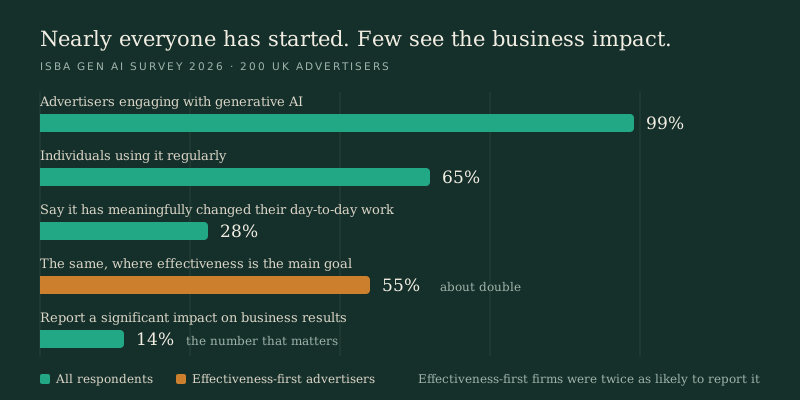
- ISBA's 2026 survey of 200 UK advertisers found 99% engaging with generative AI but only 14% reporting a significant impact on business results. Those aiming AI at effectiveness were twice as likely to report that impact.
- Ask the agency to walk through a live campaign and name the person at every approval point. "AI supports our team" is not an answer.
- Consumer AI accounts are the easiest way for your data to leak. Insist on business or API tiers, no training on your data and a UK GDPR data processing agreement.
- The ASA's June 2026 guidance is explicit: the CAP Code applies however an ad was made, and automation does not shift responsibility away from the advertiser.
- The UK government has proposed removing copyright protection for wholly computer-generated works, so ask where the human creative contribution sits in your key assets.
- Prompts, brand rule sets, agent workflows and trained adapters are part of what you pay for. Make them client-owned deliverables in the contract.
- A good AI-first agency will question your approval chain, because a campaign built in days is wasted if sign-off takes weeks.
Most marketing briefs still follow a template built for the 1990s: objective, audience, proposition, mandatories, budget, deadline. It works because it was designed for a world where making things was the expensive part. The agency's hours were the scarce resource, so the brief's job was to point those hours at the right output.
That world is ending quickly. In April 2026, Marketing Brew reported on an agency whose client asked for "300 unique [creative] assets that are all under the same concept" for Meta. Once the team planned it across four target personas with five new concepts each, the job needed 1,000 creative assets. Meta itself, according to a Wall Street Journal report in June 2025, is working towards letting brands generate, target and budget a whole campaign from a product image and a spend goal by the end of 2026. When output is close to unlimited, a brief that only describes the output stops being the useful document.
An AI-first agency is one whose delivery model was built around AI from the start: models and agents handle most of the production, analysis and iteration, while people own strategy, judgement, approval and accountability. (we give the longer definition in what an AI-native agency actually is). The questions you ask one are different from the questions you asked your last agency, because both the value and the risk have moved.
The gap is not adoption. ISBA's 2026 Gen AI Survey of 200 UK advertisers, published in July, found that 99% are engaging with generative AI but only 14% report a significant impact on business results. Advertisers whose main goal for AI was effectiveness, rather than efficiency, were twice as likely to report that impact. Whether AI gets aimed at the right problem is decided largely in the brief, and in the questions you ask before you sign.
This guide gives you twelve questions to put to any AI-first agency, grouped into five areas, with what a strong answer sounds like and the red flags that should end a pitch. It finishes with a rewritten brief you can use on your next project.
Why the Traditional Brief Breaks With an AI-First Agency
A traditional brief is really a production order. It tells the agency what to make, for whom and by when, and trusts the agency's process to handle everything in between. That trust was reasonable when every asset passed through a small number of experienced hands.
Three things change when the agency is AI-first:
- Volume. One concept becomes hundreds of variants across formats, audiences and placements. Nobody reads every one.
- Speed. Work that took three weeks takes three days, which exposes a new bottleneck: your own approval chain.
- Where the risk sits. The danger is no longer a single bad ad. It is a plausible error, an unsubstantiated claim, a borrowed likeness or a leaked customer file, repeated at scale before anyone notices.
What stays the same
The hard parts of strategy do not change. You still need a real business problem, a sharp audience insight and a proposition worth making. A model can write a thousand headlines; it cannot tell you which customer problem your business should own. If anything, a vague brief is more dangerous now, because an AI-first agency can execute a weak idea at enormous speed and volume.
What the new brief has to add
The additions are about control rather than content: who decides what, which inputs the agency may use, which guardrails apply, how success will be proved and what you keep at the end. Those are exactly the areas the twelve questions below test.
Questions to Ask an AI-First Agency About Workflow and Accountability
Send these to every agency on the shortlist, ideally in writing before the chemistry meeting. The answers reveal more than the credentials deck. A team that has genuinely rebuilt its delivery around AI will answer quickly and specifically; a team that has bolted a few tools onto an old process will answer in generalities. If your project is operational automation rather than marketing, our seven questions for choosing an AI automation agency are the better starting point.
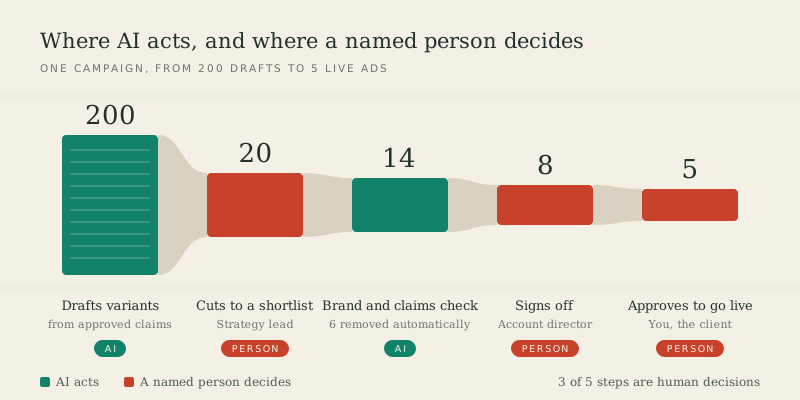
1. "Walk me through one live campaign. Where does AI act, and where does a named person decide?"
This question separates AI-first agencies from agencies with AI tools. You want a specific workflow, not a philosophy. A strong answer sounds like this: "The model drafts 200 headline and image combinations from your approved claims. A strategist cuts them to 20. An automated check scores each one against your brand rules and removes anything outside them. Our account director signs off eight, and you approve the five that go live."
Notice the roles and the numbers. The IPA and ISBA's industry principles for generative AI in advertising ask agencies and advertisers to "ensure appropriate human oversight and accountability", including fact and permission checking so that AI output is not used "without adequate clearance and accuracy assurances". Ask who that person is on your account, by name.
Red flag: "AI supports our team at every stage", with no stage named. Just as worrying is "it's fully automated", offered as a selling point.
2. "Which tools and models do you use, and who watches the platform defaults?"
A good agency is model-agnostic. It should be able to tell you which model it uses for copy, which for images and which for analysis, why, and how it tests a new model before switching. The leading models change every few months, and an agency welded to one vendor's tooling will either fall behind or pass that lock-in on to you.
The second half of the question matters as much. Ad platforms increasingly switch AI features on inside your account, often by default. Hayley Owen, SVP and group media director at Deutsch, told Marketing Brew her team is "constantly having to go through and play Whac-A-Mole" to find new features the platforms have turned on without telling them. Ask who audits your platform automation settings, how often, and what happens when something new appears.
Red flag: a proprietary "AI platform" that the agency cannot explain beyond a demo.
Data and Confidentiality Questions
3. "What happens to our data inside your tools?"
Customer lists, CRM exports, sales data and unreleased product plans are the most valuable inputs you can give an AI-first agency. They are also the easiest to leak, usually not through a hack but through someone pasting them into the wrong account.
The distinction to press on is consumer accounts versus business accounts. Anthropic's consumer terms, for example, let users of its Free, Pro and Max plans choose whether their chats help train future models, and keep that data for five years if they allow it. The same terms do not apply to its business plans or API. Other major providers draw a similar line. The practical risk is an agency employee using a personal subscription on your data.
A strong answer names the business or API tiers the agency uses, confirms that your data is not used for training, states the retention settings, and comes with a UK GDPR data processing agreement that lists every sub-processor. Ask whether staff can use personal AI accounts on client work, and how the agency enforces its answer.
Red flag: "We use ChatGPT." Which plan, on whose account, with which settings?
4. "Will our data or results improve the work you do for our competitors?"
Most marketing directors forget this one. AI-first agencies improve by pooling what they learn: shared prompt libraries, evaluation sets, tuned models and playbooks of what worked, built across clients. That pooling is part of why they are good. It is also why you should ask.
A strong answer separates method from material. Techniques and general playbooks travel between clients. Your data, your performance results, your creative assets and anything trained on them do not. Put that separation in the contract, including what happens to any model or style adapter trained on your brand assets.
Red flag: hesitation, or "everything is anonymised". Aggregated results from a small category can still tell a competitor exactly what worked for you.
Brand, IP and Compliance Questions
5. "How do you keep a thousand assets on-brand?"
Human review does not scale to a thousand variants a week, so ask what does. The strong answer is a brand system that machines can use: tone rules, banned phrases, logo and colour specifications, and a "golden set" of approved examples that new work is scored against automatically. People then review the flagged items plus a random sample.
Then ask for one number: the rejection rate. An agency that knows what share of its generated work fails its own brand checks, and can show you that rate falling over time, is measuring quality. One that cannot give you a number is guessing. Volume only helps if the variants are good enough to test; our AI UGC versus studio shoot case study shows what that looks like when it works.
Red flag: "Our creative director checks everything." At this volume, that is either untrue or the reason the work is slow.
6. "Who owns what you make, and can we protect it?"
Ownership used to be a contract clause nobody read. Now it is a live legal question. UK copyright law currently protects "computer-generated" works that have no human author, but the government's Report on Copyright and Artificial Intelligence, published in March 2026, proposes removing that specific protection while continuing to protect work created with AI assistance.
The practical consequence is simple. A purely machine-generated image may one day have no copyright at all, so a competitor could reuse your campaign visual and you would have little recourse. Ask the agency where the human creative contribution sits in your hero assets, and whether it records that contribution.
Ask for three contract terms as well: assignment of all rights in the output to you, a warranty covering the tools and training data they use, and an indemnity if an output infringes someone else's rights. The High Court's November 2025 ruling in Getty Images v Stability AI mostly went Stability's way, but the court still found trade mark infringement in a limited set of generated images that reproduced Getty's watermarks. Outputs can carry other people's marks, so someone has to check.
Red flag: "The model provider claims no rights, so you own everything", said as if it settles the matter.
7. "How do you check claims before an ad goes live?"
The Advertising Standards Authority settled any doubt in June 2026. Its guidance on AI and deepfakes states that the CAP Code "is media-neutral, meaning the rules apply regardless of how the content was created", and that even when ads are generated or distributed through automated AI platforms, "responsibility does not shift". The advertiser, meaning you, stays responsible.
Personalisation multiplies the problem. Two hundred variants can contain two hundred slightly different claims, and each one needs evidence behind it. The strong answer is a pre-approved claims library: the AI assembles copy only from claims your legal team has already cleared, and anything new goes to a person before it can run.
Reviews and testimonials need a hard line. Under the Digital Markets, Competition and Consumers Act 2024, fake reviews have been banned since 6 April 2025, and the CMA can now fine businesses up to 10% of global turnover (see its fake reviews guidance). A synthetic "customer" quote in an ad is exactly the kind of thing that gets a brand into trouble.
Red flag: any suggestion of AI-generated testimonials, or "the platform checks compliance for us".
8. "What is your policy on disclosing AI-generated content?"
There is no blanket UK rule requiring AI labels on ads. The test is whether people would be misled without one. The IPA and ISBA principles set the bar at being transparent where AI "features prominently in an ad and is unlikely to be obvious to consumers".
If you advertise in the EU, the rules tightened on 2 August 2026. Article 50 of the EU AI Act requires anyone deploying a deepfake, meaning realistic AI-generated or manipulated images, audio or video that could pass as authentic, to disclose it no later than the moment a person first sees it. Evidently creative or satirical work gets a lighter duty, but it still has to be disclosed in a suitable way.
A strong answer is a written disclosure policy with worked examples, plus a view on provenance tools such as invisible watermarks and content credentials. Red flag: "We'll disclose it if you want us to."
Measurement and Commercial Questions for an AI-First Agency
9. "How will we know it worked, and not just that the platform said so?"
More variants make attribution noisier. When the platform's AI chooses the audience, the placement and the creative, the platform's own dashboard is marking its own homework. That is not a reason to ignore it, only a reason not to rely on it alone.
A strong answer agrees the measurement design before launch: one primary business KPI, a holdout or geographic test to prove incremental lift, and a plan for marketing mix modelling. Google's open-source model, Meridian, has been available to everyone since early 2025, so there is little excuse for an agency with no view beyond last-click.
This is where the ISBA finding bites. The advertisers seeing real results were the ones pointing AI at effectiveness, not only at cheaper production. An agency that talks exclusively about cost and speed is selling you the efficiency half.
10. "What are we paying for: hours, output or outcomes?"
If AI has cut the agency's production cost sharply but you are still billed by the hour, the bill no longer tells you much about value. If you pay per asset, you will get a lot of assets. Neither ties the agency to your results.
Strong answers tend to be hybrids: a fixed fee for strategy, governance and senior time; a variable element tied to agreed outcomes; and model and compute costs passed through at cost, where you can see them. We unpack these models in our guide to outcome-based pricing and agent retainers. Ask for a line for AI compute on the estimate. An agency that cannot show it has either not measured it or would rather you did not see it.
People and Exit Questions
11. "Who will work on our account, and what will they spend their time on?"
AI-first agencies are usually smaller than traditional ones, and that is fine if the people are senior. When production is automated, the humans on your account should be doing the work machines cannot: strategy, creative judgement, integration, governance and commercial decisions. ISBA expects the same shift, with greater value placed on exactly those skills as AI takes on routine execution.
Ask for names, seniority and the share of each person's week spent on your business. Red flag: a team of juniors supervising agents, with a senior partner who appears at the pitch and then disappears.
12. "If we part ways, what do we keep?"
When you left a traditional agency, you took your assets and your data. With an AI-first agency, much of the value sits in things that are easy to overlook: prompts and prompt chains, brand rule sets, agent workflows, evaluation sets, the asset library with its provenance records, and any model adapters trained on your brand.
A strong answer lists these in the contract as client-owned deliverables, in formats you could run somewhere else. Red flag: "It all lives in our platform." In that case, it is not really yours.
How to Rewrite Your Brief for an AI-First Agency
The questions assess the agency. The brief is where you set the terms. Keep the classic sections, because the business problem and the insight still matter most, then add the inputs and controls that make AI-first delivery both safe and useful.
| Brief section | Traditional brief | What the new brief adds |
|---|---|---|
| Objective | Business goal and campaign aim | The decision the results will inform, and one effectiveness KPI |
| Audience | Demographic and attitudinal profile | Which first-party data the agency may access, and on what terms |
| Brand | Guidelines PDF | Machine-usable rules, 10 to 20 approved examples and 5 "never do this" examples |
| Proposition | The single-minded message | A pre-approved claims library, with the evidence for each claim |
| Mandatories | Logos and legal lines | Disclosure policy, likeness and voice limits, platform AI features to switch off |
| Approvals | Who signs off | Decision rights: what ships automatically, what needs the agency, what needs you, with turnaround times |
| Budget | Media spend and fees | A protected learning budget for testing, and compute costs shown separately |
| Measurement | Reporting schedule | Holdout or incrementality design, agreed before launch |
| Deliverables | Assets and formats | Prompts, rule sets, workflows and asset provenance, owned by you |
Two sections deserve extra care. Decision rights stop the agency waiting a week for approval on a paid social variant that sits entirely within claims you have already cleared. The learning budget protects testing from being cut the first time a variant underperforms, which is the whole point of testing.
Red Flags That Should End the Pitch
- No named person at any approval point.
- Personal or consumer AI accounts used on client data.
- Synthetic testimonials or reviews offered as a tactic.
- No brand scoring and no rejection rate, just "we check everything".
- Measurement that relies entirely on platform-reported results.
- Prompts, workflows and trained models kept as agency property.
- Pricing that hides compute costs, or pays per asset with no link to outcomes.
What a Good AI-First Agency Will Ask You Back
The best pitches run both ways. A strong AI-first agency will question your brief as hard as you question its process, because its speed depends on your inputs. Expect questions like these:
- How long does your approval chain take? An agency can build a campaign in days. If sign-off takes three weeks, you have bought speed you cannot use.
- What data can we access, and who can grant it?
- Where are your limits? Which claims, categories and uses of likeness or voice are off the table?
- What does success mean in business terms? Revenue, margin or qualified pipeline, not platform metrics.
- Who owns the brand rules on your side? Rules nobody maintains go stale fast.
If an agency asks none of these, it is planning to run your account like a production line. If it asks all of them, you are probably talking to the right team.
Conclusion
The old brief asked "what will you make for us?" The new one asks how the agency will decide, what it will use, how you will both know it worked and what you keep at the end. Those questions matter because AI-first agencies make output cheap, and cheap output moves the value, and the risk, into judgement, data, compliance and measurement.
Almost every UK advertiser now uses generative AI in some form. Far fewer can point to a change in business results, and the ones who can started by aiming AI at effectiveness. That aim is set in the brief, so start there.
If you are writing a brief for an AI-first agency, or want a second opinion on the one you have, get in touch. We will answer all twelve questions in writing before you commit to anything.
Frequently Asked Questions
- What is an AI-first agency?
- An AI-first agency is built around AI from the start: models and agents do most of the production, analysis and iteration, while people own strategy, judgement and approval. A traditional agency that has added AI tools gets faster at individual tasks, but its workflow, team structure and pricing stay largely the same.
- What should a marketing brief for an AI-first agency include?
- Keep the classic sections, then add machine-usable brand rules with approved examples, a pre-approved claims library, decision rights for approvals, the first-party data the agency may use, a measurement design agreed before launch, a disclosure policy and a list of client-owned deliverables such as prompts and workflows.
- Do UK ads have to say they were made with AI?
- There is no blanket legal requirement in the UK. The ASA applies the CAP Code however an ad was made, so disclosure is needed where leaving it out would mislead, such as a realistic AI-generated person presented as a real customer. Campaigns shown in the EU must also meet the AI Act's deepfake disclosure rules.
- Who owns the copyright in AI-generated marketing content in the UK?
- UK law currently protects computer-generated works with no human author, but the government's March 2026 copyright report proposes removing that protection while keeping it for AI-assisted work. The safest position is a contractual assignment of rights from your agency plus a meaningful human creative contribution to your key assets.
- How do I stop an agency training AI models on my company's data?
- Put it in the contract. Require business or API tiers of AI tools, which the major providers do not train on by default, a ban on staff using personal accounts for your work, and a UK GDPR data processing agreement listing every sub-processor. Agree in writing that nothing trained on your data is reused for other clients.
- Are AI-first agencies cheaper than traditional agencies?
- Production usually costs less, but whether you see the saving depends on pricing. Hourly billing can hide it and per-asset pricing encourages excess volume. Hybrids that combine a fixed fee for strategy and governance with outcome-linked payments and visible compute costs tend to share it more fairly.
- Does the EU AI Act affect UK marketers?
- Yes, if your campaigns reach people in the EU. Article 50's transparency duties, including disclosing deepfakes when people first see them, have applied since 2 August 2026. Campaigns aimed only at UK audiences generally fall outside it, though many brands adopt one disclosure standard everywhere.
- How many creative variants should an AI-first agency produce?
- Enough to test genuinely different ideas, but not so many that quality control fails. Several distinct concepts usually teach you more than hundreds of small variations on one idea. Set volume in the brief alongside a learning budget and a target rejection rate, so it is a deliberate choice.