Technical
Building an AI-Powered Mobile App in 2026: Offline Inference, Local Embeddings, and Hybrid Cloud Architecture
14 min read
A quantised model streams 40 tokens per second in the demo. Three runs later it settles at 24 and stays there. This covers what phones actually sustain, why local embeddings beat local generation as a first bet, and how to design the routing layer that decides where each request runs.
✦Key Takeaways
- Thermal throttling, not model quality, is the binding constraint. Benchmark on a warm device after twenty consecutive runs, because that is the number users experience.
- Decode-time inference is memory-bandwidth bound, not compute bound. Phones offer roughly 50 to 90 GB/s against 2 to 3 TB/s on datacentre GPUs, and no amount of NPU marketing closes that gap.
- Local embeddings deliver more reliable value than local generation. A 308M-parameter model such as EmbeddingGemma runs in under 22ms per embedding and degrades gracefully, while generation degrades into gibberish.
- Device fragmentation is an architectural driver, not a QA problem. Gemini Nano's newest tier needs around 12GB of RAM, restricting full local generation to a flagship minority of your install base.
- Design for bursty inference: short tasks that finish fast and let the silicon cool, rather than long streaming sessions that guarantee throttling.
- The router is the product. Sensitivity, complexity, connectivity and cost are four separate signals, and collapsing them into one boolean is the most common mistake.
- Changing your embedding model means reindexing every device in your fleet. Version the index from day one or you ship a silent retrieval bug.
The demo always works. You load a quantised 1.5B model onto a test iPhone, fire a prompt, and watch tokens stream back at roughly 40 per second. It feels instant. It feels free. Somebody asks why you are still paying an inference bill at all.
Then you run the same prompt three more times. Throughput collapses to about 24 tokens per second and stays there. Nothing broke. The phone got warm, the scheduler stepped the clocks down, and your number turned out to be a cold-start artefact rather than a product spec. A 2026 benchmark study measured exactly this on an iPhone 16 Pro: peak throughput fell from 40.49 to 23.67 tokens per second within three iterations. A Galaxy S24 Ultra on the same workload plateaued near 10.
That gap between the demo number and the sustained number is where most on-device AI projects quietly fail. Building an AI-powered mobile app in 2026 is less about picking a model than about deciding, per request, where the work happens: on the device, in your cloud, or not at all. This article covers what phones actually sustain, why local embeddings are the higher-return half of the stack, and how to design the routing layer that holds it together.
What Actually Changed by 2026
For years, on-device AI meant shipping your own model files and writing your own runtime glue. Both platforms have now absorbed that work into the OS.
On iOS, Apple's Foundation Models framework exposes the roughly 3-billion-parameter on-device model behind Apple Intelligence, callable from Swift in a few lines. Apple's research on the third generation of its foundation models describes aggressive compression: around 2 bits per weight using quantisation-aware training, a 4-bit embedding table, and an 8-bit KV cache. At WWDC 2026 Apple added a provider protocol, so the same call sites can be backed by a cloud API or a model you host. That turns routing into a configuration choice rather than two codebases.
On Android, Gemini Nano runs through the AICore system service, and ML Kit's GenAI APIs wrap it in task-shaped calls for summarisation, proofreading, rewriting and image description. Because the model is shared at OS level, your app never downloads its own copy. Outside those task APIs, LiteRT and MediaPipe handle custom models, and Play for On-device AI manages delivery, with AI packs up to 1.5GB compressed and a 4GB cumulative ceiling per app version.
The three-tier hardware reality
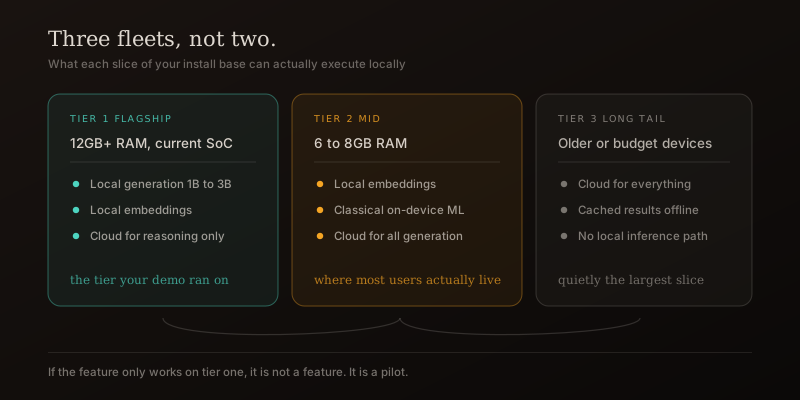
The uncomfortable part is who can run what. Gemini Nano's most capable tier expects roughly 12GB of RAM and a current flagship chipset: recent Pixel, Galaxy S and high-end Chinese flagships. Apple's framework requires an Apple Intelligence capable device. Everything else, still the majority of most consumer install bases, has no useful local generation at all.
So the honest planning model is three tiers, not two:
- Flagship tier. Full local generation, local embeddings, cloud for heavy reasoning only.
- Mid tier. Local embeddings and classical ML, cloud for all generation.
- Long tail and older devices. Cloud for everything, with cached results for offline continuity.
If your feature only works on tier one, it is not a feature. It is a pilot. That is the trap described in the AI ROI trap: why prototypes are cheap and production is expensive, and it surfaces faster on mobile than anywhere else.
Offline Inference: What a Phone Can and Cannot Do
The thermal ceiling is the real constraint
The 2026 edge inference study benchmarking a 4-bit Qwen 2.5 1.5B found the pattern consistently: mobile silicon hits impressive peak numbers and cannot hold them. The iPhone lost around 40% of peak throughput within three iterations. The Galaxy S24 Ultra degraded roughly 15% over twenty iterations through voltage and frequency downstepping. A dedicated edge NPU held near-zero variance, because it was never fighting a passive thermal envelope inside a sealed glass slab.
The design consequence is specific. Structure inference as short bursts that finish in a second or two and return the device to idle. Avoid long streaming sessions and back-to-back foreground batches, and never schedule local generation during video capture, navigation or anything else already loading the SoC.
Memory bandwidth, not compute
Generating each token requires streaming the model's weights through memory. That makes decode a bandwidth problem. Mobile devices deliver roughly 50 to 90 GB/s; datacentre GPUs deliver 2 to 3 TB/s. The 30x to 50x gap is why a phone NPU with a headline TOPS figure still generates text slowly.
This is why 4-bit quantisation is universal rather than optional. Moving from 16-bit to 4-bit is not merely a 4x storage saving; it is 4x less memory traffic per token, which translates almost directly into throughput. In practice 1B to 3B models are the workable range, with 7B to 8B possible on flagships and unpleasant in sustained use.
What to run locally
Local generation earns its place on tasks that are short, structured, bounded and frequent:
- Classification, tagging and intent detection
- Extraction into a fixed schema
- Summarising something the user just wrote or captured
- Rewriting tone or expanding shorthand
- Drafting a first pass that a cloud model will refine
It fails on tasks needing broad world knowledge, long multi-step reasoning, current information, or output that must be right first time. A 3B model does not know your pricing, and will invent it confidently. Our guide to small language models and edge AI covers the capability boundary in detail.
Local Embeddings: The Underrated Half of the Stack
Most teams reach for local generation first because it demos well. Local embeddings are the better first bet, and almost nobody starts there.
Why retrieval degrades gracefully and generation does not
A small generation model under pressure produces fluent, wrong text. A small embedding model under pressure produces slightly worse ranking. One is a support incident; the other is a marginally less relevant third result. That asymmetry should drive your sequencing.
Embedding is also cheap in a way generation is not. You encode once, store the vector, and search thousands of times with simple arithmetic. EmbeddingGemma, Google's 308M-parameter on-device model, produces 768-dimensional vectors in under 22ms on mobile hardware, supports over 100 languages, and truncates to 128 dimensions when storage matters more than precision. That is a different economic profile from running a 3B generator.
Storing and searching vectors on the device
Two options dominate. ObjectBox ships an on-device vector database with built-in HNSW indexing for Android and Java. The lighter path is SQLite, already present on every platform, storing embeddings as float32 BLOBs. For a few thousand documents, brute-force cosine similarity over an in-memory array is fast enough, and shipping that first saves weeks.
The re-embedding trap
Here is the failure that catches teams eighteen months in. Vectors from one embedding model are meaningless to another. Upgrade the model and every stored vector on every user's device goes stale, so search quality quietly degrades for anyone who has not reindexed.
Version the index from the first release: store the model identifier and dimension alongside every vector, detect a mismatch at launch, and reindex in the background with a visible progress state. Retrofitting this is painful. Broader retrieval trade-offs are covered in our comparison of advanced RAG against long context windows.
Hybrid Cloud Architecture: Designing the Router
The router is where an AI-powered mobile app is actually won or lost. It decides, per request, whether work stays local or escalates.
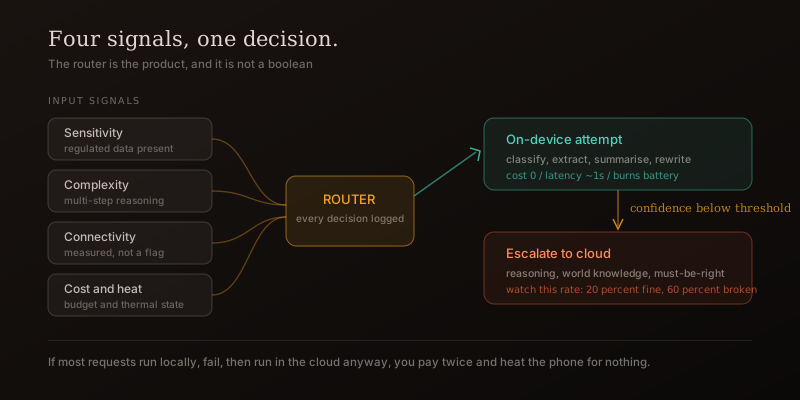
Four signals, not one flag
Teams typically collapse routing into one boolean, usually "is the user online". Four independent signals matter:
Sensitivity. Does the payload contain personal, health or financial data? For UK and EU products this is often a hard constraint rather than a preference, and local processing is the cleanest way to satisfy it. We cover this in sovereign AI and GDPR for UK businesses.
Complexity. A lightweight classifier can estimate whether a request needs multi-step reasoning. Extraction and classification stay local; synthesis and planning escalate.
Connectivity. Not binary. A 4-second round trip on a congested cell network is functionally offline for an interactive feature, so measure recent latency rather than trusting a reachability flag.
Cost and thermal budget. Track tokens spent per user per day and device temperature. Both should be able to force a routing change.
The cascade pattern
The production-standard approach runs the cheapest acceptable model first, scores the result, and escalates only when the score falls below a threshold. On mobile, the local model attempts most requests, a confidence check gates escalation, and the cloud handles the remainder.
Two details make or break it. First, the confidence signal must be genuine; token probabilities are weak proxies, and schema validation or a small verifier works better. Second, escalation must be visible in telemetry, because a rate climbing from 20% to 60% after a model update is the earliest warning you get.
Three failure modes to design against
- The silent quality cliff. Local output is plausible, wrong and never escalated. Mitigate with schema validation and sampled human review.
- The double charge. Every request runs locally, fails, then runs in the cloud anyway, so you pay full cloud cost plus battery. If escalation exceeds roughly half of requests, the local tier is costing you money rather than saving it.
- Split-brain state. The device queues work offline, the server processes a newer version of the same record, and reconciliation is undefined. Decide merge rules before shipping the offline queue.
What This Actually Costs
The savings are real but narrower than the pitch suggests. Local inference removes marginal per-token cost and network latency. It adds permanent engineering cost: a model delivery pipeline, per-tier device testing, thermal and battery instrumentation, index migrations, and a routing layer with its own observability.
A rule from projects we have shipped: on-device inference pays back when a feature runs many times per session across a large user base, and rarely when it is used once a week. If your app makes three AI calls per user per month, cloud is cheaper and simpler, and the honest reason to go local is privacy or offline capability. For budgeting context, see our guide to AI app development costs in the UK.
A Practical Build Sequence
- Instrument before you optimise. Log latency, escalation rate, battery delta and thermal state per request.
- Ship cloud-only first. Establish the quality bar you must match.
- Add local embeddings. Semantic search and on-device retrieval, with a versioned index.
- Add local generation for one bounded task. Classification or extraction, not open-ended chat.
- Build the router with all four signals, and make every routing decision loggable.
- Benchmark hot, not cold. Run twenty consecutive inferences on the lowest-tier supported device and plan around that number.
Conclusion
The interesting question in 2026 is not whether a phone can run a language model. It can. The question is which work belongs there, and the answer is narrower than platform marketing implies: short, structured, frequent tasks on capable devices, embeddings almost everywhere, and a cloud tier for anything requiring real reasoning.
Teams that treat on-device inference as a cost-saving switch ship something slower, hotter and less reliable than the cloud version they replaced. Teams that treat it as a latency and privacy capability, routed deliberately, ship features that were not previously possible.
If you are scoping a mobile product with an AI layer and want a second opinion on where that boundary sits, talk to our team. We build these systems for UK businesses and can usually tell you within a week whether local inference is worth the engineering it demands.
Frequently Asked Questions
- Can a smartphone really run a large language model offline in 2026?
- Yes, within limits. Models of 1B to 3B parameters at 4-bit quantisation run comfortably on current mid-range and flagship phones; 7B to 8B runs on flagships with noticeable heat and battery cost. Both Apple and Google now ship an OS-level model your app can call directly, so you often need not bundle your own.
- What is the biggest constraint on mobile AI inference?
- Sustained thermal performance. Peak throughput is easy to demo and impossible to hold; benchmarks show mobile devices losing 15% to 40% of peak token throughput within a handful of consecutive runs. Memory bandwidth is second, since phones offer roughly 50 to 90 GB/s against several terabytes per second on datacentre hardware.
- Should I build offline inference or use cloud APIs?
- Use cloud APIs unless you have a specific reason not to. Three reasons justify local inference: regulated data that cannot leave the device, genuine offline operation, and interaction latency below what a network round trip allows. Cost savings alone rarely justify it unless usage is very high frequency.
- What are local embeddings and why do they matter for mobile apps?
- Local embeddings turn text into numerical vectors on the device, so semantic search, deduplication and retrieval work without a network call. They matter because they are cheap, fast and degrade gracefully, unlike local generation. A 308M-parameter model such as EmbeddingGemma embeds in under 22ms, fast enough to run as the user types.
- How do I store and search vectors on a mobile device?
- For small collections, store float32 vectors in SQLite as BLOBs and run brute-force cosine similarity in memory, which is fast enough for a few thousand items. For larger collections, use an on-device vector database with HNSW indexing such as ObjectBox. Always store the embedding model version alongside each vector so stale indexes can be detected and repaired.
- What is hybrid cloud architecture for mobile AI?
- Each request is routed to the cheapest tier that can handle it well, usually a local model first with escalation to the cloud when confidence is low. Routing should treat data sensitivity, task complexity, measured connectivity and cost or thermal budget as four separate signals rather than one online or offline flag.
- Does on-device AI make my app GDPR compliant automatically?
- No, but it removes a significant category of risk. If personal data is processed locally and never transmitted, there is no international transfer and no third-party processor for that operation, which simplifies the assessment. You still need lawful basis, transparency, retention rules and a data protection impact assessment where the processing warrants one.
- How much does adding on-device AI increase app size?
- If you use the OS-level model on iOS or Gemini Nano through AICore on Android, close to nothing, because the system shares the model. If you bundle your own, expect several hundred megabytes for a quantised small model. Android's Play for On-device AI supports AI packs up to 1.5GB compressed with a 4GB cumulative ceiling, and iOS apps commonly ship a small bundled model and download larger assets on first launch.
- What performance should I expect from an on-device model?
- Plan around sustained rather than peak figures. Independent benchmarks of a 4-bit 1.5B model recorded roughly 24 tokens per second sustained on an iPhone 16 Pro and around 10 on a Galaxy S24 Ultra after throttling. Measure on the lowest-tier device you support, after twenty consecutive runs, and design the interface around that number.