SEO & Content
How to Structure Content So It Wins Featured Snippets and AI Citations
13 min read
Search systems stopped reading pages and started reading passages, but most content is still written as one continuous argument. This is the craft-level guide: exact paragraph lengths, question-shaped headings, chunk boundaries, the evidence layer that the Princeton GEO study found moves visibility most, and an eight-point test to run every page through.
✦Key Takeaways
- Retrieval happens at passage level, not page level. Your chunk competes on its own, stripped of the article around it.
- The link between ranking and being cited has weakened sharply: 76% of AI Overview citations came from the organic top ten in July 2025, against 38% by February 2026.
- Featured snippets and AI citations are one job, not two. Roughly 68% of AI Overviews cite the page that holds the featured snippet for that query.
- Paragraph snippets cluster tightly at 40 to 60 words, and around 70% of all featured snippets are paragraph format. Count the words rather than estimating.
- Put the answer in the first sentence under the heading, because retrieval treats the top of the chunk as the answer and buried conclusions lose.
- The Princeton GEO study found that adding statistics, quotations and citations lifted visibility by up to 40%, and a fifth-placed site adding citations gained 115.1% with no change in ranking.
- Apply the removal test: cut a section out, read it cold, and fix every unresolved pronoun. If it needs the paragraph above it, it cannot be quoted.
- Long-form content still works, but build it as a stack of self-contained units rather than one argument running top to bottom.
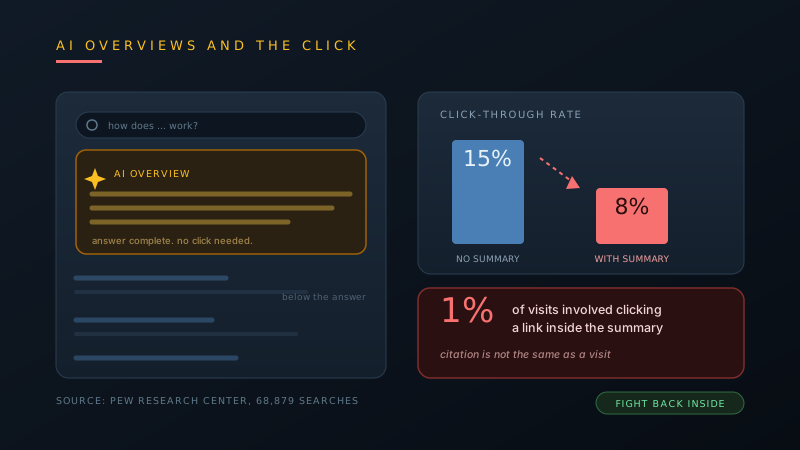
Something has broken in the relationship between ranking and being quoted. In July 2025, 76% of the URLs cited in Google's AI Overviews also ranked in the organic top ten. By February 2026, across an analysis of 863,000 keywords, that figure had fallen to 38%.
Read that as two separate problems. You can now rank first and never be quoted. You can also be quoted while sitting on page two.
Neither outcome is random. Both follow from a change in what these systems actually retrieve. They do not retrieve your page. They retrieve a passage from it, and they judge that passage largely on its own, stripped of the article that surrounds it.
That single fact is the whole of this article. Featured snippets have always worked this way, since Google has been lifting individual paragraphs out of pages for a decade. AI citation works the same way for the same underlying reason. The structural work that wins one wins the other, and most teams are still writing as though the page were the unit of value.
One Mechanic, Two Surfaces
Treat snippets and AI citations as two campaigns and you will do the work twice. They are the same job.
The overlap shows up in the data. Roughly 68% of AI Overviews cite the source that holds the featured snippet for that query, and pages that have previously won snippets get cited in AI answers at about twice the rate of pages that have not. Around 27% of results pages showing an AI Overview still show a featured snippet alongside it. AI Overviews now appear on roughly 58% of searches in active markets, so this is not a niche surface.
The reason for the overlap is mechanical rather than coincidental. A featured snippet is Google deciding that one passage on your page answers a question completely enough to display on its own. An AI citation is a retrieval system deciding that one chunk of your page answers a sub-query well enough to quote. Different systems, same underlying judgement: can this fragment stand alone?
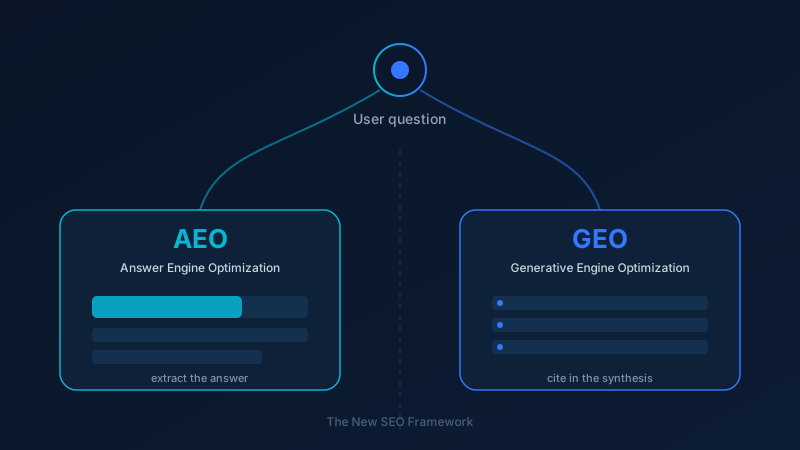
If you have been treating generative search as a separate discipline, it is worth reading this alongside our breakdown of where AEO and GEO actually diverge technically. This article is the layer below that: not which discipline, but how to shape the words on the page.
Why the Passage Beats the Page
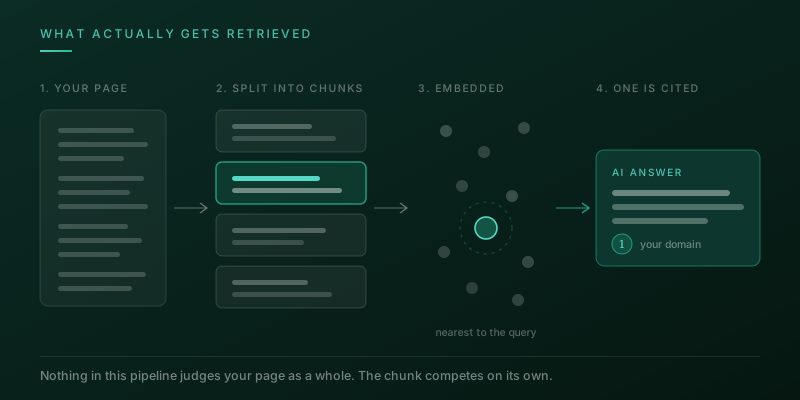
Modern AI search runs on retrieval-augmented generation. When a query arrives, the system splits candidate pages into chunks, converts each chunk into a vector, and searches for the chunks most semantically similar to the query. The model then writes an answer from the chunks it pulled and cites where they came from.
Nothing in that process evaluates your page as a whole. The chunk competes alone.
This is why long-form pillar content has quietly become a weak citation asset. A 4,000 word guide covering twelve subtopics disperses its relevance: every chunk is a partial treatment of something, and no chunk is the single best answer to any specific question. A comparison table, a pricing page, or a tightly written FAQ concentrates relevance instead, because one chunk answers one discrete question completely.
Recent analysis suggests long-form guides often get cited once and then drop out of AI answers, while comparison and specification pages persist. That is what you would expect if retrieval works at chunk level: the guide has one good chunk, the comparison page has ten.
One third-party attempt to reverse-engineer Google's AI Overview source selection describes a five-stage funnel: 200 to 500 candidate documents retrieved, narrowed to roughly 50 to 100 by semantic ranking, then to 30 to 50 by authority filtering, then to 15 to 25 by passage-level re-ranking, with 5 to 15 finally receiving visible citations. The same analysis puts the optimal self-contained answer unit at 134 to 167 words, with 62% of cited content falling between 100 and 300 words per extractable unit.
Treat those numbers as directional. This is reverse-engineered analysis rather than anything Google has confirmed, and the exact figures will move. The shape of the finding is what matters: there is a passage-level re-ranking stage, and it rewards fragments that resolve a question inside a couple of hundred words.
Write the Answer-First Paragraph
The paragraph is the workhorse. Around 70% of all featured snippets are paragraph format, so this is the single highest-leverage thing to get right.
Target 40 to 60 Words
Analysis of tens of thousands of snippets puts roughly 85% of paragraph snippets in the 40 to 60 word band. Portent's study of snippet display limits found the same practical ceiling: write past it and Google truncates with an ellipsis or declines the passage. Write under 40 words and the answer usually reads as incomplete.
The failure modes are asymmetric and worth knowing. Answers in the 30 to 40 word range get captured far less often than answers in the 45 to 55 range, and answers running 70 to 100 words do worse again. Aim for two to three tight sentences.
Lead With the Answer, Then Qualify
Most business writing buries the answer. It opens with context, works through nuance, and delivers the conclusion at the end of the paragraph. That structure is fatal here, because the retrieval system reads the opening of the chunk as the answer.
Invert it. State the direct answer in the first sentence. Add the qualifier, the caveat or the mechanism in the second and third. The nuance is not lost; it just moves one sentence later.
Before: There are a number of factors to consider when thinking about how long a featured snippet should be, and the answer depends on the format, the query and how Google chooses to render it on mobile versus desktop.
After: A paragraph featured snippet should be 40 to 60 words. Google truncates longer passages with an ellipsis and tends to reject them entirely past about 320 characters. Lists and tables follow different limits.
The second version is 42 words, answers the question in the first six, and survives being cut out of the page.
Apply the Removal Test
Cut the paragraph out of the article and read it cold. If it still makes sense to someone who has not read a word of the surrounding page, it can be cited. If it depends on the previous paragraph, it cannot.
The usual culprits are unresolved pronouns (this approach, as we saw above, it does this by), comparatives with no stated baseline (significantly faster), and definite articles pointing at something defined three sections earlier (the framework). Every one of those turns a quotable passage into a fragment that makes no sense alone.
Make Headings Ask the Question
Headings do more work than most writers realise, because in practice the heading plus the paragraph beneath it is the chunk boundary. A heading that states the question sets up a chunk that contains a complete question-and-answer pair, which is exactly the shape retrieval is looking for.
Three rules cover most of it. Phrase H2s and H3s as the question a real person types, not as a clever label. Answer immediately in the paragraph directly below, with no transitional sentence in between. Keep one question per heading, because a heading covering three questions produces a chunk that half-answers all three.
Pricing is a label. How much does an AI audit cost? is a heading that can win a snippet. Google's own documentation on featured snippets is explicit that there is no markup to force selection: the system extracts what it judges to be the best answer, so the structural clarity of the page is the only lever you hold.
Match the Format to the Question Type
Three snippet formats exist, and each has a specification worth respecting. Semrush's analysis of featured snippets puts paragraphs at the overwhelming majority, but lists and tables win categories that paragraphs cannot.
| Format | Use it for | Specification |
|---|---|---|
| Paragraph | Definitions, direct answers, what is and why queries | 40 to 60 words, answer in sentence one |
| Numbered list | Processes, sequences, how-to queries | 5 to 10 steps; Google shows 5 to 7 with a More items link |
| Bulleted list | Non-sequential sets, types of and best queries | 5 to 10 items, short and parallel |
| Table | Comparisons, pricing, specifications | 3 to 4 columns by 5 to 10 rows |
Two practical notes. Because Google shows only the first handful of list items and links to the rest, front-load the items that matter. And build tables in real HTML: a comparison rendered as an image, or as a visually aligned block of text, cannot be extracted at all.
Add the Evidence Layer
This is the part most content teams skip, and it has the best supporting research behind it.
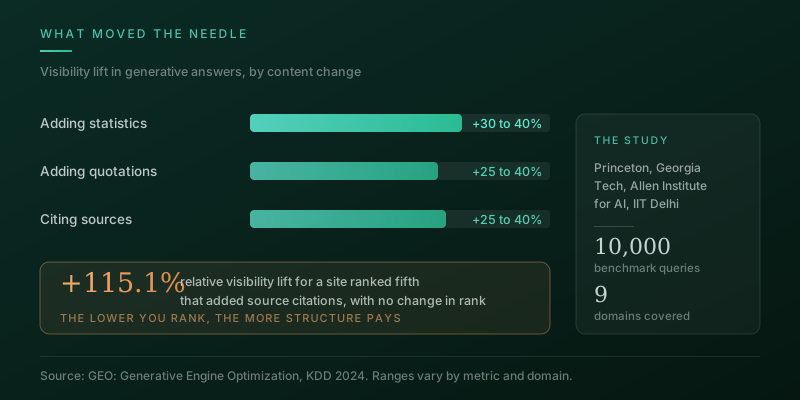
The Princeton GEO study, presented at KDD in 2024 by researchers from Princeton, Georgia Tech, the Allen Institute for AI and IIT Delhi, built a benchmark of 10,000 queries across nine domains and tested which content changes actually increased visibility in generative answers. Three interventions dominated: adding relevant statistics, adding credible quotations, and citing sources.
The effects were large. Statistics addition improved visibility by roughly 30 to 40% on their primary metric. Most striking, a site sitting in fifth position that added source citations saw a 115.1% relative lift in visibility. The paper reports gains of up to 40% from targeted structural changes alone, with no change in ranking.
The mechanism is intuitive once stated. A generative system assembling an answer prefers passages carrying machine-extractable evidence, because a sentence containing a number, a named source or a quotation is more useful to quote than an unsupported assertion. Featured snippets are usually short is an assertion. Around 85% of paragraph snippets fall between 40 and 60 words is a citable fact.
Practically: put a number, a named source or a date in every passage you actually want quoted. Not every paragraph, which reads as padding, but every passage carrying a claim you want to own.
One warning, because this technique invites abuse. Invented or unsourced statistics are worse than no statistics at all. Retrieval systems increasingly cross-check claims against other indexed sources, and a figure that appears nowhere else is a liability rather than an asset. If you cannot point at where a number came from, do not publish it. The six-pillar view of how sources earn trust in our GEO versus SEO breakdown goes further into why corroboration matters more than assertion.
Name Things Explicitly
Retrieval systems match on entities, the recognisable people, products, organisations, places and concepts in a passage. A chunk dense with named entities is easier to match to a query than one written in pronouns and generalities.
The same reverse-engineered analysis suggests around 15 recognised entities per 1,000 words correlates with materially higher selection rates. Do not chase the number, but do take the instruction underneath it: name things instead of referring to them.
That means writing Google AI Overviews rather than the feature, naming the study rather than recent research, and repeating the subject at the top of each section rather than relying on a pronoun that points back three paragraphs. It reads slightly more repetitively to a human reading top to bottom. It reads far better to a system reading one chunk in isolation, and that trade is now worth making.
Add the Machine-Readable Layer
Structured data does not force selection, but it removes ambiguity about what each part of your page is. The schema.org FAQPage type explicitly pairs questions with answers, which maps directly onto the question-and-answer chunk shape that retrieval rewards. HowTo, Article and Product types do the same for their content classes.
The reverse-engineered analysis above associates structured data with a 73% higher selection rate. Treat that as an unverified correlation rather than a promise; well-marked-up pages tend to be well-structured pages, so some of that effect is almost certainly the underlying structure rather than the markup. The markup is cheap either way, and it makes your intent unambiguous.
Does This Mean Stop Writing Long Content?
No, and the conclusion people jump to here is wrong. Long content still earns links, still demonstrates depth, and still ranks.
What changes is how you build it. Stop writing a 3,000 word essay with a single argument running through it, and start writing a stack of self-contained units under question-shaped headings, arranged in a sensible order. Each section should survive being cut out. The article as a whole still reads properly, because a good answer-first section reads fine in sequence, whereas a section that only makes sense in sequence reads badly alone.
That is the actual shift: from writing an argument to writing a set of answers that happen to be well ordered. It also explains why the traffic that still arrives from search converts better than it used to, a pattern we covered in what AI Overviews are doing to organic traffic.
The Chunk Test: A Checklist
Run every important page through this before publishing.
- Does each H2 state a question? If it is a noun label, rewrite it as the question a person would type.
- Is the answer in the first sentence under the heading? Delete any transitional sentence sitting between the heading and the answer.
- Is the answer paragraph 40 to 60 words? Count it. Do not estimate.
- Does each section survive removal? Cut it out, read it cold, fix every unresolved pronoun and undefined reference.
- Does each key passage carry evidence? A number, a named source or a date.
- Are entities named rather than implied? Replace the platform with the platform's name.
- Is the format right for the question type? Process questions get numbered lists, comparisons get real HTML tables.
- Is the schema present and accurate? FAQPage, HowTo or Article, matching what is actually on the page.
None of this requires new content. Most teams can apply it to their existing top twenty pages in a fortnight, which is a far better use of time than publishing twenty more articles built the old way.
Conclusion
The unit of retrieval changed and the writing has not caught up. Search systems stopped reading pages and started reading passages, but most content is still built as a continuous argument that only makes sense read from the top.
The fix is unglamorous and mostly mechanical: question-shaped headings, answers in the first sentence, 40 to 60 word paragraphs, real tables, named entities, a number in every claim you want quoted, and schema that says what each block is. Do that and you are optimising for featured snippets and AI citations at the same time, because underneath they are the same mechanism.
The teams winning this are not producing more. They are producing content that can be taken apart.
Frequently Asked Questions
- What is the ideal length for a featured snippet?
- For paragraph snippets, 40 to 60 words is the target, and roughly 85% of paragraph snippets fall inside that band. Shorter answers tend to read as incomplete and get passed over; longer ones get truncated with an ellipsis or rejected. List snippets work best at 5 to 10 items, and table snippets at 3 to 4 columns by 5 to 10 rows.
- Do featured snippets still matter now that AI Overviews exist?
- Yes, and arguably more than before. The expectation that AI Overviews would kill featured snippets did not hold. Instead snippets became an input: around 68% of AI Overviews cite the source holding the featured snippet for that query, and pages that have won snippets are cited in AI answers at roughly twice the rate of pages that have not.
- Why does my page rank first but never get cited in AI answers?
- Because ranking and citation have come apart. In July 2025 about 76% of URLs cited in AI Overviews also ranked in the organic top ten; by February 2026 that had fallen to 38%. Ranking is a page-level judgement, while citation is a passage-level one. If no single passage on your page answers a specific sub-query completely and independently, you can rank first and still never be quoted.
- How do AI search engines decide which sources to cite?
- They use retrieval-augmented generation. The system splits candidate pages into chunks, converts each chunk into a vector, retrieves the chunks most semantically similar to the query, and writes an answer from what it retrieved. Nothing in that process evaluates your page as a whole, which is why self-contained passages outperform long continuous arguments.
- Does schema markup help you get cited by AI?
- It helps by removing ambiguity about what each block of your page is, particularly FAQPage, HowTo, Article and Product types. Treat specific percentage claims about schema and AI selection with caution, since well-marked-up pages tend also to be well-structured pages and the two effects are hard to separate. The markup is cheap, so the sensible approach is to add it accurately and not expect it to compensate for weak structure.
- Should I stop writing long-form content?
- No. Long content still earns links, demonstrates depth and ranks well. What should change is how it is built. Write it as a stack of self-contained sections under question-shaped headings rather than one argument that only makes sense read from the top, so that any individual section can be lifted out and still make sense.
- Can you optimise for featured snippets and AI citations at the same time?
- Yes, and you should, because they run on the same mechanic. A featured snippet is Google judging that one passage answers a question well enough to display alone. An AI citation is a retrieval system judging that one chunk answers a sub-query well enough to quote. Both reward the same thing: a fragment that stands on its own.
- How long should a section be to get cited by AI?
- Reverse-engineered analysis of AI Overview source selection puts the optimal self-contained answer unit at roughly 134 to 167 words, with about 62% of cited content falling between 100 and 300 words per extractable unit. Those figures are not confirmed by Google and will move, so treat them as directional: aim for sections that fully resolve one question inside a couple of hundred words.