AI Tools
5 Low-Cost AI Tools Every London SME Should Use for Marketing in 2026
10 min read
Running a small business in London is expensive, but your marketing no longer has to be. These five low-cost AI marketing tools, most free or under £20 a month, let a lean team handle content, design, social, and customer outreach like a much bigger one. Here is the battle-tested stack and how to roll it out for under £50 a month.
✦Key Takeaways
- A complete AI marketing stack covering strategy, content, design, social, and email costs a London SME under £50 a month in 2026, and often far less on free tiers.
- Claude is the highest-leverage single tool for an SME: best-in-class long-form writing, campaign strategy, and UK-aware brand voice, with a usable free tier and a roughly £20 Pro plan.
- Canva Magic Studio removes the designer bottleneck, turning text prompts into social posts, video, and ad creative for around £10 to £12 a month on Pro.
- ChatGPT and Gemini are your speed tools for ideation, research, and batch content; pair them with Perplexity for cited, verifiable research.
- Buffer and Metricool handle consistent distribution and analytics on free or sub-£15 plans, and consistency, not creativity, is where most SMEs actually lose.
- Brevo and HubSpot Breeze automate the email and CRM follow-up where most small-team revenue is quietly won or lost.
- The winning move is sequencing, not stacking: master one tool, measure for 30 days, then add the next, with Zapier's free tier gluing them into one system.
Running a small or medium business in London is expensive. Rent eats your margin, good marketers are hard to hire and harder to keep, and a competitor three streets over is fighting for the same customers you are. Marketing is where that pressure lands hardest, because it is the one function you cannot switch off and still expect to grow.
The good news for 2026 is that the tools that used to require an in-house team are now available for the price of a couple of coffees a month. A capable stack of AI marketing tools can write your campaigns, design your visuals, schedule your social posts, and nurture your leads, often for free and rarely for more than £20 a month per tool. Used well, they let a three-person business produce the output of a ten-person one.
This is our battle-tested shortlist: five low-cost AI marketing tools every London SME should be using in 2026, what each one is genuinely good at, what it costs, and how to combine them into a single stack for under £50 a month. No hype, no shiny-object chasing, just the tools that earn their place.
Why London SMEs Punch Above Their Weight in 2026
London is one of the most competitive and most expensive markets in the world to run a business in, and that cuts both ways. The cost pressure is real, but so is the customer density: a well-targeted campaign reaches a huge, affluent, digitally native audience without you ever leaving your postcode.
AI tools tilt that maths in your favour. The barrier that used to protect larger competitors, a budget big enough for agencies, designers, and a content team, has mostly collapsed. McKinsey's research on the state of AI consistently finds marketing and sales among the functions where companies report the most value from adoption. For a small London firm, that value shows up as time and output you simply did not have before.
The trap is treating every new tool as essential. It is not. The five tools below cover the whole marketing workflow, from strategy and content to design, distribution, and follow-up, with deliberate overlap kept to a minimum.
1. Claude: Your All-Round Strategist and Writer
If you only adopt one tool from this list, make it Claude. Built by Anthropic, it is the strongest of the current models for long-form writing, campaign strategy, and anything where tone and judgment matter. It is genuinely good at picking up a brand voice and at the small nuances of writing for a UK audience rather than an American one, which is where a lot of generic AI copy gives itself away.
In practice you can use Claude to brainstorm campaign concepts, write blog posts and landing pages, draft email sequences, turn one idea into a week of social threads, sharpen a rough brief, and build a full content calendar from a single prompt. It is the closest thing on this list to a marketing strategist who also happens to write fast.
The free tier is generous and, for many small businesses, enough on its own in 2026. Claude Pro runs at roughly £20 a month and earns its keep the moment you are using the tool daily or want higher usage limits and access to the most capable models.
Pro tip: use Claude Projects to store your brand guidelines, tone of voice, and best past campaigns in one place. Every chat inside that Project then writes with your context already loaded, which is the difference between generic output and copy that actually sounds like you.
2. Canva Magic Studio: Design Without a Designer
Canva turned design into something anyone can do; Magic Studio, its AI layer, turned it into something you can do in minutes from a text prompt. For an SME without a designer on payroll, it removes the single biggest bottleneck in marketing: producing professional visuals at the pace social media demands.
Magic Studio generates social posts, short-form video, presentations, and ad creative from a brief. The standout features are Magic Edit, which lets you change part of an image just by describing the change, the one-click Background Remover, and the text-to-design and video tools. You can produce Instagram and TikTok visuals, LinkedIn carousels, email banners, and a full campaign's worth of assets in an afternoon.
The free plan is already powerful. Canva Pro, at roughly £10 to £12 a month, unlocks the full Magic Studio feature set, brand kits, and the premium asset library. For most London SMEs that is the single most cost-effective design spend available.
It is particularly handy for the things London businesses need at short notice: a mockup for an out-of-home or event promo, a localised campaign asset, or a quick set of variations to test before a launch.
3. ChatGPT Plus or Gemini: Fast Ideation and Research
Claude is your strategist; ChatGPT and Google's Gemini are your fast-twitch research and ideation tools. Where Claude rewards a considered brief, these are built for speed: rattling off twenty headline variations, batch-producing social captions, sketching SEO outlines, and pulling together quick competitor and keyword research.
Typical jobs include generating a month of social posts in one pass, A/B testing headline and subject-line options, building customer personas, and drafting personalised email campaigns. Gemini has the added advantage of living inside Google Workspace, so it sits right next to your Docs, Sheets, and Gmail.
Both have solid free tiers. ChatGPT Plus is around £20 a month for faster responses and advanced features, and Gemini is included with many Google Workspace plans, so you may already be paying for it.
Pro tip: pair either with Perplexity for research you can actually trust. Perplexity cites its sources inline, so you can verify a claim before it goes anywhere near a client campaign, which is exactly the discipline AI research needs.
4. Buffer or Metricool: AI-Powered Social Media Management
Creating content is half the battle; getting it out consistently is the other half, and it is where most busy SME owners quietly fall down. Buffer and Metricool are the affordable, AI-assisted schedulers that fix that. They draft captions, suggest the best times to post, repurpose one piece of content across channels, and tell you what actually worked.
Use them to schedule and optimise posts across LinkedIn, Instagram, X, and TikTok from one dashboard, generate caption and hashtag sets tailored to your audience, and recycle your best-performing posts instead of always starting from scratch.
Buffer has a free plan and low-cost paid tiers in the region of £5 to £15 a month. Metricool offers a strong free tier with genuinely useful AI analytics, which makes it a favourite for owner-operators watching every pound.
For a London audience, the analytics matter as much as the scheduling. Knowing when your specific local followers are active, and which posts drive enquiries rather than just likes, is what separates busy-looking social from social that brings in customers.
5. HubSpot Breeze or Brevo: Email and CRM Automation
The money in marketing is in the follow-up, and follow-up is what small teams forget to do. HubSpot's Breeze AI and Brevo, formerly Sendinblue, both bring AI into email and customer relationship management, so leads get nurtured automatically instead of going cold in an inbox.
Both will draft high-converting campaign emails, segment your audience, personalise outreach at scale, help produce lead magnets, and automate nurture sequences that run while you sleep. Crucially, they also track the return, so you can see which campaigns actually generate revenue rather than just opens.
HubSpot offers a genuinely free CRM with Breeze available on pay-as-you-go credits, while Brevo has excellent free and low-cost plans with strong AI features built in. For beginners, Mailchimp's AI features and Salesforce Starter are reasonable alternatives, though Brevo tends to win on price for UK small businesses.
If lead generation is your priority, it is worth pairing this with a deliberate strategy rather than ad-hoc blasts. Our guide to AI lead generation for UK B2B covers how to build that engine properly.
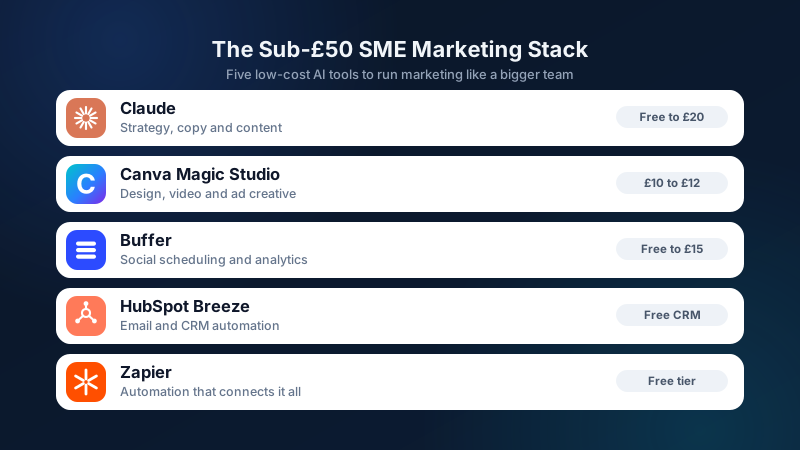
The Sub-£50 London SME Marketing Stack
Tools in isolation create work; tools in a stack remove it. Here is the combination we recommend for a London SME that wants maximum output for under £50 a month in total.
| Layer | Tool | Rough monthly cost |
|---|---|---|
| Strategy and content | Claude | Free to £20 |
| Design and visuals | Canva Pro | £10 to £12 |
| Social scheduling | Buffer (free or low tier) | £0 to £15 |
| Email and CRM | Brevo or HubSpot Free | £0 to £15 |
| Automation glue | Zapier (free tier) | £0 |
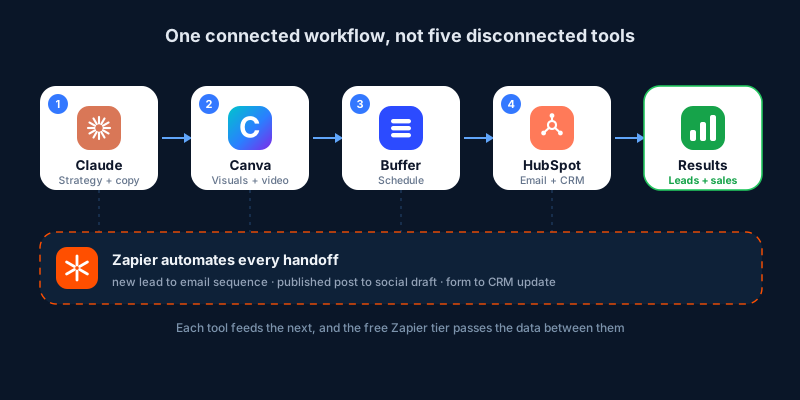
Zapier is the connective tissue. On its free tier it can pass information between the others automatically: a new lead in Brevo creates a task, a published blog triggers a social draft, a form fill updates your CRM. Zapier is what turns five separate tools into one system, and we go deeper on this in our piece on AI workflow automation for UK businesses.
If you want a wider menu of options before committing, our roundup of the top free AI tools for UK SMEs is a useful companion to this stack.
What Results to Expect in 2026 (Realistically)
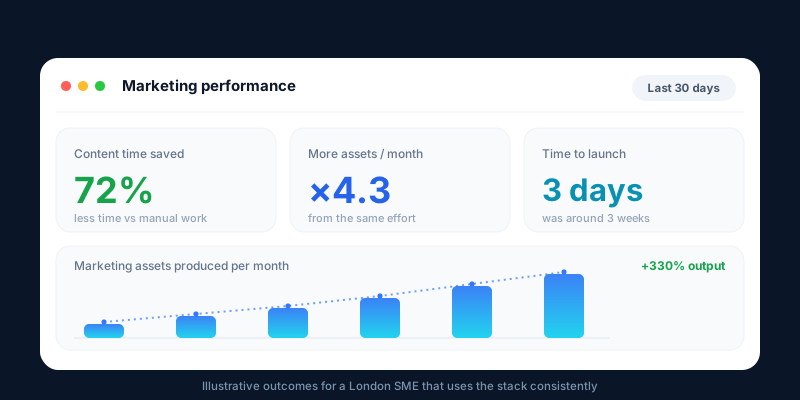
Set expectations honestly. AI tools are a force multiplier, not a magic wand, and the gains depend entirely on consistent use. That said, the realistic outcomes for a London SME that adopts this stack properly are substantial.
- Content creation time cut by 60 to 80 percent
- Three to five times more marketing assets produced from the same effort
- Better engagement through genuine personalisation rather than generic blasts
- Campaign launches measured in days instead of weeks
None of that requires new headcount. It requires picking the tools, building the habit, and measuring what happens, which is the part most businesses skip.
How to Roll This Out Without Losing a Month
The fastest way to waste 2026 is to sign up for all five tools at once and master none of them. Do the opposite.
- Start with one tool this week. We recommend Claude or Canva, depending on whether your weakest link is words or visuals.
- Master it properly. Build one real campaign with it rather than poking at features.
- Measure for 30 days. Track time saved and one outcome metric that matters: enquiries, sign-ups, or sales.
- Then layer in the next tool. Repeat until the stack is complete.
Consistent execution with two tools beats dabbling with ten. The businesses that win with AI in 2026 are not the ones with the longest tool list; they are the ones that turned a couple of tools into a reliable habit.
The Bottom Line
London is expensive, competitive, and unforgiving, and that is exactly why a lean AI marketing stack is such an advantage. For under £50 a month, the five tools here let a small team produce the kind of content, design, social presence, and follow-up that used to need a whole department.
Start with one tool this week, prove it over 30 days, then add the next. If you would rather have that stack designed, integrated, and running for you, that is the work we do at AI Native Agency: building practical, AI-native marketing systems for UK businesses that want the output without the overhead.
Frequently Asked Questions
- What is the best AI marketing tool for a small business in 2026?
- For most small businesses the highest-leverage choice is Claude, because it covers strategy, long-form writing, email sequences, and brand voice in one place. If your weakest link is visuals rather than words, start with Canva Magic Studio instead. The best tool is the one that removes your single biggest bottleneck, so pick based on where you currently lose the most time.
- How much does a full AI marketing stack cost for an SME?
- A capable stack covering content, design, social, and email comes to under £50 a month in 2026. Claude Pro is around £20, Canva Pro around £10 to £12, and Buffer, Brevo, and Zapier all have free or sub-£15 tiers. Many small businesses run effectively on free tiers alone for the first few months.
- Are free AI marketing tools good enough for a London SME?
- In most cases, yes. The free tiers of Claude, Canva, Buffer, Brevo, and Gemini are genuinely usable in 2026 and cover the majority of day-to-day marketing tasks. You typically only need paid plans once volume grows, you want higher usage limits, or you need premium features such as Canva's full Magic Studio set.
- Is Claude better than ChatGPT for marketing?
- They have different strengths. Claude tends to be stronger for considered long-form content, campaign strategy, and holding a consistent brand voice, especially for a UK audience. ChatGPT and Gemini are excellent for fast ideation, batch content, and quick research. Many marketers use both: Claude as the strategist and writer, the others for speed.
- Which AI tool should I start with?
- Start with one tool this week, not five. We recommend Claude if your bottleneck is writing and strategy, or Canva if it is design. Master it on one real campaign, measure the results for 30 days, then layer in the next tool. Consistent use of two tools beats dabbling with ten.
- Can AI marketing tools replace a marketing agency or a hire?
- They replace a large amount of the manual production work and let a small team punch well above its weight, but they do not replace strategy, integration, and judgment. Tools combined with a clear plan beat tools alone every time. Many SMEs use the stack themselves for execution and bring in specialist help to design the system and set the strategy.
- How do I connect these AI tools together?
- Zapier is the simplest connective layer, and its free tier is enough to start. It passes data between your tools automatically, so a new lead in Brevo can trigger a nurture sequence, a published blog post can create a social draft, and a form submission can update your CRM. That automation is what turns five separate tools into one working system.