Strategy
Why Most B2B Websites Still Lose Leads After the First Click, and How AI Can Close the Gap
11 min read
Most B2B websites don't have a traffic problem. They lose buyers between the first click and the first useful answer. We map the four post-click leaks, from unanswered questions and form walls to 42-hour reply times and lost context, and show how grounded AI assistants, instant follow-up and sales briefings close the gap.
✦Key Takeaways
- 6sense's 2025 study of nearly 4,000 B2B buyers found first contact happens about 61% of the way through the buying journey, and the vendor contacted first wins roughly four deals in five. Your website does most of the selling before sales is involved.
- Lead loss after the click clusters at four points: the page answers the wrong question, the form becomes a wall, the reply is slow and context is lost at the handoff to sales.
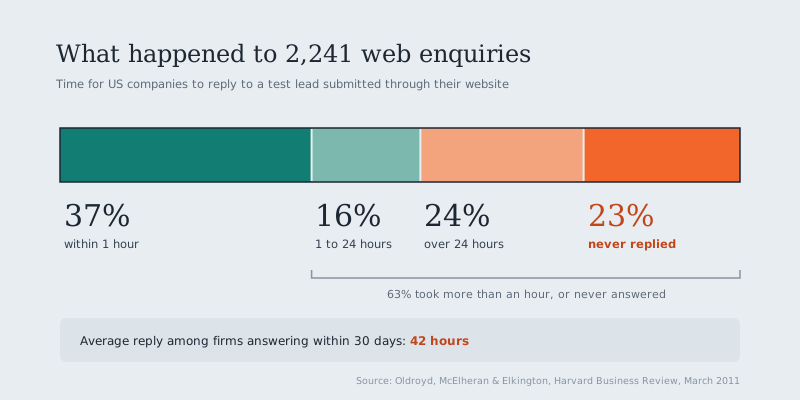
- In an audit of 2,241 US companies published in Harvard Business Review, 23% never answered a web enquiry and the average reply took 42 hours. Firms that tried to reach a lead within an hour were nearly seven times as likely to qualify it as those that waited an hour longer.
- AI adds the most value when a buyer wants an answer and no person is available: evenings, weekends and detailed product questions.
- A website assistant should be grounded in your own approved content and cite the source page. One that improvises prices or integrations does more harm than having no assistant at all.
- Respond instantly when buyers ask, but don't use AI to chase anonymous visitors. 6sense found that sellers who reached out before buyers were ready were less likely to win.
- Under PECR, B2B marketing emails to limited companies don't need prior consent, but sole traders and some partnerships count as individuals, so automated follow-up must tell them apart.
- Measure speed to first meaningful reply, meetings booked and pipeline created, not chat volume or form fills.
Most B2B marketing teams spend their energy on the first click: paid search, landing pages, rankings and attribution. Then the click lands, and the website quietly loses the buyer it worked so hard to attract.
The loss rarely shows up in a dashboard. Traffic looks healthy and a handful of forms arrive each week. What you don't see is the operations director who read your pricing page at 9pm, couldn't work out whether you integrate with Sage, filled in nothing and booked a call with a competitor the next morning. Poor B2B website lead conversion is rarely a traffic problem. It is the gap between a buyer's interest and your first useful answer, and most of that gap sits after the click.
Here is where that gap opens, and how AI can close it without turning your site into a pushy chatbot.
Why the First Click Is Not the Problem
B2B buyers now arrive late and largely decided. The 2025 Buyer Experience Report from 6sense, based on nearly 4,000 B2B buyers, found that first contact with a vendor happens about 61% of the way through the buying journey. Buyers started 79% of those first conversations themselves, and the vendor they contacted first won roughly four deals in five.
So a visitor arriving from search or an AI answer is probably not browsing; they are checking a shortlist. They want specifics: does this work with our systems, what does it roughly cost, who like us uses it, and how long does implementation take? TrustRadius's B2B Buying Disconnect research found that virtually all buyers want to self-serve part of the journey, and that their strongest self-service wishes are finding pricing and getting hands-on experience of the product.
Most B2B websites are still built for someone at the start of the journey: a bold headline, three benefit tiles, client logos and a "Book a demo" button. That is a brochure for an audience that has already read the brochure.
The Four Places B2B Websites Lose Leads After the Click
Lead loss after the click clusters at four points. None shows up clearly in analytics, because each ends with a visitor who simply leaves.
1. The page answers the wrong question
A buyer lands on a service page with one concrete question and finds positioning statements instead. "Seamless integration" is not an answer to "do you connect to Xero?" Every unanswered question is a reason to go back to the search results, where a competitor's page or an AI summary may answer it directly.
2. The form becomes a wall
On many B2B sites the only route to an answer is a form that asks for job title, company size, budget and timeline before offering anything back. For a buyer who only wants to know whether you are worth a call, that is a poor trade. Gated pricing and "contact us for a quote" turn a two-minute check into a sales process the buyer did not ask to start.
3. The reply is too slow
This is the most expensive leak, and the best documented. In research published in Harvard Business Review, James Oldroyd, Kristina McElheran and David Elkington audited 2,241 US companies by submitting web enquiries and timing the response. Only 37% replied within an hour, 23% never replied at all, and the average response time among companies that replied within 30 days was 42 hours.
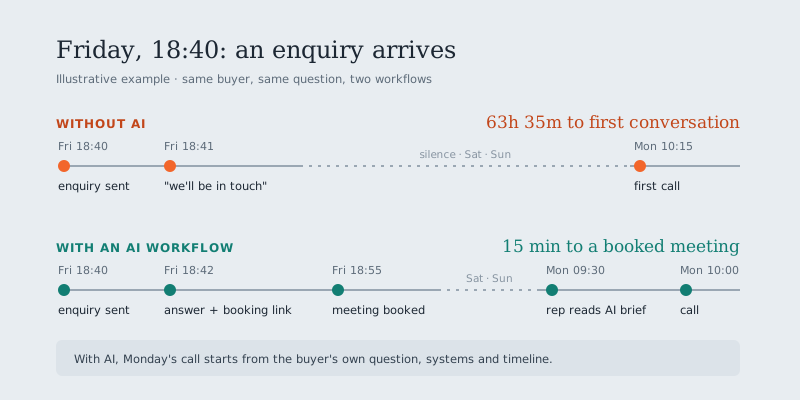
The same authors analysed 1.25 million sales leads and found that firms that tried to contact a lead within an hour were nearly seven times as likely to qualify it as firms that waited even one hour longer, and more than 60 times as likely as firms that waited 24 hours or more. The research dates from 2011, but buyers have not grown more patient. If an enquiry lands at 6pm on a Friday and the first human reply arrives at 10am on Monday, 64 hours have passed.
4. The context disappears at the handoff
When a lead does reach sales, it often arrives as a name, an email address and a box saying "please call". The rep doesn't know which pages the buyer read or what they asked, so the first call repeats questions the website already answered, just when the buyer expected to be understood.
How AI Can Close the Post-Click Gap
Most of these leaks happen when a buyer wants an answer and no person is available: evenings, weekends and detailed product questions that sales has no time for. Used carefully, AI fills those moments with accurate answers and fast, relevant follow-up.
Answer the real question from your own content
The first fix is a website assistant grounded in your own approved material: service pages, case studies, integration lists, pricing ranges and implementation guides. Grounding means the assistant retrieves the relevant passage before it answers and links to the source page, rather than improvising. Scripted bots could only follow decision trees; our guide to chatbots versus AI agents explains the distinction. The test is simple: can it answer "do you work with Sage, and what does a typical project cost?" in two sentences, with a link?
Replace the form wall with a conversation that earns details
Instead of front-loading eight form fields, let the buyer ask first and share details when they have a reason to. After a useful answer, "Would you like a sample plan for a business your size?" feels like service, not interrogation. Company size, systems and timeline come out naturally in the exchange.
Respond in minutes, at any hour
When a buyer raises their hand, an AI workflow can reply within minutes, answer what they actually asked, offer calendar slots with the right specialist and route the lead by service line, region and deal size. For high-value or sensitive enquiries, keep a person in the loop: the AI drafts, a human approves, and the target becomes minutes rather than days. We cover where those approval points belong in our piece on human-in-the-loop AI.
Hand sales a briefing, not a name
Finally, AI can summarise the buyer's visit before the first call: pages read, questions asked and systems mentioned, written straight into the CRM record. The rep opens with "you asked about migrating from your current supplier" rather than "so, tell me about your business", which shortens discovery and shows the buyer they were heard.
Where AI Makes Lead Loss Worse
AI can also widen the gap when it is deployed as a growth hack rather than a service. Watch for these failures:
- Pop-ups in the first three seconds. An assistant should be available, not aggressive.
- Email before answers. Demanding contact details first rebuilds the form wall inside a chat window.
- Improvised facts. An ungrounded model will confidently invent a price or an integration. Every factual answer should trace back to a page you have approved.
- Pretending to be human. Buyers notice, and it does far more damage than an honest "I'm the site's AI assistant".
- Chasing anonymous visitors. Earlier 6sense research found that sellers who contacted buyers before they were ready were less likely to win the deal. Use AI to respond instantly when buyers ask, not to pursue them before they do.
There is a compliance angle too. The ICO's guidance on business-to-business marketing confirms that, under PECR, marketing emails to limited companies and LLPs don't need prior consent, provided you identify yourself and offer a way to opt out. Sole traders and some partnerships, however, are treated as individuals. Automated follow-up needs to know which is which, and UK GDPR still applies to any personal data the assistant collects.
A 30-Day Plan to Improve B2B Website Lead Conversion
- Mystery-shop your own site. Submit a specific enquiry at 6pm on a Friday and time the first useful reply. Then test two competitors.
- Measure the last 90 days. From your CRM, work out the median time to first human reply and the share of enquiries that never received one.
- Collect the real questions. Rank the top 20 from sales call notes, the support inbox and site search.
- Publish the answers. Pricing ranges, integrations, implementation timelines and relevant case studies belong on the site, where people and AI assistants can both find them (more on that in why your next customers may never visit your website).
- Ground an assistant and automate the first reply. Start with those 20 questions, add calendar booking and routing, and set clear rules for when a human must approve.
- Track the right numbers. Measure speed to first meaningful reply, meetings booked and pipeline created, not chat volume or form fills.
Conclusion
Most B2B websites do not have a traffic problem. They have a gap between a buyer's interest and a useful answer, and every hour in that gap favours a competitor. Buyers arrive with a shortlist, contact their favourite first, and speed of response decides whether a conversation happens at all.
AI closes that gap when it is grounded in your own content, replies within minutes and hands sales the full context. Start with the Friday-evening test. If you would like a second pair of eyes, talk to AI Native Agency and we will map your post-click journey with you. For the wider picture of AI across the funnel, read our guide to AI lead generation for UK B2B companies.
Frequently Asked Questions
- Why does my B2B website get traffic but very few leads?
- Usually because visitors cannot get the specific answers they came for without starting a sales process. B2B buyers arrive with a shortlist and concrete questions about price, integrations and fit. If the site hides those answers behind a form, or the reply takes days, they move on to a vendor that answers sooner.
- What is a good lead response time for B2B enquiries?
- Aim for a useful reply within minutes and a human conversation within the hour during working hours. The Harvard Business Review study of online leads found that firms trying to contact a lead within an hour were nearly seven times as likely to qualify it as those that waited even an hour longer. Out of hours, an accurate automated reply with booking options beats silence.
- Will an AI chatbot on our website put B2B buyers off?
- A badly deployed one will. Assistants that pop up instantly, demand an email address or invent answers damage trust. An assistant that waits to be asked, answers from your approved content with links to the source and openly says it is AI is usually experienced as a faster way to find information.
- How do you stop a website AI assistant giving wrong answers?
- Ground it in a defined set of approved pages and documents, require it to cite the source page for factual claims, and instruct it to say when it doesn't know and offer a person instead. Review conversation logs every week, and fix gaps in the source content rather than patching the prompt.
- Should B2B companies show pricing on their website?
- Showing at least a typical range usually helps. Buyers rank pricing among the things they most want to find without speaking to sales, and a range filters out poor-fit enquiries before they reach your team. Where every project is bespoke, publish the factors that drive cost and a few example project sizes.
- Can AI qualify B2B leads automatically?
- AI can collect qualification details such as company size, systems in use and timeline, and route each lead to the right person. On large or complex deals, final qualification is still best confirmed by a person, using the AI's summary of the buyer's questions and visit as the starting point.
- Do we need consent to send automated follow-up emails to B2B leads in the UK?
- Not for marketing emails to corporate subscribers such as limited companies and LLPs, provided you identify yourself and include a working opt-out. Sole traders and some partnerships count as individuals under PECR, so the stricter rules for individuals apply to them. UK GDPR applies to the personal data either way.