Strategy
Your Next Hire: Person, Freelancer or AI Agent? A Simple Way to Decide Before You Post the Job Ad
10 min read
Before you post a job ad, break the role into tasks and sort each one into three piles: work for a person, a freelancer or an AI agent. Four questions do the sorting in an afternoon, and a worked example shows a full-time role turning into a 20-hour one plus a three-month freelance project.
✦Key Takeaways
- "Can AI do this job?" is the wrong question. A job ad bundles 10 to 20 tasks, and most roles split between three kinds of worker: a person, a freelancer and an AI agent.
- Four questions sort each task: will it still need doing in six months, does it depend on trust or presence, can the result be checked in minutes, and is a mistake cheap and caught early?
- Agents are capable but not yet dependable alone. The strongest model METR tested in 2026 succeeded four times out of five on software tasks that take a human expert about three hours.
- Every agent needs an owner. Move review time back into the person pile, or the hours you saved come back later as quiet mistakes.
- Pay freelancers for expertise and finished projects. Routine freelance work is the part AI is taking: in the most exposed occupations, contracts fell about 2% and earnings about 5%.
- Judge the result on quality as well as cost. Klarna's chief executive said putting cost first had left its AI-led customer service with "lower quality".
- Pilot the agent pile for two to four weeks before you post the ad, then write the ad around the work that's left.
In April 2025, Shopify's chief executive, Tobi Lütke, sent his staff a memo that plenty of other bosses have since borrowed. "Before asking for more headcount and resources," he wrote, "teams must demonstrate why they cannot get what they want done using AI," as TechCrunch reported. Three weeks later, Duolingo said it would gradually stop using contractors to "do work that AI can handle" and would add staff only if "a team cannot automate more of their work", according to Fortune.
Eighteen months on, the same question has reached businesses with no HR department and no AI team. You're about to post a job ad, and a nagging thought won't go away: should your next hire be a person, a freelancer or an AI agent?
Most owners then ask whether AI can do the job. That's the wrong question, because a job isn't one thing. It's a bundle of tasks, and in most job ads the bundle belongs to all three kinds of worker. This guide gives you a simple way to sort it in an afternoon, before you pay for the ad.
Why "Can AI Do This Job?" Is the Wrong Question
List everything your next hire would actually do and you'll usually find 10 to 20 separate tasks. Some need judgment, relationships or someone in the room. Some are projects that will be finished by summer. Some repeat every week, follow clear rules and happen entirely on a screen. Ask whether AI can do "the job" and you'll get a single yes or no that's wrong for half the list.
Klarna is the best-known example of asking at the wrong level. In February 2024, the payments company announced that its AI assistant was "doing the equivalent work of 700 full-time agents". By May 2025, its chief executive, Sebastian Siemiatkowski, was explaining why it would recruit people for customer service again. "As cost unfortunately seems to have been a too predominant evaluation factor when organizing this, what you end up having is lower quality," he said, as CX Today reported. The AI handled plenty of tasks well. Handing it the whole job, and judging it mainly on cost, is what went wrong.
Microsoft's 2025 Work Trend Index offers a better frame. Nearly half of the leaders it surveyed (45%) said expanding team capacity with "digital labor" was a top priority for the next 12 to 18 months, and Microsoft proposed a new number to manage: the human-agent ratio, meaning how many agents a role needs and how many people it takes to guide them. Even in the most agent-friendly view, agents come with people attached.
Person, Freelancer or AI Agent: What Each Is Good At
Before you sort anything, be clear about what each option does well, what it really costs, and the cost people forget.
| A person | A freelancer | An AI agent | |
|---|---|---|---|
| Best for | Ongoing work that needs judgment, relationships, accountability or presence | A project with an end date, or a specialist skill you need now and then | Recurring screen work with a clear result someone can check |
| What you pay | Salary, benefits, recruiting and equipment | A day rate or a fixed project fee | Software and usage fees, plus setup |
| The cost people forget | Months before they're fully productive, and your time managing them | Re-explaining your business with every new brief | A person's time to check its work and fix what breaks |
| How easy to undo | Hard: hiring is slow, and letting someone go is slower | Easy: the contract ends | Fairly easy, unless your workflows come to depend on it |
A person
Employees are the right answer for work that carries on and improves with context: knowing which customers need a phone call, which supplier always runs late, why the last campaign flopped. They're also the only option that can be meaningfully accountable. They cost more than the salary suggests, though. In US private industry, benefits made up 30.1% of employers' compensation costs in March 2026, according to the Bureau of Labor Statistics, so each dollar of wages came with roughly 43 cents more. Add recruiting, equipment and the months before a new hire is fully up to speed.
A freelancer
Freelancers are at their best on a defined piece of work with an end date and a result you can judge: a website rebuild, a brand identity, a one-off data clean-up. You pay more per hour, but nothing between projects. The catch is context. Every new brief means explaining your business again, and the person who learned it last time may be booked up. Freelance work is also where AI has bitten first. Researchers studying a large freelance platform found that in the occupations most exposed to generative AI, freelancers saw about 2% fewer contracts and 5% lower earnings after the new tools arrived, with experienced, higher-priced freelancers hit hardest, as the authors explained for Brookings.
The lesson for anyone hiring: pay freelancers for expertise and finished work, not for first drafts.
An AI agent
An AI agent is software that uses a language model to work through a task in several steps, using your own tools: reading an inbox, updating a spreadsheet, drafting a report and filing it in the right folder. Unlike a chatbot, it takes actions rather than just answering questions. Agents are strongest on work that repeats, happens entirely on a screen and has a result someone can check quickly.
They're capable, but not yet dependable on their own. METR, a research group that measures how long a task AI agents can complete, found that the strongest model it tested in 2026 succeeded four times out of five on software tasks that take a human expert about three hours. Give it longer tasks, or demand a higher success rate, and it becomes less reliable quickly. Those were tidy, well-specified tasks with automatic scoring; most business work is messier. So plan for a person to check the output, at least until you've seen how often it's right.
The Three-Pile Test: Sort the Tasks, Not the Title
Here's the method. You need the draft job description, or just a blank page and an honest hour.
Step 1: List the tasks, not the title
Write down every task the new hire would do, with a rough number of hours a week beside each one. Include the jobs you're doing yourself late at night because nobody else can. Leave the job title until the end, because a title like "marketing assistant" quietly decides the answer for you.
Step 2: Ask four questions of every task
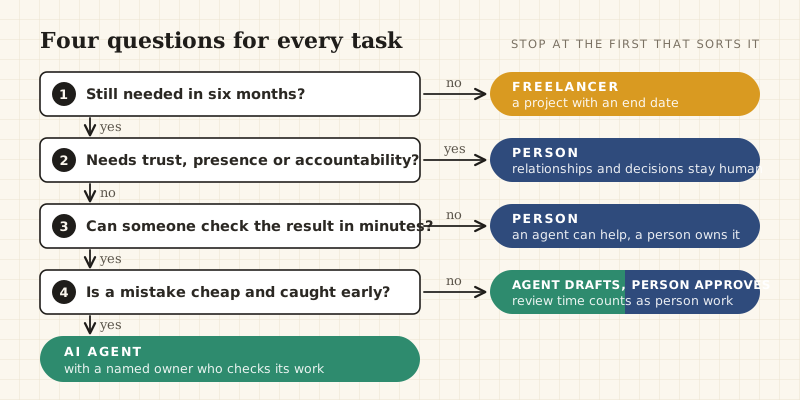
Take each task in turn and stop at the first question that sorts it.
- Will it still need doing in six months? If not, it's a project, and it goes in the freelancer pile.
- Does it depend on trust, presence or accountability? If so, it goes in the person pile. Selling, managing people, handling a complaint from your biggest customer and signing off spending all live here.
- Could someone check the result in a few minutes against a clear standard? If not, it goes in the person pile. An agent can still help, but a person owns the work.
- If it goes wrong once, is the mistake cheap and caught before a customer sees it? If so, it goes in the agent pile. If not, the agent can still draft it, but a person approves every piece, and that review time goes in the person pile.
Step 3: Add up the piles, then add the checking
Total the hours in each pile. Then move some time back into the person pile for checking the agent's work. As a starting assumption, allow an hour of review for every four hours you hand over, and replace that guess with the real figure once you've tried it. An agent nobody checks doesn't save time; it moves the mistakes somewhere you won't see them until later.
Step 4: Read the result
- A person pile of 30 hours a week or more: hire a person, full time.
- Roughly 15 to 30 hours: a part-time or fractional hire is likely the better fit.
- Under 15 hours: don't hire yet. Share the work between the team, an agent and a freelancer, and run the test again in six months.
- The freelancer pile: brief each project with an end date and a fixed deliverable.
- The agent pile: pilot it before you post anything, as the checklist below explains.
A Worked Example: The Marketing Assistant Ad
Here's the test on a common case. A 15-person business is about to advertise for a full-time marketing assistant. This is the owner's task list, at 40 hours a week:
| Task | Hours a week | Pile |
|---|---|---|
| Draft and schedule social posts | 6 | Agent, person approves |
| Write the monthly newsletter | 2 | Agent, person approves |
| Pull the weekly performance report | 3 | Agent |
| Update product pages and listings | 3 | Agent, spot-checked |
| Reply to comments and messages | 4 | Person |
| Customer case studies | 4 | Person |
| Events and trade shows | 5 | Person |
| Partner and creator relationships | 4 | Person |
| Website rebuild (about three months) | 6 | Freelancer |
| Product photo shoot (one-off) | 3 | Freelancer |
The agent pile comes to 14 hours, so about 3.5 hours of review moves back to the person pile. The freelancer pile is 9 hours a week, and it ends within three months. That leaves the person pile at 17 hours plus 3.5 hours of checking: about 20 hours a week.
So the business doesn't need a full-time marketing assistant. It needs a part-time marketing coordinator who looks after the relationships, runs the case studies and events, and owns the agents, plus a web freelancer for one quarter. That's a different ad, probably for someone more experienced, and it attracts people who are comfortable reviewing AI drafts rather than people hoping to write every post from scratch.
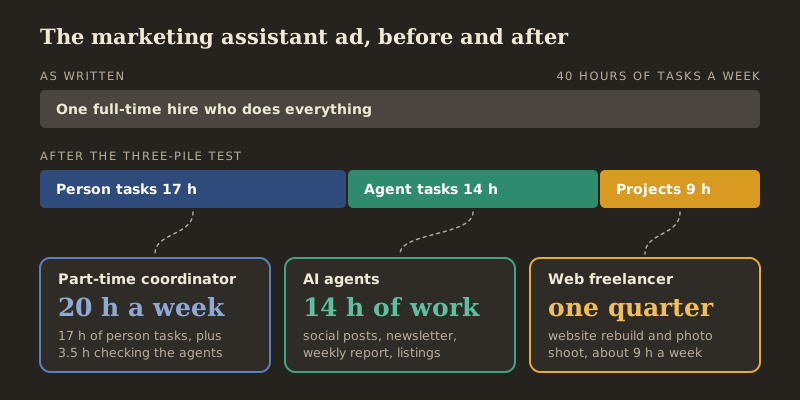
The point isn't the money saved, although there is some. It's that the person you hire spends their week on the work only a person can do.
Before You Post the Job Ad: A Five-Step Checklist
- Write the task list before the title. Put hours beside every task, including the ones you do yourself.
- Run the three-pile test. Four questions per task; stop at the first one that sorts it.
- Pilot the agent pile for two to four weeks. Have the person who'd own it run the pilot, and keep score: how often the output needed fixing, and how long the checking took. Our guide to testing an AI system before launch covers what to measure.
- Write the ad around the person pile. Say plainly that the role works alongside AI tools and what that means day to day, such as "you'll review AI drafts of our weekly report". The right candidates will read that as a plus.
- Put a date in the diary to run the test again. Six months is about right. In METR's original 2025 analysis, the length of task agents could complete had been doubling roughly every seven months for six years. Some tasks will move into the agent pile; a disappointing pilot can move others back.
Three Mistakes That Undo a Good Decision
Hiring a person to do the agent pile. If most of the role is drafting, copying and formatting, you'll pay a salary for work an agent can draft in minutes, and you'll struggle to keep a good person in a job that's mostly busywork.
Giving the agent no owner. Agents fail quietly. They loop, stall or keep producing plausible work that's slightly wrong, and nobody notices because it's nobody's job to look. Name a person for every agent, and read why AI agents get stuck and how to keep them on track before you rely on one.
Judging the result on cost alone. That was Klarna's own diagnosis. Track quality as well: complaints, rework, customer replies and how often a person had to step in. If quality drops, move the task back to a person.
Conclusion
Person, freelancer or AI agent is rarely an either-or choice. Most roles split three ways once you list the tasks: ongoing work that needs a human, projects that need an expert for a while, and recurring screen work an agent can draft while a person checks it. Sort the tasks first, pilot the agent pile, and write the ad for what's left. You'll hire fewer people into the wrong job, and the people you do hire will spend more of their week on what only they can do.
If you're only just starting with AI, our calm 30-day plan for busy business owners is a gentle first step. If you'd like help running the three-pile test on a role you're about to fill, or building and supervising the agents that come out of it, talk to AI Native Agency about our AI automation and agent systems work.
Frequently Asked Questions
- Can an AI agent replace an employee?
- Rarely the whole role, but often part of it. Most jobs mix tasks that need judgment, relationships or accountability with recurring screen work an agent can draft. Split the role into tasks first: the agent takes the routine, checkable work, and a person keeps the rest, including checking what the agent produces.
- Is an AI agent cheaper than a freelancer?
- For recurring, routine work, usually yes, once it's set up and you count the time spent reviewing it. For a one-off project that needs expertise and taste, such as a brand identity or a website rebuild, a good freelancer is usually better value, because setting up and supervising an agent for a single project costs more than it saves.
- What tasks should I give an AI agent first?
- Start with work that comes round every week, happens entirely on a screen and can be checked in minutes: a weekly report, first drafts of routine posts, product listing updates or sorting an inbox. Keep anything where a single mistake would reach a customer or cost real money with a person until you've seen how reliable the agent is.
- When should I hire a freelancer instead of an employee?
- When the work has an end date and a deliverable you can judge, or when you need a specialist skill only occasionally. If the same work keeps coming back and depends on knowing your business well, an employee usually works out better, because you stop paying for someone to relearn the business with every brief.
- How much supervision does an AI agent need?
- More than most people expect at first. A reasonable starting budget is an hour of checking for every four hours of work handed over, adjusted once a two to four week pilot shows the real figure. Every agent also needs a named owner whose job includes noticing when it stops working properly.
- Should a job ad mention that the role works with AI?
- Yes, and specifically. Say which tasks AI handles and what the person does with the output, such as reviewing drafts or approving replies. It sets honest expectations, puts off candidates who want to do everything by hand, and appeals to people who are already comfortable working with AI tools.
- How do I know if a part-time hire is enough?
- Add up the hours of work that genuinely need a person, then add the time it will take to check any agent's output. If that comes to less than about 15 hours a week, hold off hiring; somewhere between 15 and 30 usually suits a part-time or fractional hire; beyond 30, a full-time role makes sense.